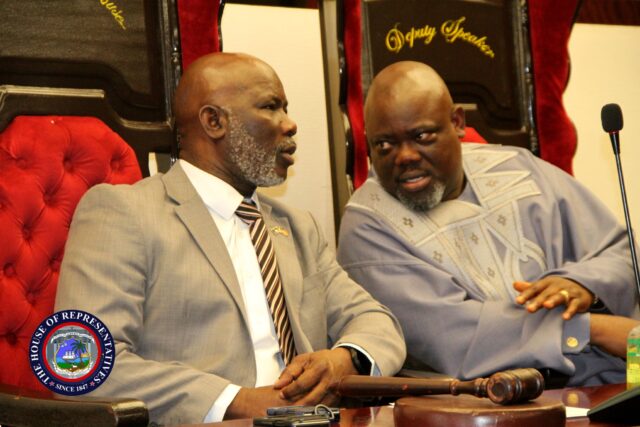
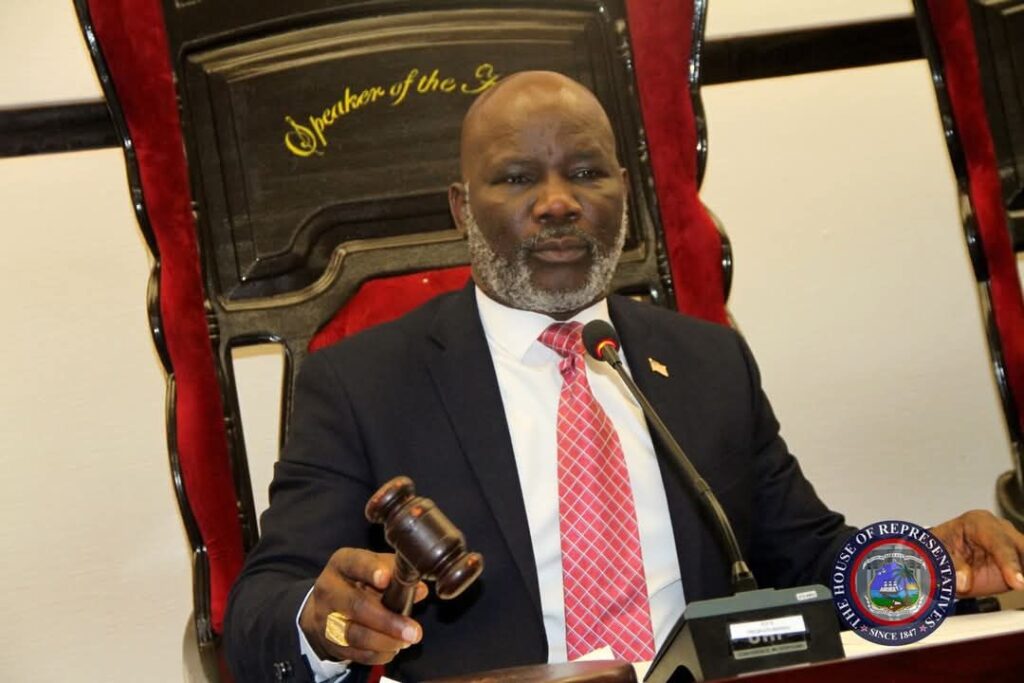
MONROVIA – Liberia’s fragile press‑freedom gains came under fresh strain on Tuesday, November 25, when House Speaker Richard Nagbe Koon openly threatened to jail journalists covering the House of Representatives, echoing a growing pattern of powerful figures vowing to “deal with” critics despite legal reforms meant to protect free expression.
During a regular session of the House, called to order by the Acting Sergeant‑at‑Arms but stalled by lack of quorum, Koon issued a direct warning to the press gallery after realizing that reporters were recording exchanges on the floor while members waited for more lawmakers to arrive.
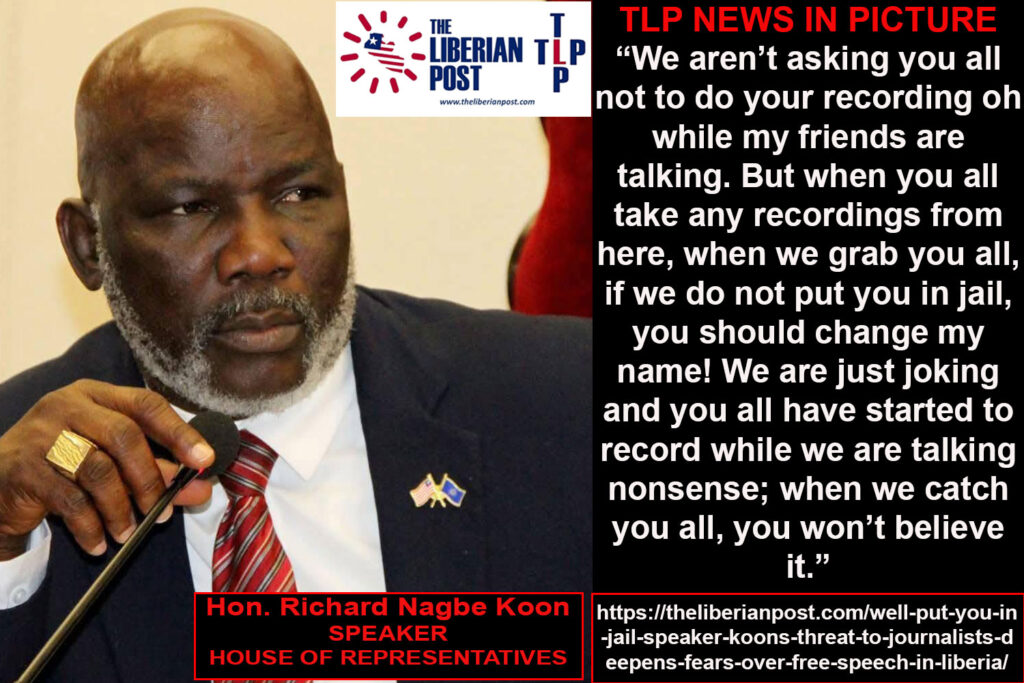
“To the press, this session is not legal yet. Anything you record from here, we will deal with you. This session is not legal yet until we get quorum,” the Speaker declared.
“We aren’t asking you all not to do your recording oh while my friends are talking. But when you all take any recordings from here, when we grab you all, if we do not put you in jail, you should change my name!
We are just joking and you all have started to record while we are talking nonsense; when we catch you all, you won’t believe it. You can’t do it. Don’t believe me.”
Reporters who heard the remarks described them as a “direct, unambiguous threat” of incarceration for simply doing their jobs in the public gallery of the Legislature.
The comments have triggered alarm among media advocates, who say they undermine both Liberia’s international commitments and its own landmark Kamara Abdullah Kamara (KAK) Act of Press Freedom, adopted in 2019 under former President George Weah.
Clash With the KAK Act and Table Mountain Declaration
The KAK Act decriminalized defamation, sedition and criminal malevolence, which for decades had been used to arrest and jail journalists and critics. The law was hailed as a major step toward aligning Liberia with the Table Mountain Declaration, a continental framework urging African states to abolish criminal defamation and “insult” laws.
In principle, this means that no journalist should face prison for what they publish or record, with disputes over reputation to be settled in civil court, not through criminal charges or political threats.
Speaker Koon’s remarks, press‑freedom advocates argue, run directly counter to that spirit.
“Regardless of whether the Speaker calls the session ‘legal’ or not, the press is constitutionally entitled to cover the Legislature,” one senior media lawyer told this paper. “Threatening jail for recording public proceedings is not only dangerous; it is completely inconsistent with the KAK law and Liberia’s obligations under Table Mountain and the African Charter.”
While the KAK Act removed criminal liability for many speech‑related offenses, journalists still face crippling civil suits and, increasingly, extra‑legal intimidation—from social‑media attacks to physical threats and, now, open warnings from the podium of the Speaker.
Part of a Broader Pattern: “We Will Deal With You in Jesus’ Name”
Koon’s outburst comes on the heels of another high‑profile warning against speech, this time from the country’s traditional leadership.
At a recent National Assembly of Traditional Chiefs and Governors in Gbarnga, a senior chief told President Joseph Boakai that the Council of Chiefs would move against anyone who publicly “cusses” the President.
“Today when we hear anybody, whether in the Senate or in the Executive Mansion, or in the chief compound, when you cuss on radio… any official of government or other people that cuss our President, we, the Council of Chiefs, we will invite you,” the chief vowed. “We will deal with you in Jesus’ name.”
The line drew loud laughter—partly because many Liberians saw the invocation of “Jesus’ name” by a traditional spiritual leader as an ironic clash of Christianity and traditional religion. But the substance of the message was deadly serious: two powerful institutions—the Legislature and the traditional chieftaincy—are now on record threatening to “deal with” citizens and journalists for how they speak about the President and other leaders.
Taken together, rights groups say, the two incidents signal a creeping intolerance of criticism at a time when Liberia is legally bound to protect dissent.
A Rough Public Discourse—But the Wrong Response
No one disputes that public discourse in Liberia has coarsened. On talk shows and social media, some opposition voices and ordinary citizens regularly refer to the President and senior officials in crude and disrespectful terms, abandoning even basic courtesies.
Traditional leaders and many older Liberians see this as a collapse of cultural norms — “not African,” as one chief put it—and argue that leaders deserve a level of deference.
But legal analysts insist that the remedy for incivility is not intimidation from the state or traditional authorities.
“In a democracy, the answer to bad speech is more speech—counter‑arguments, clarifications, sometimes even moral rebukes—but never threats of jail from the Speaker’s chair,” a constitutional lawyer said. “The Constitution and the KAK law exist precisely to prevent powerful actors from weaponizing state authority against speech they don’t like.”
What the Lawmakers Should Know

Article 15 of the 1986 Constitution guarantees freedom of expression and of the press. The KAK Act builds on that by removing criminal penalties, while Liberia’s endorsement of the Table Mountain Declaration commits the state to “encourage a free and independent press as an essential condition of democratic societies.”
Legal experts say that if the House leadership believes some part of its proceedings should be off‑the‑record—for example, a caucus or executive session—it must formally declare and structure such sessions, not issue ad‑hoc threats in a public sitting.
“Once the gallery is open and the microphones are on, journalists have every right to record,” said one media‑rights advocate. “If lawmakers are ‘talking nonsense,’ as the Speaker himself said, that is precisely the kind of thing the public deserves to know.”
Boakai Government Caught Between Reform and Old Habits
The episode poses a test for President Joseph Boakai’s administration, which has pledged to uphold democratic norms while also restoring “respect” for the presidency and public offices.
Boakai himself recently received strong backing from traditional chiefs who promised to go after those who verbally abuse him. Now, the head of the House—a co‑equal branch of government—is threatening jail for journalists who record legislative sessions.
So far, the Executive has not publicly commented on Koon’s remarks. But civil‑society campaigners say silence would send the wrong signal.
“If the President and his ministers do not clearly distance themselves from these threats, it risks normalizing a climate where both chiefs and lawmakers believe they can punish speech outside the courts,” one activist warned.
A Shrinking Safe Space for Journalists
Despite the KAK Act, Liberian journalists continue to report cases of harassment, physical threats, and arbitrary restrictions when covering sensitive issues—from corruption probes to legislative politics. Speaker Koon’s outburst, they say, only deepens the sense that their work is increasingly unwelcome in powerful spaces.
Press unions and rights groups are now calling for:
- A formal retraction and clarification from Speaker Koon;
- A reaffirmation by the House of Representatives of journalists’ right to cover all open sessions;
- Clear internal rules distinguishing public from executive sittings, without resort to threats;
- Renewed commitment from government and traditional leaders to operate within the bounds of the Constitution and the KAK law when responding to criticism.
For now, the image is stark: in the span of weeks, a chief vowed to “deal with” citizens who criticize the President “in Jesus’ name,” and the Speaker of the House promised to jail journalists who record lawmakers “talking nonsense.”
In a country that once jailed reporters for “insulting” the presidency but then reformed its laws to protect them, the question facing Liberia’s democracy is whether old habits of power will overwhelm the new freedoms won on paper—or whether leaders will step back from the brink and choose the harder path of tolerating scrutiny in a free society.