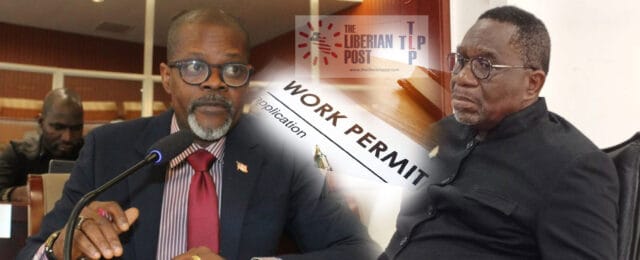
CAPITOL, Monrovia – Montserrado County Senator Abraham Darius Dillon and Labor Minister Cllr. Cooper Kruah have moved to calm weeks of escalating political tension, holding a closed‑door meeting Thursday, November 27, in the presence of Grand Gedeh County Senator Thomas Yaya Nimely, Chair of the Senate’s Committee on Labor.
The meeting, held in Senator Dillon’s Capitol Building office, followed a very public spat over the Ministry of Labor’s work‑permit regime and spiraling accusations that Dillon was “anti‑Nimba” for challenging Minister Kruah, a prominent Nimba politician and political leader of the Movement for Democracy and Reconstruction (MDR).
Speaking to reporters afterwards, Dillon stressed that the clash had never been about personality or ethnicity.
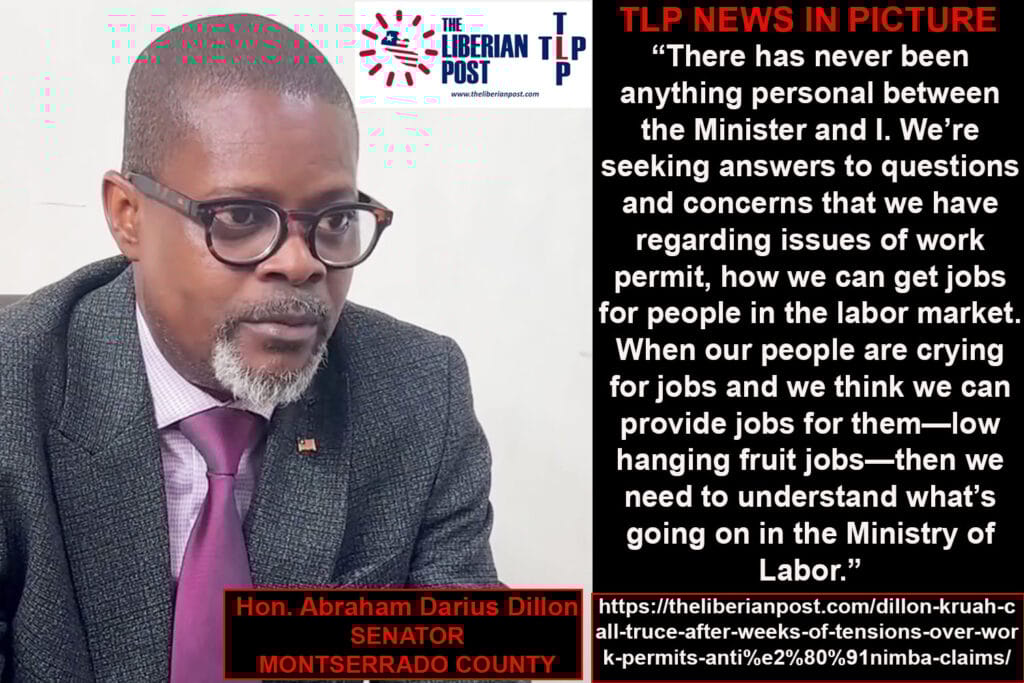
“There has never been anything personal between the Minister and I,” he said. “We’re seeking answers to questions and concerns that we have regarding issues of work permit, how we can get jobs for people in the labor market.
When our people are crying for jobs and we think we can provide jobs for them—low‑hanging‑fruit jobs—then we need to understand what’s going on in the Ministry of Labor.”
Background: Work Permits, Revenue Targets and Nimba Politics
In recent weeks Dillon has repeatedly accused the government of effectively “selling jobs” to foreigners by depending on revenue from work permits, arguing that Liberians are being displaced from positions they are qualified to hold. He questioned projections in the FY2026 budget that expect the Labor Ministry to raise millions of dollars from work‑permit fees.
His criticism triggered a fierce backlash from some MDR partisans and a few vocal Nimbaians on social media, who accused him of targeting Nimba and its leaders. MDR’s youth wing and allied commentators accused Dillon of “hating Nimbaians” and of being responsible, politically and rhetorically, for fueling hostility toward the late Nimba strongman, Senator Prince Y. Johnson.
The Liberian Post and other outlets reported that the row spilled into ethnic overtones, with some supporters framing any attack on Kruah as an attack on Nimba as a whole. Senator Dillon, in return, blasted what he called an attempt to “ethnicize legitimate oversight.”
Thursday’s meeting appears to have been an effort to lower the temperature—especially after the issue was raised in the Senate and traditional leaders from Nimba publicly disowned threats made in the county’s name against Dillon.
Dillon: “Same Dillon Who Wants Jobs for Liberians”
Asked after the meeting whether he would soften his position, Dillon was blunt.
“The same Dillon who wants jobs for Liberians,” he replied. “We shouldn’t be giving work permits for jobs that Liberians are qualified and available to do.”
He clarified that his earlier remark about government “selling jobs” was not an accusation of personal corruption against Kruah, but a criticism of how the national budget pressures the ministry to issue work permits for revenue.
“It was not that the Minister was selling the jobs,” Dillon explained. “If the Executive is projecting US$10 million, US$11 million in revenue collection from the Ministry of Labor, and I sit here as a senator and pass that budget, it means I’m asking the Minister to go bring that money to the revenue. And the source of that revenue, part of which is written on paper, is work permits.”
He said his “doubts are not cleared” because the ultimate outcome he seeks is simple: “jobs for our people.”
“That advocacy is not going to rest,” he said. “We will keep asking: how many work permits are you revoking or not renewing, and what’s happening to those positions and the opportunity for a job for Liberians?”
Kruah: Miscommunication, Not Malice
Labor Minister Kruah, who has faced significant online attacks since the controversy broke, said the misunderstanding grew out of communication gaps, not ill intent.
“In government, there will always be agreement and disagreement… you disagree to agree,” he told journalists. “Perhaps there were some missing links in terms of communications, in terms of the flow of information between the Executive at our level and the Senate Committee. We’ve now agreed to take steps to make sure that those missing links are taken care of.”
Kruah said he and the Senate Labor Committee have agreed that the Ministry of Labor will brief the committee every quarter on major decisions and work‑permit trends.
“We have agreed basically that on a quarterly basis, some of the good things that we do at the Ministry of Labor should be communicated to the Labor Committee so that the committee will have an idea of what we do,” he said. “Their concerns are legitimate… we need to find jobs for Liberians, which we are doing. But that information may not have been reached the way it should be.”
Higher Fees and Canceled Permits
Defending his policies, Kruah said the ministry deliberately raised the cost of foreign work permits to US$3,000 in order to discourage companies from hiring expatriates in positions that Liberians can fill.
“When we adjusted the work permit, we adjusted it to US$3,000 to say, look, some of these companies will now begin to reduce non‑essential workers,” he said. “If you can find Liberians to do a job, you will not want to bring somebody and you will have to pay US$3,000.”
He cited examples reported by The Liberian Post and confirmed by the Ministry:
- Bea Mountain has canceled 357 foreign work permits and committed to filling those roles with Liberians;
- AFSCOM has canceled 247;
- WHBO has canceled 15 permits as of November 26, 2025.
“These measures are already beginning to take effect,” Kruah argued, saying the full impact will be clearer next year.
The Minister also insisted that Liberians do not require work permits and that the ministry is actively posting permit cancellations and denials online so that prospective Liberian job seekers can identify open positions.
“Most of the denials and the cancellations I mentioned here, we are putting them on our website,” he said. “We want job seekers and Liberians to visit our website to pick up these job vacancies.”
Possible Law Changes: Caps on Foreign Workers
Kruah suggested that part of the structural problem lies in the current labor and concession laws, which he says lack clear numerical limits on foreign employees.
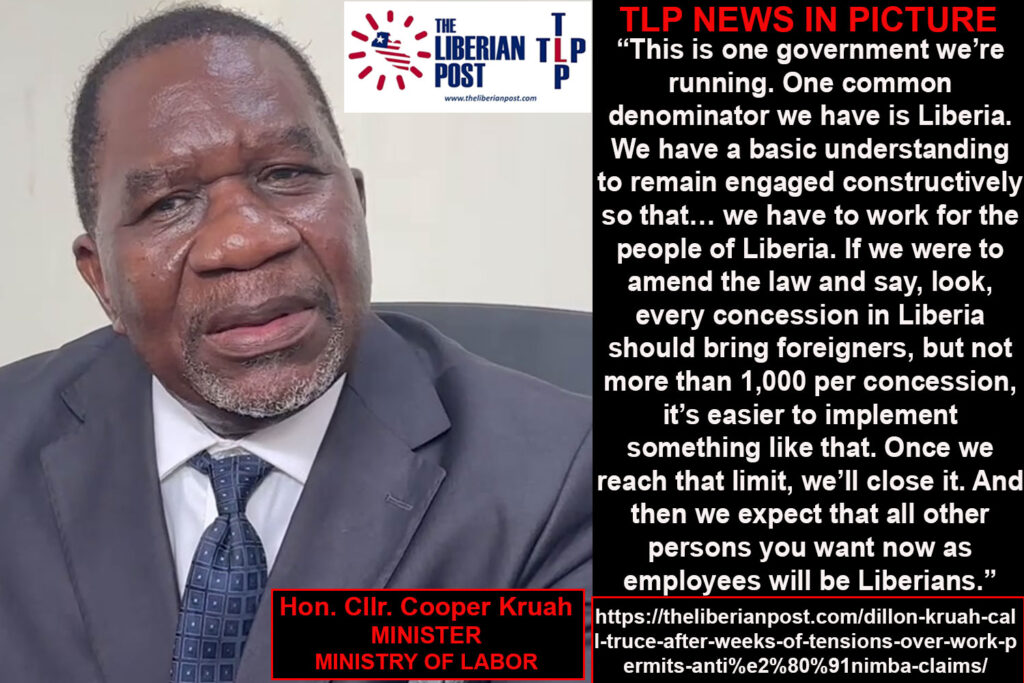
“If we were to amend the law and say, look, every concession in Liberia should bring foreigners, but not more than 1,000 per concession, it’s easier to implement something like that,” he said. “Once we reach that limit, we’ll close it. And then we expect that all other persons you want now as employees will be Liberians.”
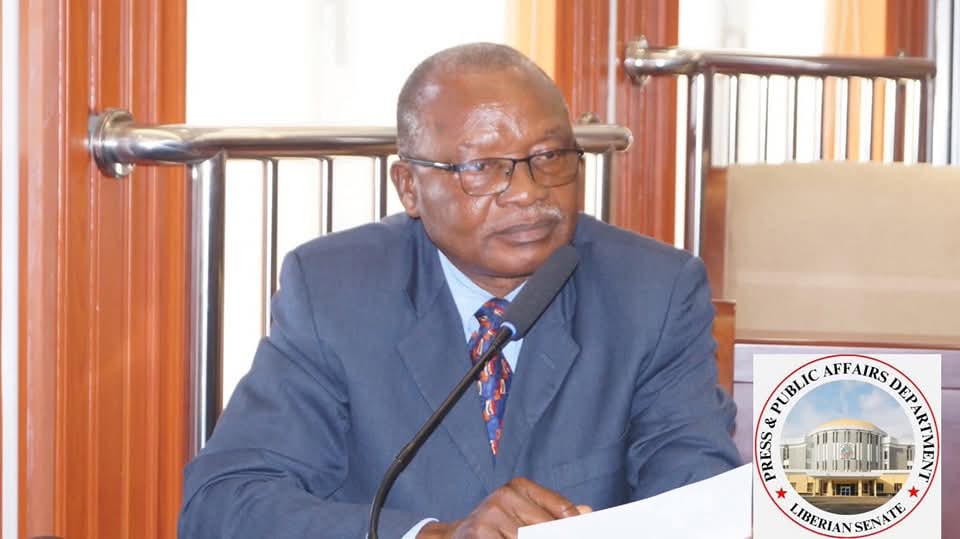
Until such amendments are made, he said the ministry will continue to use its discretion to deny or cancel permits for jobs “that we believe Liberians can do.”
Tackling the “Anti‑Nimba” Narrative
Behind closed doors, Kruah is understood to have briefed Dillon on the backlash from some MDR supporters and Nimba figures who interpreted the senator’s criticisms as tribal hostility. Earlier this month, The Liberian Post reported coordinated audio messages and statements accusing Dillon of “attacking Nimba” and its leaders.
That narrative was publicly rejected by Nimba County Senators Nya Twayen and Samuel G. Kogar, who apologized to Dillon on the Senate floor and clarified that “Nimba is not Kruah, and Kruah is not Nimba.”
By meeting with Kruah in the presence of Senator Nimely and framing the issue strictly in policy terms, Dillon appeared keen to blunt the ethnic angle.
“We’ve known each other for over 25 years. We used to work together at the Ministry of Justice,” he reminded journalists. “This is not personal, it’s not tribal. It’s about jobs and how policies are implemented.”
Kruah, for his part, said the government must act as “one team” despite internal disagreements.
“This is one government we’re running. One common denominator we have is Liberia,” he said. “We have a basic understanding to remain engaged constructively so that… we have to work for the people of Liberia.”
Advocacy Continues, Tone Shifts
For now, Thursday’s engagement has cooled a public row that was threatening to deepen ethnic divisions and strain relations between the Legislature and the Executive.
Dillon made clear that while the tone may change, the substance of his advocacy will not.
“There’s an outcome we’re seeking here—jobs for our people,” he said. “That advocacy is not going to rest.” Whether the new spirit of cooperation and the measures outlined by Kruah—higher fees, canceled permits, quarterly reporting, and proposed legal caps—translate into more Liberians actually getting the jobs they are qualified to do will now be tested over the coming months, in hiring offices and on worksites far from Capitol Hill.