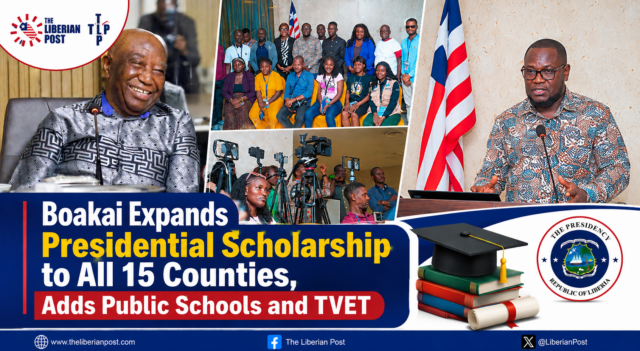
–Government Moves to Decentralize Program as More Than 490 Students Benefit and Nearly 100 Prepare to Graduate
MONROVIA, Liberia — The Government of Liberia is expanding the Presidential Scholarship Program to all 15 counties, with the initiative set to cover more public institutions, community colleges, technical and vocational education and, in a later phase, public high schools.
The expansion was announced Friday during the Executive Mansion’s regular press briefing, where Deputy Minister for Administration at the Ministry of State for Presidential Affairs, Bill McGill Jones, said the restructuring is intended to make the scholarship more accessible to young Liberians outside Montserrado County and reduce the financial burden of higher education on families.
The Presidential Scholarship Program, launched in December 2024 as a merit-based initiative to expand access to higher education, has so far supported more than 490 students across seven counties and 22 colleges, with nearly 100 beneficiaries expected to complete their studies this year.
According to Jones, the program is now being deliberately restructured to move away from its concentration in Monrovia and expand opportunities into Liberia’s counties.
Of the more than 490 current beneficiaries, approximately 370 are from Montserrado County, a distribution the government says demonstrates the need to decentralize the program and reach students in underserved parts of the country.
Under the new expansion plan, the scholarship will increasingly focus on public institutions, including community colleges, public universities, technical and vocational education and training (TVET) institutions, and eventually public high schools for students in Grades 10 through 12.
Expansion Across Counties
The government said new participating institutions are being brought into the scholarship program in several counties.
These include Grand Bassa University in Grand Bassa County, Bong County University in Bong County, Sinoe Community College in Sinoe County, Grand Gedeh Community College in Grand Gedeh County, Bomi County University in Bomi County and the University of Liberia’s Sinje campus in Grand Cape Mount County.
The government also plans to increase the number of scholarship recipients in counties already covered by the program, including Lofa, Nimba, Grand Kru, Maryland and Margibi.
Jones said the objective is to have the scholarship operating across all 15 counties by the end of next year, with additional public institutions and community colleges brought into the program in phases.
“This is to reduce the burden on families and also make sure that some of the kids who cannot afford can make this process go forward,” Jones explained during the briefing.
He said the expansion reflects a broader government effort to strengthen public education institutions rather than concentrating educational opportunities in private institutions and the capital.
TVET Gets Greater Attention
A significant component of the expansion is the inclusion of technical and vocational education.
The government says it recognizes that not every young Liberian will pursue a traditional university degree and that vocational and technical skills can provide alternative pathways to employment, entrepreneurship and economic independence.
Jones said TVET institutions will therefore become an important part of the decentralized scholarship program, particularly in rural communities.
The government also plans to introduce public high schools serving students in Grades 10 through 12 into the program in a later phase. Community colleges across the country are expected to be incorporated as part of the immediate expansion.
Merit and Community Service Required
Despite the expansion, the government says the scholarship will remain anchored in academic merit and demonstrated need.
Under the existing requirements, students with a 3.0 GPA can qualify for full tuition support, while students with a 2.5 GPA may qualify where there is documented humanitarian need.
Beneficiaries are also required to perform community service as part of the program.
The government says the community-service requirement is intended to ensure that students receiving public support develop a sense of responsibility toward the communities that are helping to finance their education.
Jones said beneficiaries may undertake a range of activities, including public awareness campaigns, community development initiatives and other forms of service appropriate to local needs.
The requirement is also monitored through participating institutions and local structures, with universities expected to provide reports on students’ participation. Repeated failure to fulfill the requirement can trigger scrutiny of a student’s continued eligibility.
Government Commits US$200,000 Annually
The scholarship program is financed through a combination of government funding and private-sector support.
Jones said the Government of Liberia has allocated US$200,000 annually to the initiative since its establishment, while corporate partners have provided additional assistance.
Orange Liberia, which has supported the program since its inception, is among the initiative’s major partners. Other institutions identified during the briefing include NASSCORP, the Liberia Maritime Authority, the Liberia Telecommunications Authority, the National Port Authority and the Liberia Petroleum Refining Company.
Jones said the government intends to maintain the program through the national budget while continuing to seek support from the private sector and other partners as demand increases.
Applications Expected Soon
The government said applications for the new intake will open shortly, with information expected to be published through the Executive Mansion’s official communication platforms and participating institutions.
Officials emphasized that the process is intended to be open to all eligible Liberians and not based on political connections.
Jones said applications will not be limited to online submissions, particularly because many prospective beneficiaries in rural areas may have limited access to the internet.
Printed application forms will also be distributed through technical and vocational institutions and community colleges to make the process more accessible outside Monrovia.
The government says the expanded approach is intended to make the scholarship more inclusive while preserving its merit-based character.
Nearly 100 Beneficiaries Set to Graduate
As the government prepares to expand the program, nearly 100 existing beneficiaries are expected to complete their studies this year.
Officials say attention is also being given to what happens after students graduate.
The Ministry of State for Presidential Affairs is working with the Civil Service and other institutions on internship and professional pathways for graduates, while private-sector partners, including Orange Liberia, have also provided internship opportunities.
The government said it is seeking to create pathways through which graduates can gain professional experience and potentially transition into employment.
Preparing Liberia’s Next Generation
The scholarship expansion is being presented by the Boakai administration as part of its broader investment in Liberia’s next generation of leaders.
The government says the initiative is intended not only to increase access to education but also to strengthen academic performance, technical skills, civic responsibility and opportunities for young Liberians to contribute to national development.
Jones said the administration’s broader objective is to ensure that educational opportunities are not concentrated in Monrovia and that young people in rural counties can also access government-supported pathways to higher and technical education.
The expansion comes as the government is simultaneously implementing a separate policy to provide free primary education for children from kindergarten through sixth grade beginning with the new academic year.
Taken together, the initiatives represent an effort by the government to reduce education costs for families while widening access to educational opportunities at different levels of the system.
The Presidential Scholarship Program is expected to continue expanding in phases, with the government targeting coverage of all 15 counties by the end of 2027.
For breaking news, in-depth analysis, and exclusive reports from Liberia and around the world, follow The Liberian Post on Facebook (https://web.facebook.com/profile.php?id=61576017166570) and X, formerly Twitter (https://x.com/LiberianPost).