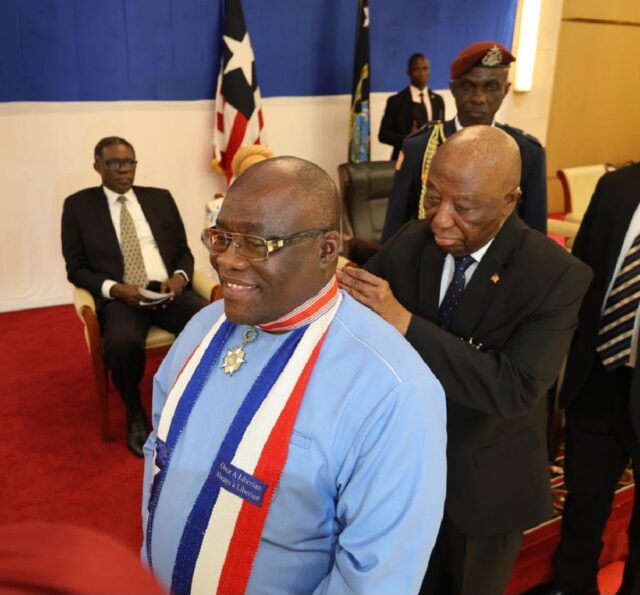
-Eminent Wettee Says Citizenship Law Remains Valid Until Supreme Court Rules Otherwise
MONROVIA, Liberia – As Liberia intensifies discussions on possible reforms to its nearly four-decade-old Constitution, a leading advocate of dual citizenship has argued that recent amendments to the country’s nationality law are not in conflict with the 1986 Constitution and remain legally binding unless overturned by the Supreme Court.
Emmanuel S. Wettee, Eminent Chairman of the All-Liberian Conference on Dual Citizenship (ALCOD), made the assertion amid growing public debate over citizenship rights following the Governance Commission’s launch of a nationwide dialogue on constitutional reform.
At the center of the discussion is Article 28 of the Constitution and provisions of the amended Aliens and Nationality Law that allow children born to Liberian mothers to automatically acquire Liberian citizenship at birth, regardless of the nationality or racial background of their fathers.
Critics of the revised law argue that it conflicts with the Constitution’s provision that only persons who are “Negroes or of Negro descent” are eligible for Liberian citizenship. However, Wettee maintains that such arguments overlook a key legal question: What exactly does the Constitution mean by the term “Negro”?
“The Constitution states one must be a Negro or of Negro descent to become a citizen of Liberia,” Wettee noted. “What is the definition of Negro? Does Negro refer to one parent or both parents? Does it apply across generations? Only the Supreme Court can contextualize the meaning of ‘Negro’ within the Constitution.”
According to him, the issue remains open to judicial interpretation and should not be settled solely through public opinion or political debate. Until Liberia’s highest court provides a definitive ruling, he argues, claims that the amended nationality law is unconstitutional remain speculative.
Citizenship Through Liberian Mothers
A major point of contention in the ongoing debate concerns provisions allowing Liberian mothers to pass citizenship to their children at birth.
Historically, Liberia’s citizenship framework was criticized for creating disparities between Liberian fathers and Liberian mothers in transmitting citizenship rights to their children. The amended law sought to address those concerns by promoting greater gender equality in nationality matters.
Wettee argued that the reform merely formalized a reality that has existed in Liberia for many years. He recalled an instance in which an individual’s Liberian citizenship was challenged during a Senate confirmation process because only the person’s mother was Liberian while the father was not of Negro descent.
According to Wettee, the individual successfully presented legal documentation showing that he had elected to assume his mother’s Liberian citizenship upon reaching maturity, as required under Liberian law.
“For many years, we have had people with similar circumstances serving in government without issue,” he said. “The changes to the Aliens and Nationality Law that allow a child of a Liberian mother to become a citizen at birth are not in conflict with the Constitution.”
Constitutional Reform Revives Citizenship Questions
Wettee’s comments come as the Governance Commission, working with the Law Reform Commission and development partners, continues a national conversation on reviewing the 1986 Constitution.
During recent public policy discussions in Monrovia, constitutional experts, lawmakers, civil society leaders, and international partners identified several issues requiring public input, including dual citizenship, decentralization, women’s representation, local governance, presidential powers, and electoral reforms.
Among the most debated topics is whether constitutional provisions drafted nearly 40 years ago adequately reflect the realities of modern Liberia and its growing global diaspora.
Liberia’s citizenship laws have long generated controversy, particularly as increasing numbers of Liberians living abroad seek to maintain ties to their homeland while obtaining citizenship in other countries.
Landmark Reform and Continuing Debate
The issue gained national prominence in 2022 when legislation amending the Aliens and Nationality Law was signed into law, recognizing dual citizenship for natural-born Liberians and individuals born to Liberian parents.
Supporters hailed the measure as a landmark reform that could encourage diaspora investment, strengthen family ties, and enable Liberians abroad to contribute more fully to national development.
However, the legislation also raised constitutional questions that continue to fuel public debate. Some legal scholars maintain that certain aspects of the reform may ultimately require judicial interpretation or constitutional amendment to eliminate ambiguities.
For Wettee, however, the law remains valid and enforceable unless successfully challenged before the Supreme Court.
“Until the law is challenged in the Supreme Court and a ruling is made, it is the law,” he stated.
He further argued that every child born to a Liberian mother is a Liberian citizen at birth, regardless of the nationality, citizenship, or racial background of the father.
“In all aspects of development and nation-building, all Liberians are needed,” Wettee said.
His remarks are expected to add momentum to an already vigorous national debate as Liberia weighs possible constitutional reforms and seeks to balance historical identity, legal certainty, gender equality, and the realities of an increasingly global Liberian population.
As discussions continue, citizenship and dual citizenship are expected to remain among the most closely watched issues in the country’s constitutional review process.
For breaking news, in-depth analysis, and exclusive reports from Liberia and around the world, follow The Liberian Post on Facebook (https://web.facebook.com/profile.php?id=61576017166570) and X, formerly Twitter (https://x.com/LiberianPost).