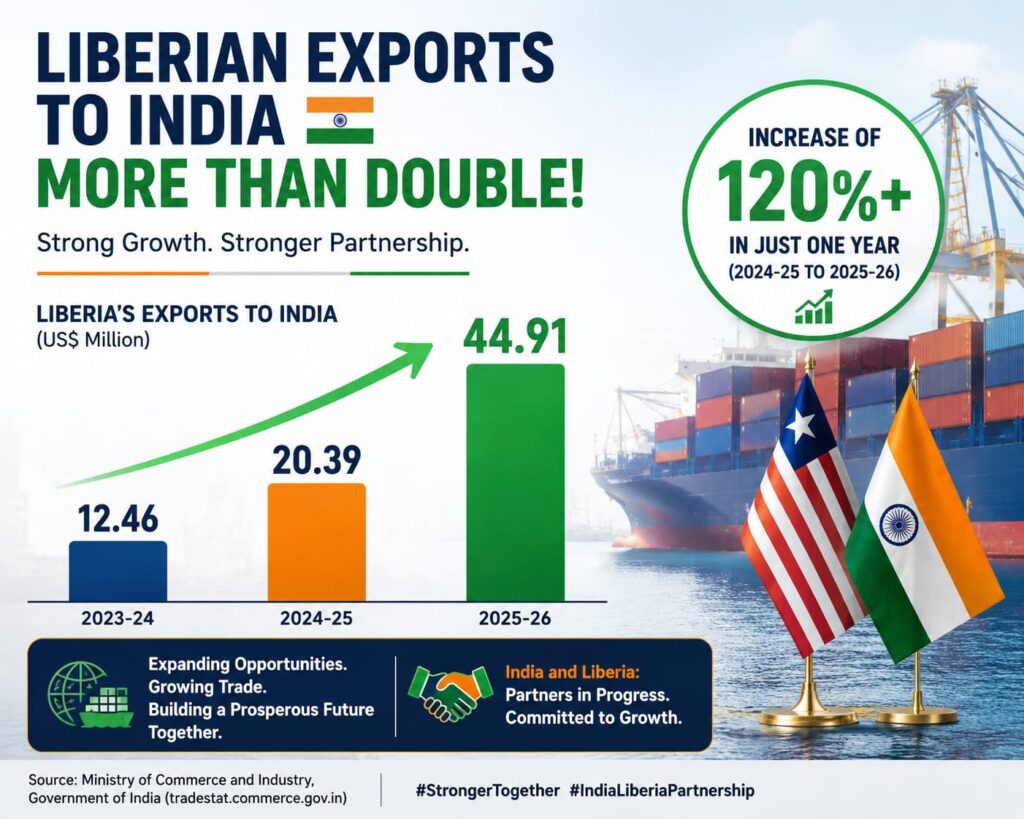
Liberia’s remarkable surge in exports to India is more than just a trade statistic—it is a powerful signal of what the country can achieve when it expands its economic horizons, strengthens international partnerships, and positions itself more competitively in global markets.
The latest figures indicating that Liberia’s exports to India have more than doubled, rising from US$20.39 million in 2024-25 to US$44.91 million in 2025-26, represent one of the most encouraging developments in the nation’s recent trade performance. Equally significant is the fact that bilateral trade between the two countries is now approaching the US$400 million mark, underscoring the growing importance of the Liberia-India relationship.
For years, Liberia’s economy has struggled with overdependence on a narrow range of commodities and a limited number of trading partners. Such dependence has often left the country vulnerable to fluctuations in global commodity prices, external shocks, and changing international market conditions. The recent growth in trade with India demonstrates the value of diversification and the opportunities that emerge when Liberia actively engages with one of the world’s fastest-growing major economies.
India today is not only one of the largest economies in the world but also one of the largest consumers of raw materials and agricultural products. Its expanding industrial base and growing population continue to create demand for resources that countries like ours can supply. The increase in exports therefore reflects growing confidence in Liberian products and highlights the potential for deeper economic cooperation.
However, while these figures deserve celebration, they should also prompt serious reflection. The real question is whether Liberia can transform growing trade volumes into broad-based national development.
Export growth is meaningful only when it translates into jobs for ordinary Liberians, increased government revenue, stronger local industries, and improved living standards. Too often, African countries export raw materials while importing finished goods, thereby capturing only a small fraction of the value generated by their natural resources.
Our country must therefore view this moment as an opportunity to move beyond the traditional export model. Policymakers should prioritize value addition, agro-processing, manufacturing, and industrial development so that more products are processed locally before reaching international markets. Such an approach would create employment opportunities, strengthen domestic enterprises, and increase the country’s share of global value chains.
The growing relationship with India also presents opportunities beyond trade. India has become a global leader in information technology, pharmaceuticals, agriculture, renewable energy, education, and healthcare. These are sectors where Liberia continues to face significant development challenges. Stronger economic ties should therefore be leveraged to attract investment, technology transfer, skills development, and capacity building.
At the same time, government institutions must continue improving the business environment. Investors and trading partners seek predictability, transparency, efficient infrastructure, and clear regulations. Expanding trade requires modern ports, reliable electricity, good roads, digital connectivity, and a regulatory framework that encourages both domestic and foreign investment.

The private sector also has an important role to play. Liberian entrepreneurs must position themselves to take advantage of emerging opportunities by improving product quality, meeting international standards, and exploring new export markets. Trade growth should not be the exclusive domain of large corporations; small and medium-sized businesses must also benefit from expanding international commerce.
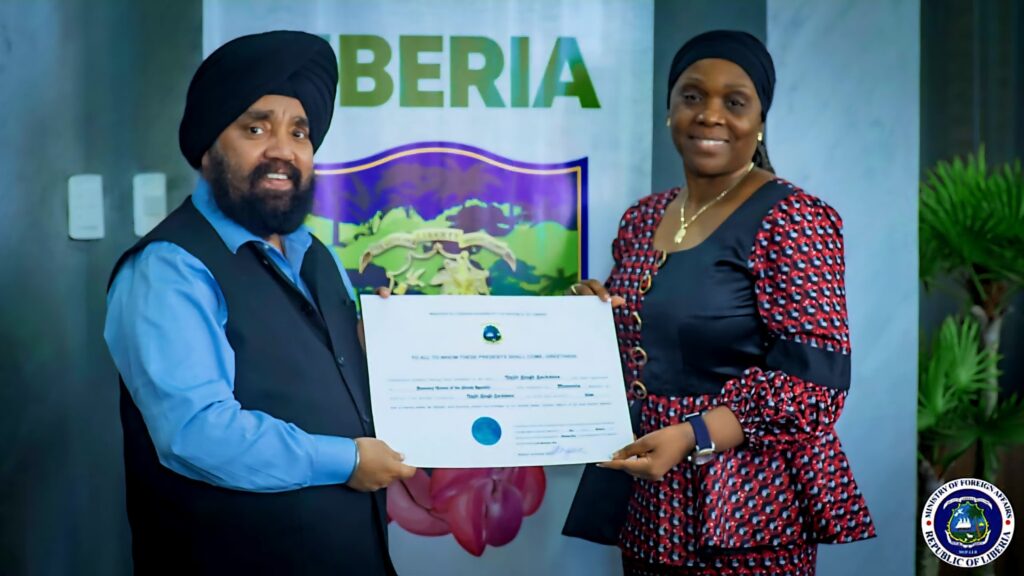
Perhaps most importantly, Liberia’s growing trade with India serves as a reminder that economic diplomacy matters. Strong bilateral relations often produce tangible economic benefits. The continued engagement between Monrovia and New Delhi demonstrates how diplomacy can open doors for commerce, investment, and development cooperation.
As bilateral trade moves closer to US$400 million, Liberia should not view this achievement as a destination but as a foundation for greater ambitions. The country’s long-term objective should be to build a diversified, resilient, and competitive economy capable of creating prosperity for all its citizens.
The numbers are encouraging. The challenge now is to ensure that this growth reaches beyond spreadsheets and trade reports and becomes visible in communities, businesses, farms, schools, and households across Liberia.
That is the true measure of economic progress.
Follow The Liberian Post on Facebook and X (formerly twitter)