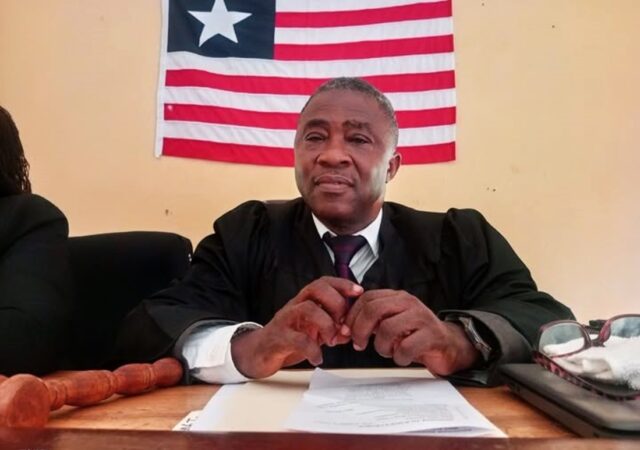
GBARNGA – Joe Barkon, Assigned Judge of the Ninth Judicial Circuit Court in Gbarnga, has called for major amendments to Liberia’s New Judicial Law, arguing that certain provisions undermine judicial independence and expose magistrates to potential political influence.
Judge Barkon made the call during his formal charge at the opening of the May A.D. 2026 Term of the Ninth Judicial Circuit Court in Bong County.
Focusing specifically on Chapter 7, Subsection 7.5 of the New Judicial Law of Liberia, as amended in 2012, the judge raised concerns over provisions that grant the President of Liberia authority to appoint, reappoint, and remove Stipendiary Magistrates.
Under the existing law, Stipendiary Magistrates are appointed by the President for renewable four-year terms and may also be removed for established cause.
According to Judge Barkon, the arrangement creates the impression that magistrates serve “at the will and pleasure” of the President despite operating directly under the Judicial Branch of Government.
He warned that such a structure could compromise the independence of magistrates and negatively affect the fair dispensation of justice.
“The frequent appointment and reappointment of magistrates by the President jeopardizes their independence and the effective administration of justice,” Judge Barkon stated.
Calls for Reform
The Ninth Judicial Circuit Judge proposed that the law be amended to place Stipendiary Magistrates under a system more closely aligned with the status of civil servants and judges, rather than leaving them subject to repeated presidential appointments.
According to him, such reform would strengthen institutional independence and allow magistrates to perform their duties without fear, intimidation, or political pressure.
Judge Barkon argued that the current arrangement creates the risk of undue executive influence over judicial officers, particularly at the lower court level where magistrates handle a large volume of cases affecting ordinary citizens.
He stressed that strengthening the independence of magistrates is essential to preserving public confidence in Liberia’s justice system.
“Magistrates should be allowed to function independently and without fear of interference,” he emphasized.
Judicial Independence Debate Intensifies
Judge Barkon’s comments come amid ongoing national discussions surrounding judicial reform, accountability, and the constitutional separation of powers among Liberia’s three branches of government.
Concerns over judicial independence have increasingly surfaced in recent years, especially in politically sensitive and high-profile corruption cases that have attracted strong public attention.
Legal observers say lower court magistrates often face institutional vulnerabilities due to their appointment structure, limited protections, and administrative dependence on the Executive Branch.
Some legal experts have argued that reforms aimed at strengthening tenure protections and reducing executive influence could improve impartiality and enhance public trust in the Judiciary.
Others, however, maintain that presidential appointment authority remains necessary to preserve oversight and accountability within the lower court system.
Still, Judge Barkon insisted that Liberia’s democratic progress and justice sector reforms require stronger safeguards for judicial officers.
He maintained that insulating magistrates from political pressure would ultimately strengthen the Judiciary as an institution and reinforce the rule of law across the country.
Legal observers say the judge’s remarks are likely to reignite broader debate over judicial autonomy and constitutional reforms within Liberia’s justice system.
Follow The Liberian Post on Facebook and X (formerly twitter)