–Monrovia Central Prison Deputy Superintendent Says “Where Is the Smallest Piece of Evidence?” as Ministry Reveals Intelligence Alleging Contact With Inmate and Possible Cartel-Linked Payments
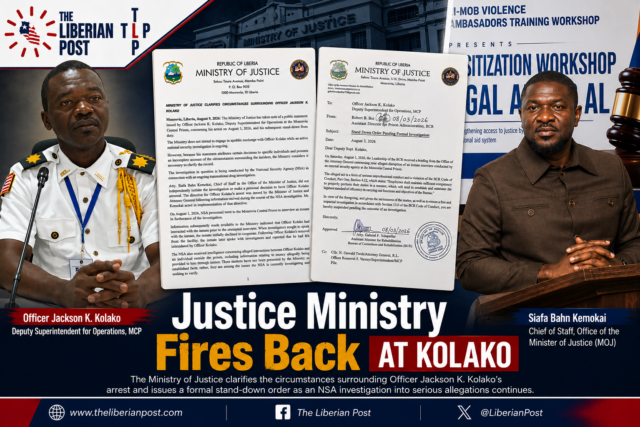
MONROVIA, Liberia — Liberia’s Ministry of Justice has moved to clarify the circumstances surrounding the arrest and subsequent stand-down of Jackson K. Kolako, Deputy Superintendent for Operations at the Monrovia Central Prison (MCP), insisting that the action was taken in connection with an ongoing National Security Agency (NSA) investigation into suspected transnational drug trafficking and was not the result of a personal decision by a senior Justice Ministry official.
The clarification came after Kolako publicly challenged the circumstances of his arrest and suspension, demanding evidence of wrongdoing and questioning why he was taken into custody after an attempted NSA interview with an inmate at the prison.
In a lengthy statement circulated publicly, Kolako asked a pointed question: “WHERE IS THE SMALLEST PIECE OF EVIDENCE!”
He maintained that he had been arrested while performing his duties at the prison on August 1 and accused authorities of portraying his intervention in an inmate interview as obstruction of a security operation.
But in a formal statement issued Sunday, August 9, 2026, the Ministry of Justice rejected the suggestion that the action against Kolako was arbitrary or personally motivated, saying the matter arose from information received during an active NSA investigation connected to Liberia’s widening narcotics probe.
Justice Ministry: Arrest Was Ordered by Minister
The Ministry specifically pushed back against Kolako’s account concerning Atty. Siafa Bahn Kemokai, Chief of Staff in the Office of the Minister of Justice.
According to the Ministry, Kemokai did not independently initiate the investigation or personally decide to have Kolako arrested.
“The directive for Officer Kolako’s arrest was issued by the Minister of Justice and Attorney General following information received during the course of the NSA investigation,” the Ministry said.
It added that Kemokai “acted in implementation of that directive.”
The clarification is significant because Kolako’s account portrays Kemokai as personally present at the prison and responsible for ordering his arrest after a confrontation over the attempted interview of an inmate.
The Ministry’s version instead places the decision within the chain of authority of Justice Minister and Attorney General Cllr. N. Oswald Tweh, based on information provided through the ongoing NSA investigation.
What Triggered the Prison Incident?
According to the Justice Ministry, NSA personnel went to the Monrovia Central Prison on August 1 to interview an inmate as part of the investigation.
Information subsequently made available to the Ministry indicated that Kolako had interacted with the inmate before investigators could conduct their interview.
The Ministry said the inmate initially refused to cooperate when investigators sought to speak with him.
After Kolako was removed from the facility, however, the inmate reportedly spoke with investigators and claimed that he had previously felt intimidated by Kolako.
The Ministry stressed that the allegations have not been established as facts.
“The NSA has also received intelligence concerning alleged interactions between Officer Kolako and an individual outside the prison, including information relating to money allegedly being provided to him through that person,” the statement said.
“These matters have not been presented by the Ministry as established facts; rather, they are among the issues the NSA is currently investigating and seeking to verify.”
That distinction appears central to the Ministry’s position: Kolako is not being declared guilty of participating in drug trafficking, but information concerning his alleged interactions and possible financial links is serious enough to warrant investigation.
Kolako: “I Asked If I Could Reach Out to Them”
Kolako’s account offers a sharply different description of the events at the prison.
He said two individuals claiming to be NSA agents arrived at the facility wearing shorts, which he said violated prison rules, and allegedly failed to properly identify themselves or enter their names and purpose of visit in the prison’s visitor log.
He said two senior prison officials subsequently arrived and overrode established procedures to facilitate the visit.
Kolako said he questioned whether the Chief Superintendent of the Monrovia Central Prison, Col. Roosevelt Varney, and Assistant Minister for Corrections Gabriel Fayiah Ndupellar had been informed.
According to Kolako, both officials were contacted and expressed surprise that they had not been informed of the visit.
After discovering that the inmate investigators wanted to interview was outside his housing unit, Kolako said he ordered the inmate to return to his housing area before resuming his supervisory responsibilities.
He said he later encountered Siafa Bahn Kemokai accompanied by several Liberia National Police officers.
Kolako alleged that Kemokai ordered his arrest at the prison.
He said he deliberately avoided confrontation because of the potential consequences inside a facility holding approximately 1,800 inmates.
“I recognized the provocation and the potential national consequences that accepting such provocation could have caused,” Kolako said.
He added that he left the area because he feared his arrest could provoke his officers and potentially create conditions that inmates could exploit for a mass escape.
Ministry Says Stand-Down Is Not a Finding of Guilt
The Justice Ministry emphasized that Kolako’s removal from duty is temporary and should not be interpreted as a final disciplinary finding.
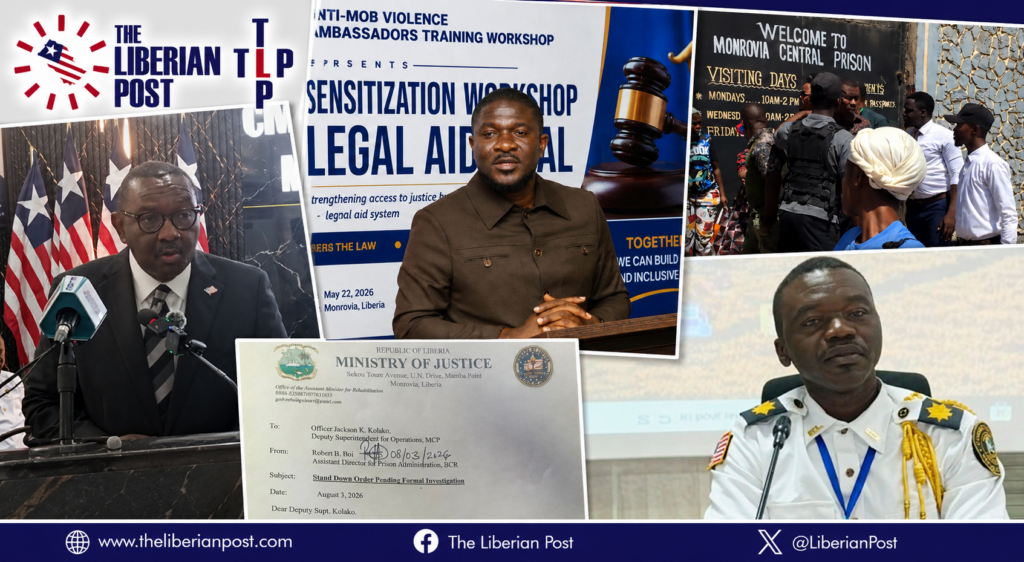
A stand-down order dated August 3, 2026, signed within the Bureau of Corrections and Rehabilitation, states that the measure was imposed pending the outcome of a formal investigation.
The order describes the alleged conduct as a serious breach of the Bureau of Corrections Code of Conduct, citing a provision requiring employees to maintain sufficient competence and the highest standard of efficiency in carrying out their functions.
The Ministry said the stand-down was necessary because of concerns that Kolako’s continued presence at the facility could obstruct or compromise an active investigation.
“It is therefore not a finding of guilt or a final disciplinary action,” the Ministry said.
The Ministry further stressed that an officer’s position inside a correctional facility does not automatically entitle that officer to know or access every intelligence or security operation being conducted there.
Kolako Challenges the Allegations
Kolako, however, has questioned why an alleged prison-security infraction resulted in his transfer into the custody of the Liberia National Police rather than being handled through the Ministry of Justice’s established disciplinary mechanisms.
“The Ministry of Justice has an established disciplinary board. Why, then, was I turned over to the Liberia National Police?” he asked.
He also disputed any suggestion that he had compromised the investigation.
Kolako said that during his detention from August 1 through August 7, he was not interviewed by LNP investigators.
He alleged that on August 3, senior prison officials, NSA personnel and an LNP unit compelled him to have his mobile phones brought to LNP headquarters and provide passwords associated with the devices.
Kolako said he complied.
He further alleged that he was subsequently accused of being a cartel member and of receiving substantial deposits from drug cartels.
Those allegations have not been publicly established, and the Justice Ministry’s statement specifically says the intelligence concerning alleged money provided to Kolako remains under investigation and verification.
“Where Is the Smallest Piece of Evidence?”
Kolako has presented himself as a career public servant whose record should be considered alongside the allegations now under investigation.
He said he spent nine years as a classroom teacher, three years as a conductor at the National Transit Authority, and 12 years in law enforcement.
He also said that despite his years of public service, his net monthly salary had never exceeded US$224, arguing that he deliberately chose integrity and loyalty to Liberia over financial gain.
“Out of self-discipline, I chose never to trade my integrity and loyalty to my country for financial gain or personal advancement,” Kolako said.
He also invoked his experience within the Justice Ministry itself.
“I spent six years as intelligence and investigator within this same MOJ,” he declared.
Kolako’s central challenge is that the government should produce evidence if it believes he has committed wrongdoing.
His public statement repeatedly questioned the basis of the allegations and called for transparency surrounding the investigation.
Justice Ministry: Investigation Must Be Protected
The Ministry, meanwhile, said it would not engage Kolako in a public back-and-forth while the national security investigation remains active.
It said the decision to withhold further details is deliberate because the NSA investigation is ongoing.
“The Ministry has deliberately refrained from publicly discussing the details of the investigation because it remains active,” the statement said.
It added that Kolako’s public statement does not change the investigative process.
“The NSA must be allowed to complete its work and determine whether the intelligence and allegations under review can be substantiated.”
The Ministry also invited Kolako to submit any evidence or information he believes could assist investigators.
“If Officer Kolako possesses specific information or evidence relevant to the investigation, including the matters raised in his public statement, he is encouraged to submit that information to the appropriate authorities,” the Ministry said. “It will be considered as part of the investigative process.”
Ministry Warns No Officer Is Above Investigation
The Justice Ministry used the controversy to reinforce a broader principle at the heart of Liberia’s expanding anti-narcotics campaign.
It said investigations involving transnational drug trafficking constitute serious national-security matters and that no official, regardless of rank or position, should interfere with an investigation.
“The Ministry emphasizes that investigations involving transnational drug trafficking are serious national security matters,” it said.
“No officer, irrespective of rank, assignment, tenure, or position, may interfere with, obstruct, or compromise a lawful investigation.”
At the same time, the Ministry acknowledged an equally important principle:

“No officer will be adjudged guilty merely because an allegation has been made.”
That position places Kolako’s case squarely within the broader tension now confronting Liberia’s drug investigation: authorities are seeking to move quickly against suspected members and facilitators of an alleged trafficking network, while also insisting that accusations must ultimately be tested against evidence.
A Prison Security Dispute Becomes Part of the Drug Probe
The Kolako controversy has added another institutional dimension to Liberia’s unprecedented narcotics investigation.
What began as an attempted interview of an inmate at the Monrovia Central Prison has now raised questions about prison access protocols, intelligence operations, command authority, the use of police powers, evidence gathering and the treatment of officials who become subjects of a national-security inquiry.
Kolako has also warned against any attempt to create conditions that could compromise security at the prison.
“No one will set us up for failure at the Monrovia Central Prison,” he said. “We are far too experienced!”
He has called on senior government officials and international partners to consider moving individuals detained in connection with the multi-million-dollar drug case to a more secure holding facility, preferably outside Liberia, while they await trial.
That proposal has not been adopted by the government, and Kolako did not provide publicly verifiable evidence that a prison break was being planned.
The Names Kolako Wants Investigators to Consider
In his statement, Kolako specifically asked the public and investigators to keep several names in mind as the investigation progresses, including Siafa Bahn Kemokai, Lawrence G. Bohlen, Samuel Lance Jasper and Raymond A. Messan.
However, Kolako did not establish criminal wrongdoing by those individuals in his statement, and the Justice Ministry’s clarification does not accuse those persons of wrongdoing in connection with the incident.
Their inclusion should therefore be understood as part of Kolako’s account and not as an established finding of criminal conduct.
What Happens Next?
The Justice Ministry says Kolako will remain on stand-down while the NSA completes its investigation.
Only after investigators determine whether the intelligence and allegations can be substantiated will the government decide what further action, if any, is warranted.
That leaves several important questions unanswered.
What precisely did NSA investigators uncover before seeking access to the inmate?
What information prompted the Justice Minister to authorize Kolako’s arrest?
What evidence, if any, exists concerning the alleged financial transfers?
Did Kolako’s intervention amount to obstruction, or was he enforcing legitimate prison-security procedures?
And what will the NSA ultimately establish about the allegations?
For now, the two accounts stand in sharp contrast.
Kolako says he was performing his duty, protecting prison procedures and was arrested without being shown evidence.
The Justice Ministry says an active national-security investigation produced intelligence serious enough to justify his temporary removal and that investigators are still working to determine whether the allegations can be substantiated.
The resolution of that dispute may ultimately depend not on public statements, accusations or counter-accusations, but on the evidence the NSA is able to establish.
And as Liberia’s massive drug investigation continues to expand into increasingly sensitive areas of the state, the Kolako case could become another important test of whether the government can simultaneously protect national-security investigations, maintain institutional discipline and uphold the principle that allegations must ultimately be proven.
For breaking news, in-depth analysis, and exclusive reports from Liberia and around the world, follow The Liberian Post on Facebook (https://web.facebook.com/profile.php?id=61576017166570) and X, formerly Twitter (https://x.com/LiberianPost).