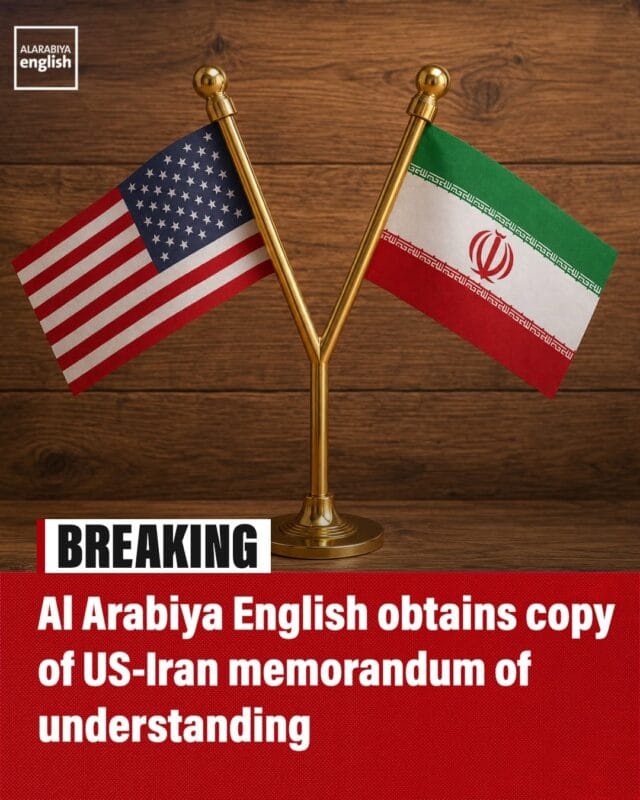
–Draft Agreement Calls for Permanent End to Hostilities, Lifting of Sanctions, Withdrawal of U.S. Forces, and US$300 Billion Economic Rehabilitation Package for Iran
MONROVIA – A leaked memorandum of understanding reportedly obtained by Al Arabiya English has revealed the framework of what could become one of the most consequential diplomatic agreements in modern Middle Eastern history, outlining an ambitious roadmap to end hostilities between the United States and Iran, dismantle decades of sanctions, and pave the way for a comprehensive final peace agreement.
The document, which has not yet been officially confirmed by Washington or Tehran, contains sweeping commitments from both sides, including an immediate end to military hostilities, sanctions relief, maritime security guarantees, and negotiations aimed at resolving longstanding disputes surrounding Iran’s nuclear program.
If implemented, the agreement could fundamentally reshape geopolitical dynamics across the Middle East and significantly reduce tensions that have fueled instability in the region for decades.
Immediate End to Hostilities
At the heart of the memorandum is a commitment by Iran and the United States, along with their respective allies involved in the current conflict, to immediately and permanently end military operations on all fronts, including Lebanon.
Under the proposed framework, both countries would pledge not to engage in hostile actions against one another and would refrain from threatening or using force in future disputes.
The agreement also commits both nations to respecting each other’s sovereignty and territorial integrity while avoiding interference in each other’s domestic affairs.
The provisions represent a dramatic departure from years of hostility, proxy confrontations, economic warfare, and periodic military escalation that have defined U.S.-Iran relations since the 1979 Iranian Revolution.
Final Agreement Targeted Within 60 Days
According to the memorandum, both sides have agreed to negotiate a comprehensive final settlement within 60 days, with the possibility of extending talks by mutual consent.
Pending a final agreement, both parties would maintain the status quo.
Under this arrangement, Iran would refrain from expanding or altering its nuclear activities, while the United States would commit to avoiding additional sanctions and refrain from strengthening its military presence in the region.
Sanctions Relief and Economic Recovery
One of the most significant components of the draft agreement concerns sanctions relief.
The memorandum reportedly commits the United States to eventually ending all sanctions imposed on Iran, including United Nations Security Council restrictions, measures imposed through the International Atomic Energy Agency (IAEA), and unilateral American sanctions.
As an initial confidence-building measure, the U.S. Treasury Department would issue waivers permitting exports of Iranian crude oil, petrochemical products, and related services, including banking, insurance, transportation, and other commercial activities.
The agreement also provides for the release of frozen Iranian assets and restricted funds currently held abroad.
According to the draft, these funds would become fully accessible to the Central Bank of Iran and could be used for any authorized beneficiary payments determined by Iranian authorities.
Massive US$300 Billion Development Package
Perhaps the most striking provision in the memorandum is a commitment by the United States and its regional partners to support a comprehensive economic rehabilitation and development plan for Iran.
The proposed initiative would provide financing of at least US$300 billion to help rebuild and modernize Iran’s economy.
Details of the implementation mechanism are expected to be negotiated as part of the final agreement and completed within 60 days.
Analysts say such a package would represent one of the largest international economic support commitments ever linked to a diplomatic settlement.
Maritime Security and Military Drawdown
The memorandum also focuses heavily on restoring stability to critical maritime trade routes.
Immediately upon signing, the United States would lift what the document describes as a naval blockade and work to ensure the restoration of normal maritime traffic involving Iran within 30 days.
In return, Iran would take steps to facilitate the safe movement of merchant vessels between the Arabian Gulf and the Sea of Oman, including removing technical obstacles and neutralizing naval mines that may threaten commercial shipping.
The United States would also commit to withdrawing its forces from surrounding areas within 30 days after the final agreement takes effect.
Nuclear Issue Remains Central
The future of Iran’s nuclear program remains one of the most sensitive aspects of the negotiations.
According to the memorandum, Iran reiterates that it will never produce nuclear weapons.
The document states that the fate of Iran’s enriched nuclear material and other nuclear-related matters will be addressed through the final agreement, which will also consider Iran’s legitimate civilian nuclear needs.
To ensure compliance, both sides have agreed to establish a mechanism that would oversee implementation of the final accord and monitor future commitments.
International Legitimacy Through UN Approval
In an effort to provide international legitimacy and durability, the memorandum stipulates that any final agreement reached between the parties would ultimately be approved through a binding resolution of the United Nations Security Council.
Such a step would elevate the agreement beyond a bilateral understanding and provide a broader international framework for enforcement and compliance.
A Potential Turning Point
The leaked memorandum emerges after years of tensions marked by sanctions, military confrontations, disputes over Iran’s nuclear activities, and regional conflicts involving various allied groups.
While questions remain about the authenticity of the document and whether both governments will formally endorse its provisions, the framework outlines what could become a landmark diplomatic breakthrough if successfully implemented.
Should negotiations proceed as envisioned, the agreement would not only transform relations between Washington and Tehran but could also have far-reaching implications for regional security, global energy markets, international trade, and Middle Eastern stability.
For now, diplomats, investors, and observers around the world are closely watching for official confirmation and indications of whether the ambitious roadmap contained in the memorandum will ultimately lead to a lasting settlement between two nations whose relationship has been defined by confrontation for nearly half a century.
For breaking news, in-depth analysis, and exclusive reports from Liberia and around the world, follow The Liberian Post on Facebook (https://web.facebook.com/profile.php?id=61576017166570) and X, formerly Twitter (https://x.com/LiberianPost).