–CBL Market Data Shows LRD Moving From L$180.09 to L$174.38 Per US$1 in One Week
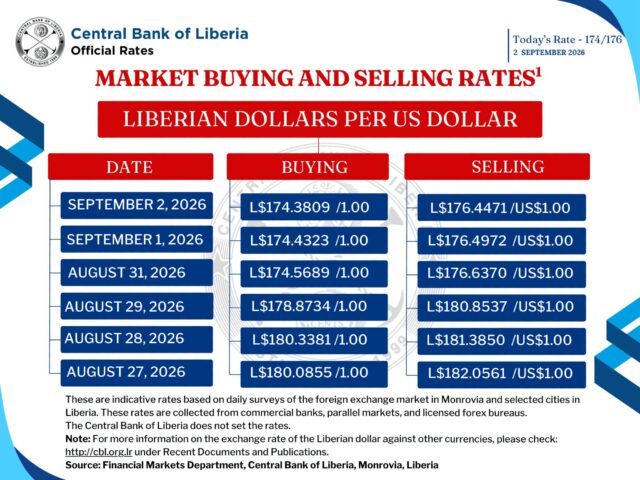
MONROVIA, Liberia — The Liberian dollar recorded a significant appreciation against the United States dollar between August 27 and September 2, 2026, with the local currency strengthening by more than 3 percent on both the buying and selling sides of the foreign exchange market.
According to market-rate data published by the Central Bank of Liberia (CBL), the indicative buying rate for US$1 fell from L$180.0855 on August 27 to L$174.3809 on September 2, representing a decline of L$5.7046, or approximately 3.17 percent, in the number of Liberian dollars required to buy one US dollar.
On the selling side, the rate dropped from L$182.0561 per US$1 on August 27 to L$176.4471 on September 2, a reduction of L$5.6090, equivalent to about 3.08 percent.
The movement means that, based on the CBL’s indicative market rates, the Liberian dollar ended the period considerably stronger than it began it.
Sharp Movement Toward Week’s End
The data show that the most notable movement occurred around the end of August.
On August 27, the indicative buying and selling rates stood at L$180.0855 and L$182.0561, respectively. By August 28, the rates had moved to L$179.3381 and L$181.3850.
The buying rate then fell to L$178.8734 on August 29 before dropping further to L$174.5689 on August 31.
The strengthening continued into September, with the buying rate reaching L$174.4323 on September 1 and L$174.3809 on September 2.
The selling rate followed a similar pattern, declining from L$180.8537 on August 29 to L$176.6370 on August 31, before reaching L$176.4471 on September 2.
The seven-day figures therefore point to a relatively sustained strengthening rather than a single-day movement.

What The Numbers Mean
For ordinary consumers and businesses, a lower Liberian-dollar-per-US-dollar rate generally means the local currency is stronger against the US dollar.
If sustained, such appreciation can reduce the local-currency cost of dollar-denominated imports and other transactions priced in US dollars. It can also provide some relief to businesses and consumers who need foreign exchange for imported goods, services or international payments.
However, the exchange-rate figures should not automatically be interpreted as evidence that prices of goods and services will fall by the same proportion. Retail prices are influenced by several other factors, including import costs, transportation, taxes, market margins, global commodity prices and the availability of foreign exchange.
The CBL itself stresses that these figures are indicative market rates and not rates set by the central bank. The rates are compiled from daily surveys of the foreign exchange market in Monrovia and selected Liberian cities, drawing information from commercial banks, parallel markets and licensed foreign-exchange bureaus.

CBL Does Not Set The Market Rate
The distinction is important because the published figures represent observed market conditions rather than an official exchange rate imposed by the monetary authorities.
The CBL’s latest data also show that the strengthening continued after the period covered by the graphic. On September 3, the indicative buying rate stood at L$174.1928 per US$1, while the selling rate was L$176.2109, representing another modest improvement from the September 2 figures.
The latest movement comes against a backdrop in which Liberia has continued to monitor exchange-rate pressures and broader monetary conditions. In its first-quarter 2026 financial and economic bulletin, the CBL reported that the Liberian dollar had depreciated by 2.4 percent during the quarter to L$182.86 per US$1, citing seasonal foreign-exchange demand, elevated import payments and structural vulnerabilities in the foreign-exchange market.
The sharp improvement recorded in late August and early September therefore represents a notable reversal from those earlier pressures.
For now, the CBL data point to a stronger Liberian dollar entering September, although the sustainability of the movement will depend on market conditions, foreign-exchange supply and demand, imports, remittance flows and broader economic fundamentals.
Source: Financial Markets Department, Central Bank of Liberia, Monrovia, Liberia.
For breaking news, in-depth analysis, and exclusive reports from Liberia and around the world, follow The Liberian Post on Facebook (https://web.facebook.com/profile.php?id=61576017166570) and X, formerly Twitter (https://x.com/LiberianPost).