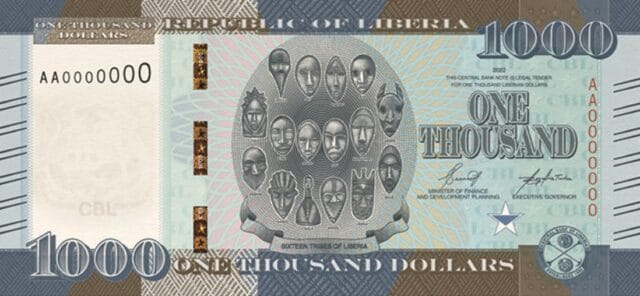
MONROVIA – Liberia’s Supreme Court has ruled that the controversy surrounding the exclusion of the Sarpo Community from the imagery on the LD$1,000 banknote presents a non-justiciable political question, and has therefore declined to rule on the merits of the case.
The case originated from a Petition for Declaratory Judgment filed by the Sarpo Community against the Central Bank of Liberia (CBL) and the Executive Branch of Government through the Ministry of Justice. The petition challenged the CBL’s 2021 redesign of the LD$1,000 banknote, which displays cultural masks representing sixteen ethnic groups but omits the Sarpo.
According to the petitioners, the omission amounts to discrimination and violates constitutional guarantees of national unity, equal protection, and due process. The Sarpo Community relied on national census data and cultural references, including the existence of Sapo National Park, to support its claim of ethnic recognition.
The Civil Law Court had earlier dismissed the suit, holding that the Sarpo Community lacked standing and failed to show a cognizable legal injury. That ruling was appealed to the Supreme Court.
At the hearing, the Sarpo Community was represented by Cllrs. Tiawon S. Gongloe, Momolu G. Kandakai, and Philip Y. Gongloe of Gongloe & Associates, while the Government was represented by Solicitor General Augustine C. Fayiah and Cllr. Ruth Jappah-Samukai, Legal Counsel for the Central Bank of Liberia.

In affirming the dismissal, the Supreme Court underscored the doctrine of separation of powers, emphasizing that policy decisions—such as defining or recognizing tribes—fall within the constitutional authority of the Legislative and Executive branches, not the Judiciary. The Court further noted that it does not render advisory opinions, particularly in the absence of a legislative framework defining Liberia’s tribes.
“The Judiciary is empowered to decide legal disputes, not to determine political or policy questions,” the Court stated.
However, the Court modified the lower court’s ruling by recognizing that the Sarpo Community has standing and legal capacity to institute an action. Despite this acknowledgment, the Court concluded that the substantive issue raised could not be judicially determined.
The Clerk of the Supreme Court was ordered to issue a mandate to the lower court to resume jurisdiction and enforce the judgment in keeping with the Opinion.
The ruling effectively leaves the question of ethnic recognition and representation on national symbols to the political branches of government, reinforcing judicial restraint while sustaining ongoing public debate on equality and inclusion in Liberia.