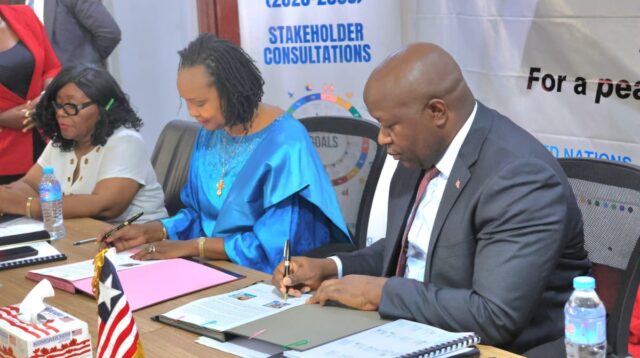
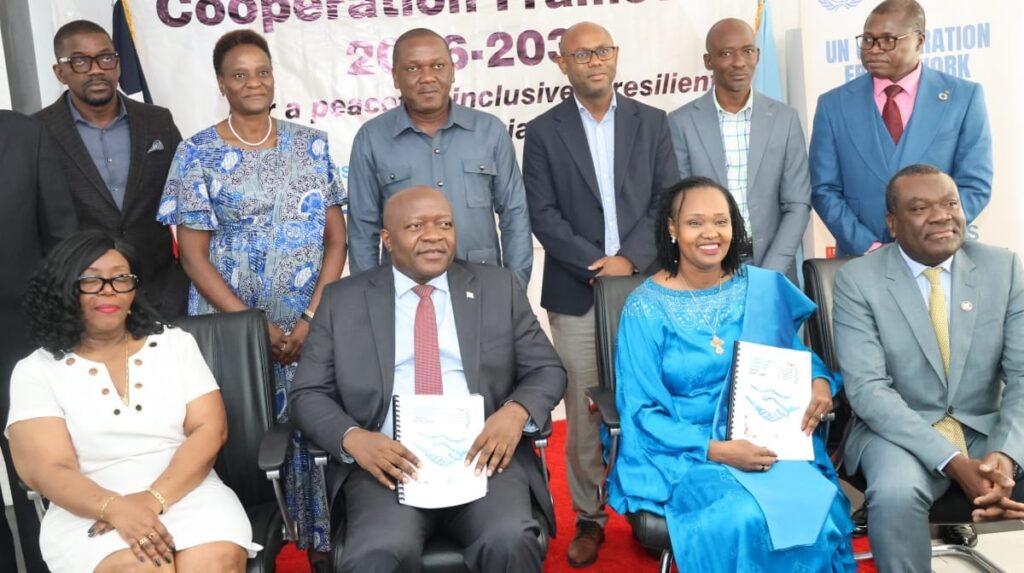
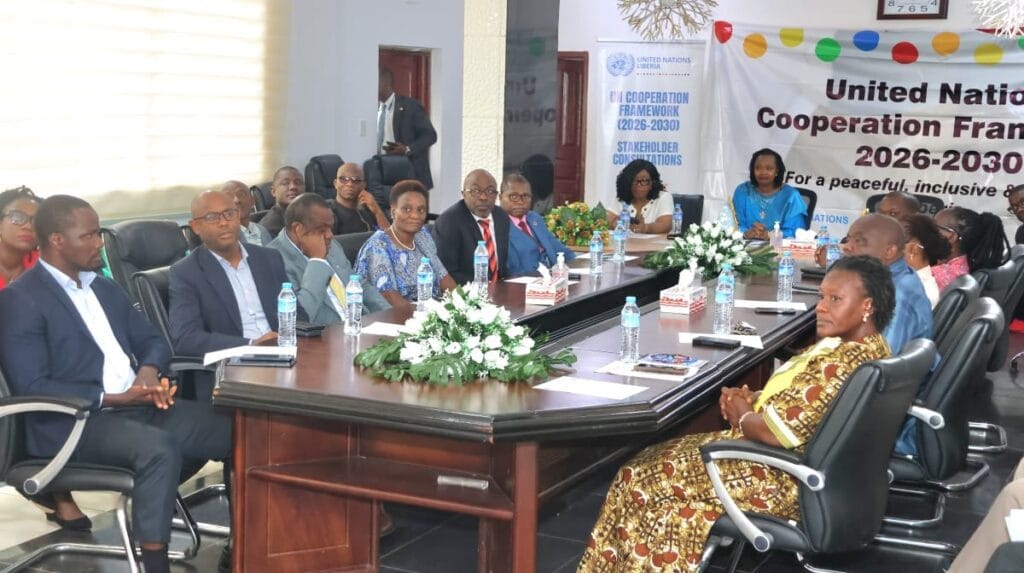
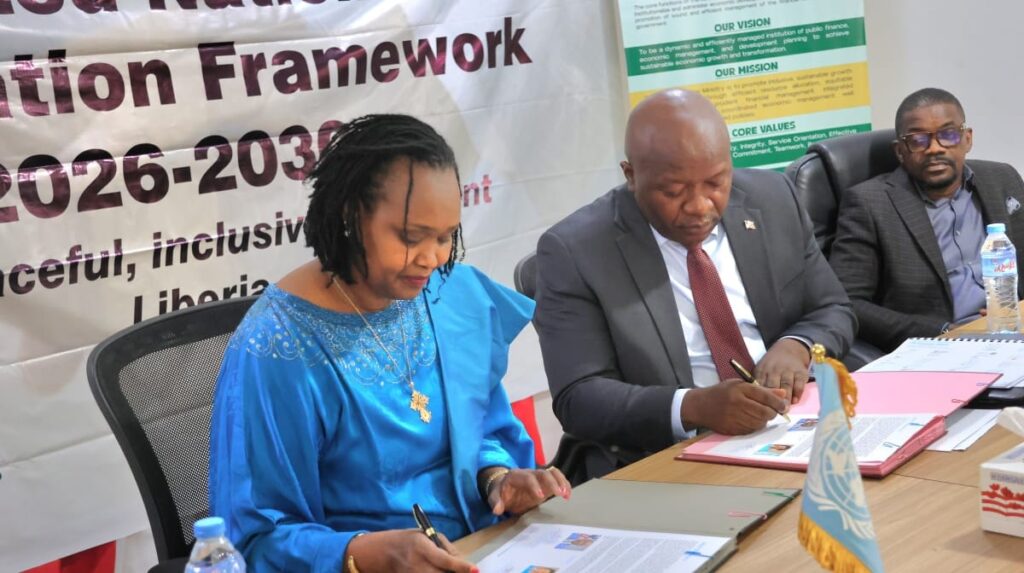
MONROVIA, Liberia — The Government of Liberia and the United Nations Systems in Liberia on Tuesday, December 16, signed a new Cooperation Framework (2026–2030) valued at approximately US$883 million, reaffirming a shared commitment to inclusive development, national ownership, and resilient partnership amid shifting global development dynamics.
The signing ceremony, held at the Ministry of Finance and Development Planning, marks the formal conclusion of the outgoing UN cooperation framework ending in 2025 and the commencement of a new five-year partnership aligned with Liberia’s ARREST Agenda for Inclusive Development (AAID) and the Sustainable Development Goals (SDGs).
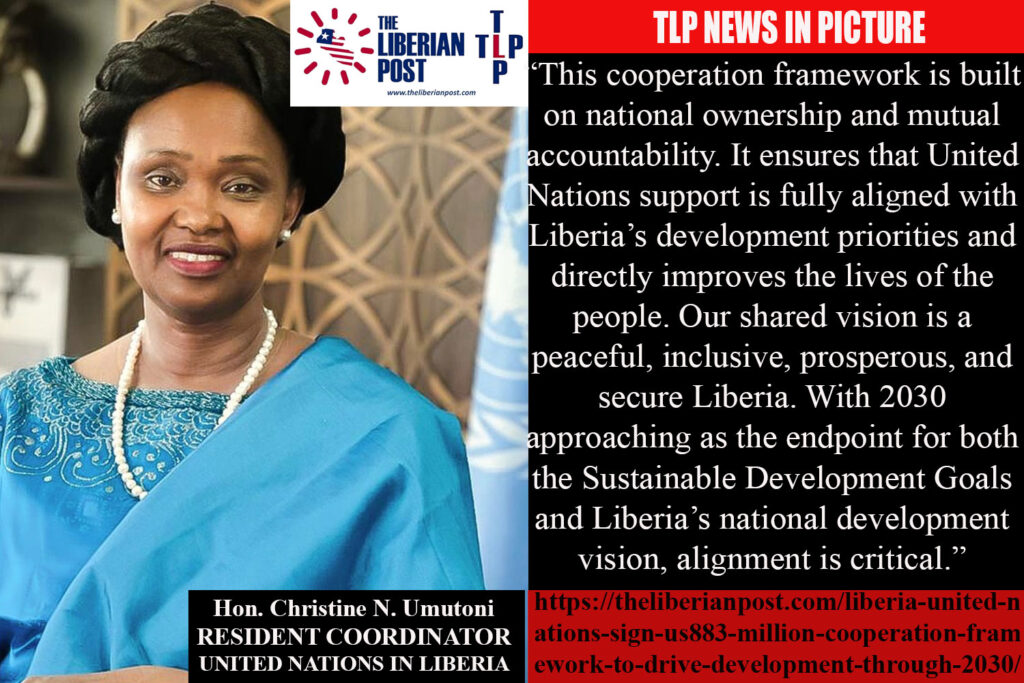
Speaking at the event, United Nations Resident Coordinator Christine N. Umutoni described the framework as a major milestone that reaffirms a joint vision for “a peaceful, inclusive, prosperous, and secure Liberia.”
“This cooperation framework is built on national ownership and mutual accountability,” Umutoni said. “It ensures that United Nations support is fully aligned with Liberia’s development priorities and directly improves the lives of the people.”
Aligned With National and Global Agendas
Umutoni explained that the 2026–2030 framework was deliberately designed to align with Liberia’s national development agenda as well as global and regional commitments, including Agenda 2030, Agenda 2063, ECOWAS priorities, and the Doha Programme of Action.
“With 2030 approaching as the endpoint for both the SDGs and Liberia’s national vision, alignment is critical,” she noted. “This framework strengthens Liberia’s pathway toward inclusive, resilient, and sustainable development.”
Three Strategic Priority Areas
The new Cooperation Framework is anchored on three priority pillars, jointly identified by the Government of Liberia and the UN system:
- Human Capital Development — improving health and nutrition, strengthening social protection systems, and expanding access to quality education and essential services;
- Good Governance and Rule of Law — enhancing democratic governance, accountability, justice, and strong institutions; and
- Economic Sustainability — promoting inclusive economic growth, job creation, climate resilience, and sustainable livelihoods.
At the core of the framework, Umutoni said, is a commitment to equity and inclusion, ensuring that vulnerable and marginalized populations are not left behind.
Flagship Programs and Financing Innovation
A key innovation under the new framework is the introduction of flagship programs aimed at accelerating national results. These include initiatives focused on education and skills for jobs, empowerment of adolescent girls, digital governance and service delivery, and climate-smart agriculture under the “She Feeds Liberia” program.
Umutoni noted that while some of the US$883 million envelope is already available, additional resources will be mobilized through innovative financing approaches, domestic resource mobilization, and strengthened development financing strategies.
“Traditional aid systems are under pressure globally,” she said. “That makes innovation in financing more important than ever.”
Ngafuan: Partnership Proven in Tough Times
In his remarks, Finance and Development Planning Minister Augustine Kpehe Ngafuan underscored the strength of the UN–Liberia partnership, noting that it was tested and proven during a turbulent year for both Liberia and the global development system.
“It is not in good times that you know your good friends,” Ngafuan said. “It is in tough times that you know your good friends.”
He recalled that as global development financing contracted and uncertainty intensified earlier in the year, the United Nations stood firmly with Liberia.
“When the headwinds came and others were retreating, the UN rallied around us,” Ngafuan said. “That is what partnership means.”
From Planning to Performance
Ngafuan emphasized that while the framework represents ambitious financing and planning, the real test lies in execution and timely implementation.
“To build a good structure, you must first have a good plan—and this framework is a solid plan,” he said. “But now the time for planning is over. Now is the time for performance.”
He stressed that Liberia’s citizens expect development outcomes that translate into real improvements at the community level, not just figures on paper.
“We must turn these big numbers into action in communities—not only in Monrovia, but across the country,” Ngafuan said.
Governance and Oversight
The framework will be overseen by a Steering Committee co-chaired by the Minister of Finance and the UN Resident Coordinator, providing strategic direction and accountability. Technical working groups and results teams will support implementation across sectors.
The Ministry of Finance and Development Planning will serve as the central coordinating institution for the UN development system in Liberia.
Looking Ahead to 2026
As the new framework prepares to take effect in January 2026, Ngafuan called for urgency and discipline.
“The Liberian people are impatient for development, and rightly so,” he said. “So as we enter 2026, it is time to get set, ready—and go.”
The signing of the 2026–2030 Cooperation Framework signals a renewed commitment by both Liberia and the United Nations to navigate global uncertainty through strong partnership, national leadership, and results-driven implementation, with the ultimate goal of improving lives and advancing sustainable development nationwide.