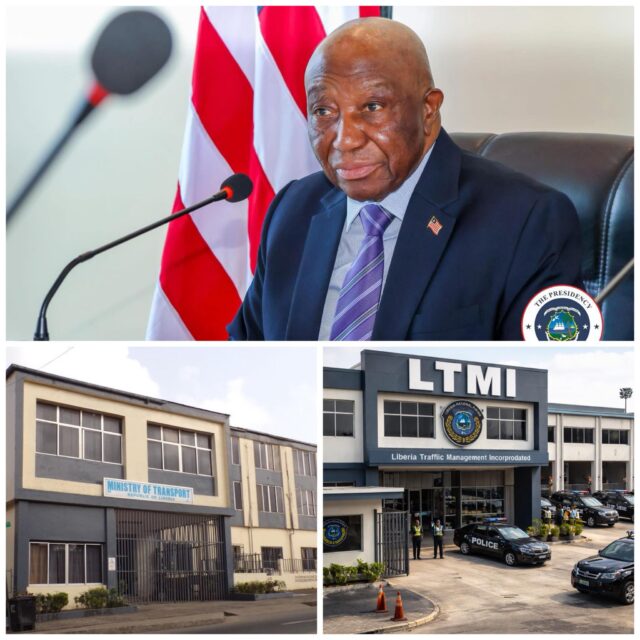
MONROVIA, Liberia – The Government of Liberia has announced a significant restructuring within the transport sector, transferring responsibility for driver’s licensing and vehicle registration services from the Ministry of Transport to the Liberia Traffic Management, Inc. (LTMI), as part of a broader reform initiative aimed at improving efficiency, accountability, and technological integration.
The decision was formalized in a Joint Press Release issued by the Ministry of Transport and the Civil Service Agency (CSA), outlining a new institutional framework that separates regulatory oversight from service delivery operations.
LTMI Assumes Operational Control
Effective March 1, 2026, LTMI assumed operational responsibility for issuing driver’s licenses and vehicle registrations. Under the new arrangement, LTMI will manage the transactional and operational components of licensing and registration on behalf of the Ministry of Transport.
However, the Ministry retains its core mandate in policy development, regulation, oversight, compliance monitoring, and enforcement.
Officials say the reform establishes a clearer separation between regulation and implementation—an approach widely adopted in public sector governance to strengthen accountability and improve performance monitoring.
The restructuring is designed to enhance service delivery standards, streamline processes, and introduce stronger technological systems within Liberia’s land transport administration.
Ministry of Transport Reconfigures Key Divisions
In tandem with the transfer of licensing functions, three major divisions within the Ministry of Transport have been reconfigured to reflect its strengthened regulatory role.
The former Division of Motor Vehicle has been transformed into the Division of Motor Vehicle Policy and Regulation. This division will now focus on developing regulatory standards, vehicle classification frameworks, compliance guidelines, safety benchmarks, and quality control oversight of licensing and registration operations. It will also monitor adherence to national transport regulations and ensure alignment with established best practices.
Meanwhile, the former Division of Drivers’ License has been restructured as the Division of Axle Load Management. This new division will concentrate on vehicle weight compliance, highway preservation standards, axle load monitoring mechanisms, and enforcement coordination related to heavy-duty and commercial transport operations. Authorities say this shift is intended to protect national road infrastructure and promote responsible freight movement.
Similarly, the former Division of Tricycles and Motorcycles has been reorganized into the Division of Traffic Monitoring and Enforcement. The division will oversee traffic surveillance coordination, compliance monitoring, violation reporting systems, and collaboration with security agencies and municipal authorities to strengthen urban traffic management and public safety initiatives.
Civil Servants to Be Reassigned, Not Displaced
Addressing concerns about job security, the Ministry of Transport and the Civil Service Agency assured employees that the transition does not represent displacement but rather a strategic repositioning of functions.
According to the release, the CSA, working closely with the Ministry, conducted competency assessments of affected personnel to ensure an orderly and policy-compliant transition. Civil servants will be reclassified and redeployed within the newly formed divisions based on qualifications, competencies, and institutional needs.
Authorities emphasized that the reform seeks to create a more professional, structured, and disciplined oversight framework within the transport sector.
Technology Rollout Planned
In a related development, the Ministry of Transport disclosed plans to install 25 Traffic Monitoring Systems across major streets and intersections in Monrovia. The systems will include closed-circuit surveillance cameras (CCTV) and modern traffic light infrastructure.
Officials say the initiative will enhance traffic flow management, support enforcement operations, improve road safety, and introduce greater technological oversight within Liberia’s land transport environment.
Part of Broader Governance Reforms
The restructuring aligns with ongoing public sector reform efforts aimed at strengthening institutional clarity, reducing bureaucratic overlap, and improving service delivery outcomes.
By delineating operational service functions from regulatory supervision, the Government intends to enhance transparency, increase efficiency, and modernize Liberia’s transport administration system.
Transport sector analysts note that effective implementation and consistent oversight will determine the long-term success of the reform, particularly as Liberia continues efforts to modernize public services and safeguard critical road infrastructure.
Follow The Liberian Post on Facebook and X (formerly twitter)