
–Group Says Proposed US$1 Remittance Contribution Could Generate Millions for Schools, Hospitals and Community Development Projects
MONROVIA, Liberia – The Diaspora Liberian Development Initiatives (DLDI) has renewed its appeal to the National Legislature to support the proposed Diaspora Development Fund Act of 2025, arguing that the initiative could unlock millions of dollars annually for national development by harnessing the collective financial power of Liberians living abroad.
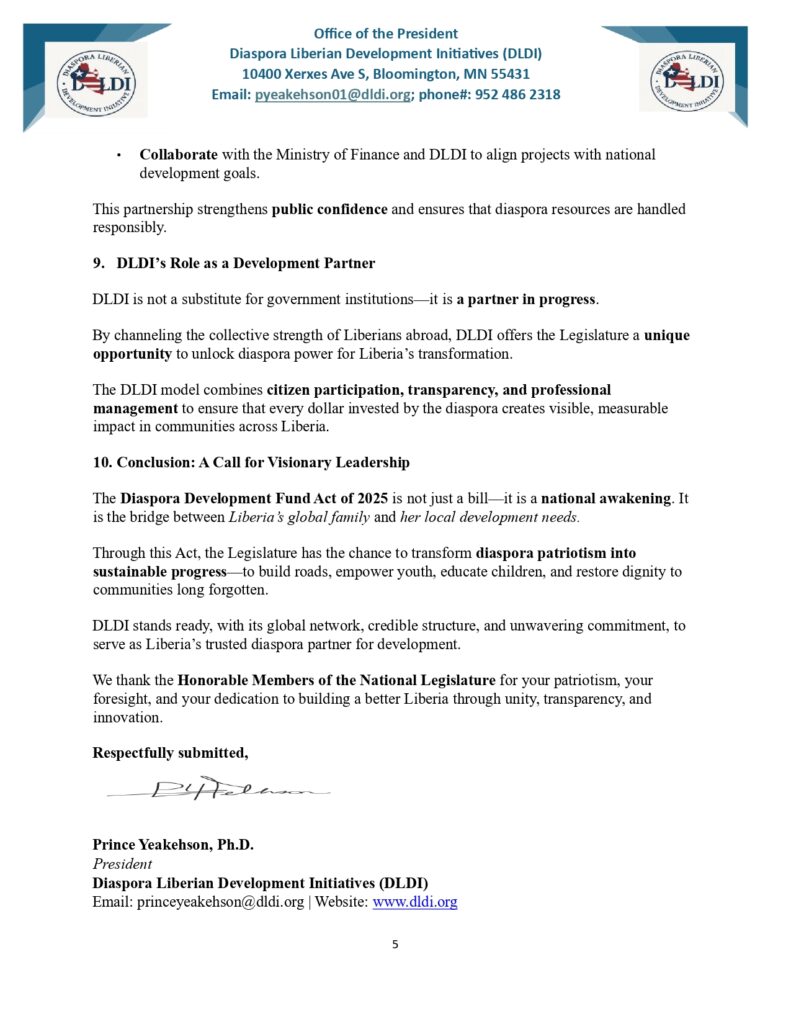
In a detailed communication submitted to members of the Liberian Senate and House of Representatives, DLDI President Dr. Prince Yeakehson sought to clarify what he described as widespread misconceptions about the organization’s mission, while drawing a clear distinction between the DLDI and the Liberia Diaspora Annual Conference (LDAC).
According to the organization, while the Liberia Diaspora Annual Conference serves primarily as a platform for dialogue, networking, and investment discussions, the DLDI was established as a permanent institutional mechanism aimed at converting diaspora remittances and expertise into tangible development projects across Liberia.
The clarification comes amid growing national debate over the DLDI’s most talked-about proposal—a plan to collect a US$1 contribution from every remittance transaction and bank transfer sent to Liberia. The proposal has generated both support and criticism among Liberians at home and abroad.
Controversial US$1 Remittance Proposal
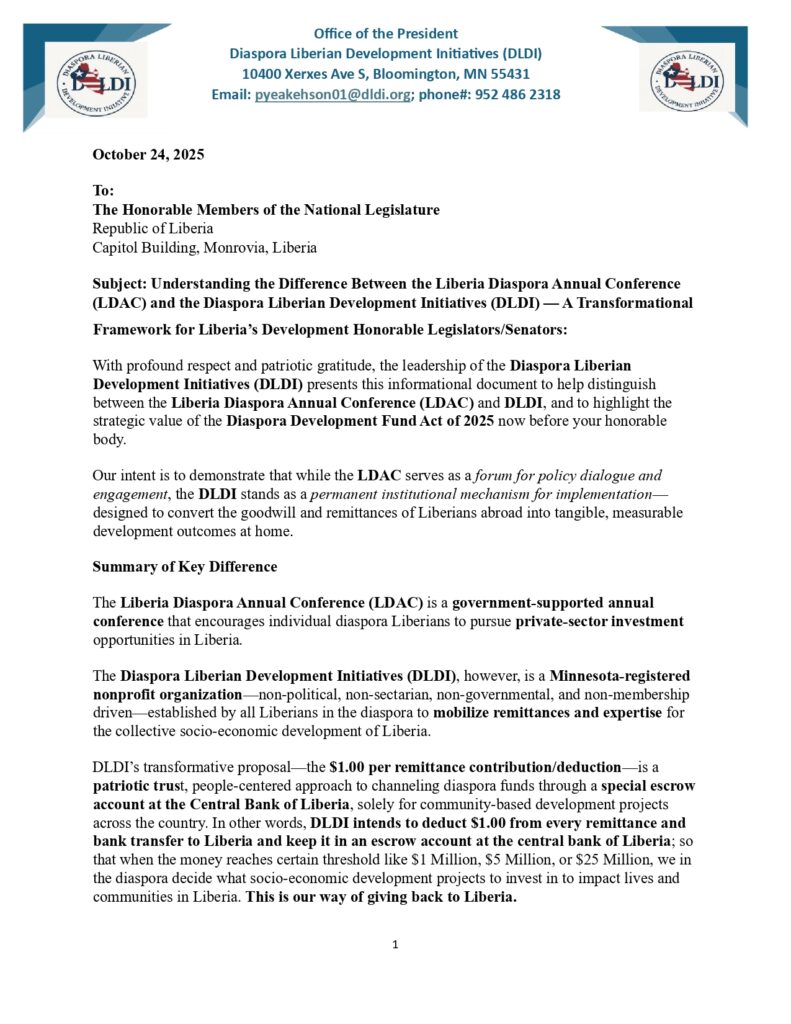
At the heart of DLDI’s proposal is a recommendation that a one-dollar contribution be deducted from each remittance transaction destined for Liberia and deposited into a special escrow account at the Central Bank of Liberia (CBL).
The organization argues that the initiative is not intended as a tax but rather as a patriotic development contribution that would be managed independently and invested in community-based projects throughout the country.
Under the proposal, funds would accumulate in the escrow account until they reach predetermined thresholds before being deployed toward development projects selected by members of the Liberian diaspora.
“We in the diaspora decide what socio-economic development projects to invest in to impact lives and communities in Liberia. This is our way of giving back to Liberia,” the organization stated.
DLDI estimates that with annual remittance inflows ranging between US$700 million and US$1 billion, the initiative could generate between US$25 million and US$30 million annually for development projects without requiring new taxes or external borrowing.
Explaining the Difference Between LDAC and DLDI
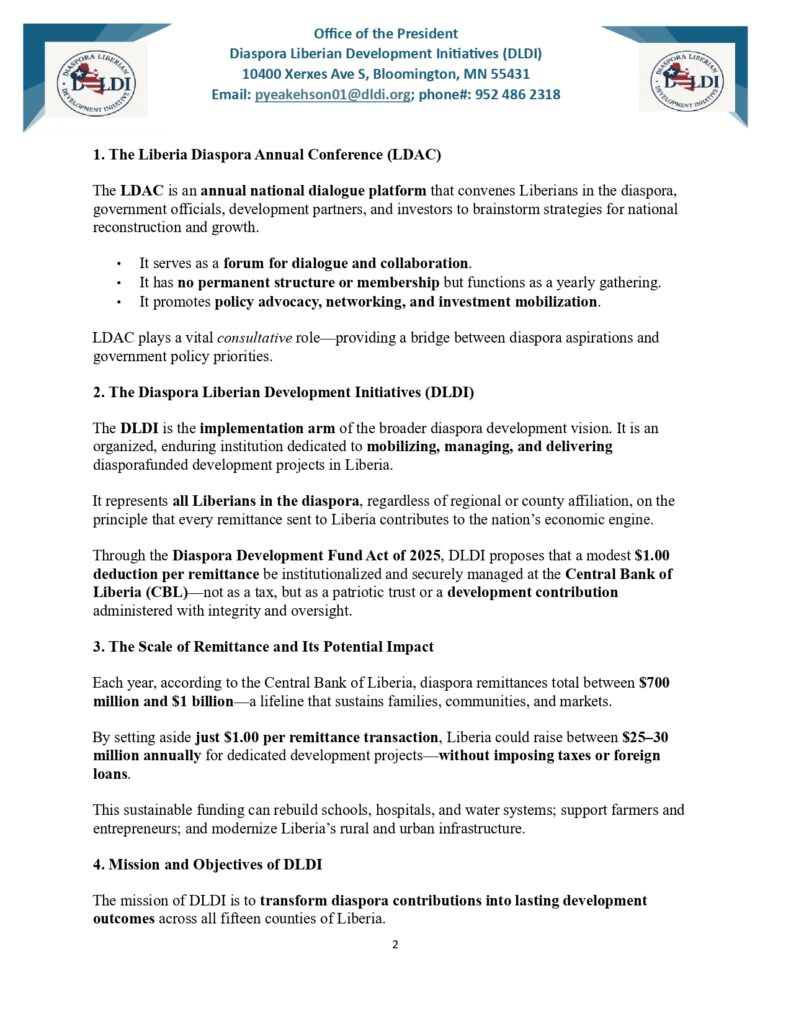
In its communication to lawmakers, DLDI emphasized that many Liberians continue to confuse the organization with the Liberia Diaspora Annual Conference.
According to the group, the annual conference functions as a government-supported platform that encourages diaspora engagement, investment promotion, policy dialogue, and collaboration between Liberians abroad and government institutions.
The DLDI, by contrast, describes itself as a Minnesota-registered nonprofit organization established to mobilize financial resources, technical expertise, and development partnerships for Liberia.
The organization said it intends to serve as the implementation arm of a broader diaspora development vision, with a permanent governance structure capable of managing large-scale development initiatives over time.
Ambitious Development Agenda
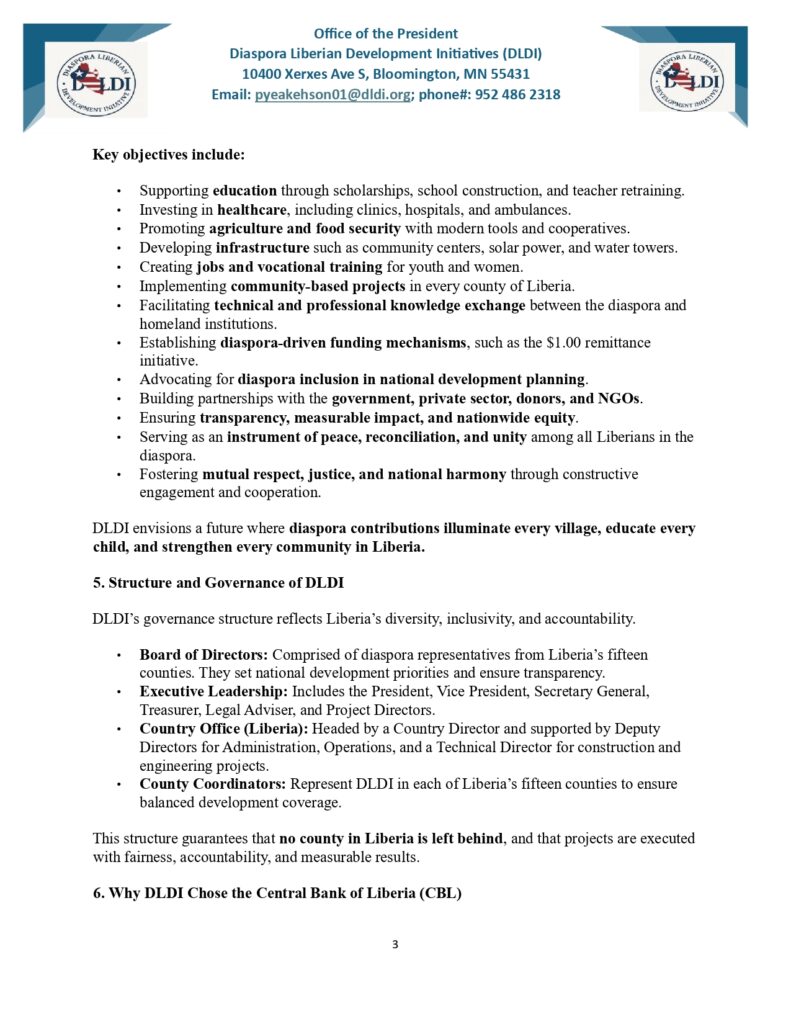
According to the proposal, funds raised through the Diaspora Development Fund would support a broad range of projects across Liberia’s fifteen counties.
Among the priorities identified by DLDI are investments in education, healthcare, agriculture, infrastructure, youth employment, vocational training, water systems, renewable energy, and community development initiatives.
The organization says it envisions a future where diaspora contributions help construct schools, clinics, hospitals, solar energy systems, water towers, and community centers while also supporting scholarships and entrepreneurship programs.
DLDI further argues that the initiative would create a structured mechanism through which Liberians abroad can participate more directly in national development planning and implementation.
Central Bank Proposed as Custodian
One of the more significant aspects of the proposal involves the role of the Central Bank of Liberia.
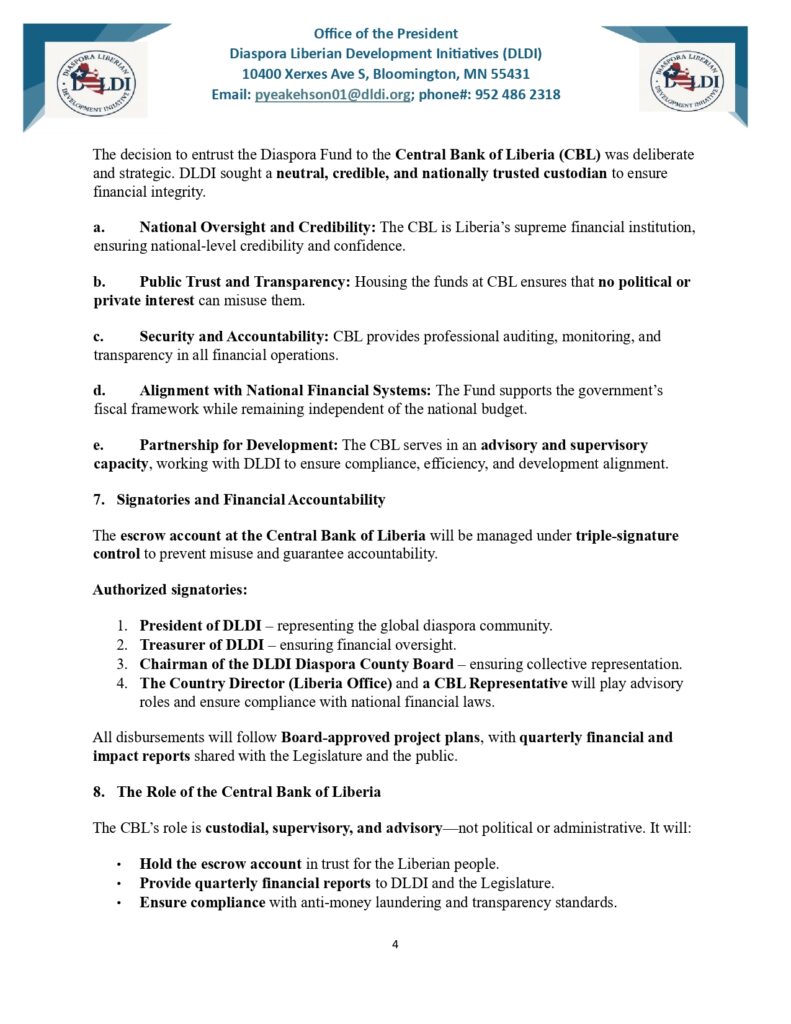
According to DLDI, the CBL would serve as the custodian of the proposed Diaspora Development Fund through a dedicated escrow account.
The organization said the decision to place the funds at the Central Bank was driven by concerns about transparency, credibility, security, and public confidence.
Under the proposal, withdrawals from the account would require multiple signatories and would be subject to oversight mechanisms intended to prevent misuse.
DLDI has also proposed quarterly financial reports and public disclosures to ensure accountability and maintain public trust.
Mixed Reactions Continue
The proposed Diaspora Development Fund has sparked considerable debate among Liberians.
Supporters argue that the initiative could create a sustainable source of development financing at a time when Liberia continues to face infrastructure deficits and growing social needs.
Advocates contend that Liberians in the diaspora already contribute significantly to the economy through remittances and should have a structured vehicle for financing national development projects.
Critics, however, have questioned the practicality of the proposed remittance contribution, raising concerns about governance, accountability, legal authority, implementation mechanisms, and whether remittance senders should be required to contribute automatically.
Others have called for broader consultations with diaspora communities before any legislation is enacted.
Awaiting Legislative Action
The proposal is now before the National Legislature as part of discussions surrounding the Diaspora Development Fund Act of 2025.
In its appeal to lawmakers, DLDI described the legislation as a transformative opportunity to convert diaspora patriotism into sustainable development financing.
“The Diaspora Development Fund Act of 2025 is not just a bill—it is a national awakening,” the organization declared.
Whether lawmakers ultimately embrace the proposal remains to be seen. However, the initiative has already succeeded in reigniting a national conversation about the role of Liberia’s diaspora community in shaping the country’s development future.
Follow The Liberian Post on Facebook (https://web.facebook.com/profile.php?id=61576017166570) and X, formerly twitter (https://x.com/LiberianPost).