
-Gasoline, Fuel Oil, Jet A-1 and Heavy Fuel Oil Prices Reduced Effective June 18
MONROVIA – The Ministry of Commerce and Industry (MOCI), in collaboration with the Liberia Petroleum Refining Company (LPRC), has announced a reduction in the prices of several petroleum products on the Liberian market, providing relief to consumers and businesses amid ongoing concerns over the cost of transportation and energy.
The new price ceilings, which took effect on June 18, 2026, cover gasoline (PMS), fuel oil (AGO), Jet A-1 aviation fuel, and Heavy Fuel Oil (HFO).
According to separate price circulars jointly issued by Commerce Minister Magdalene Ellen Dagoseh and LPRC Managing Director Amos B. Tweh, the reductions reflect changes in international petroleum market conditions and form part of the government’s efforts to ensure fair pricing on the local market.
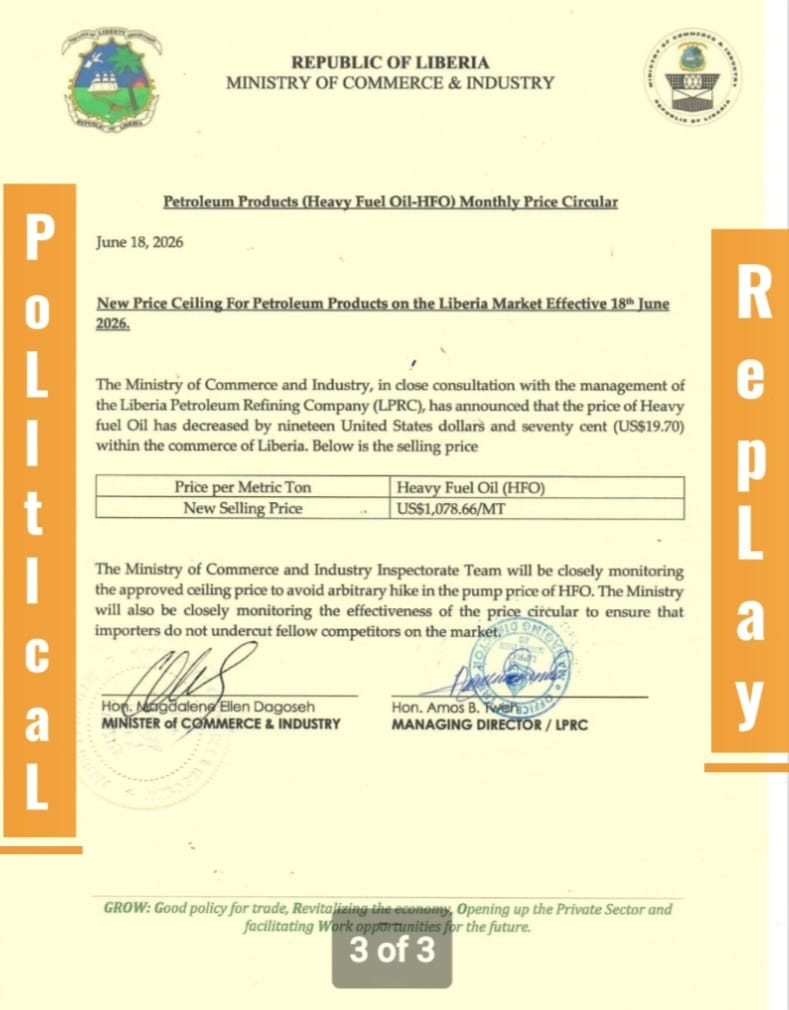
Gasoline and Fuel Oil Prices Reduced
Under the revised pricing structure, the wholesale selling price of gasoline (PMS) has been set at US$4.66 per gallon, while the approved retail pump price has been reduced to US$4.94 per gallon, equivalent to L$905.00 based on the prevailing exchange rate.
The Ministry also announced a reduction in the price of Automotive Gas Oil (AGO), commonly known as diesel or fuel oil. The wholesale price has been fixed at US$5.97 per gallon, while the retail pump price is now US$6.25 per gallon, or L$1,145.00.
According to the circular, gasoline prices declined by 15 United States cents (US$0.15), while fuel oil prices fell by 30 United States cents (US$0.30).
The Ministry used the Central Bank of Liberia’s exchange rate of L$183.1427 to US$1, issued on June 15, 2026, in calculating the Liberian-dollar retail prices.
Aviation Fuel Sees Price Cut
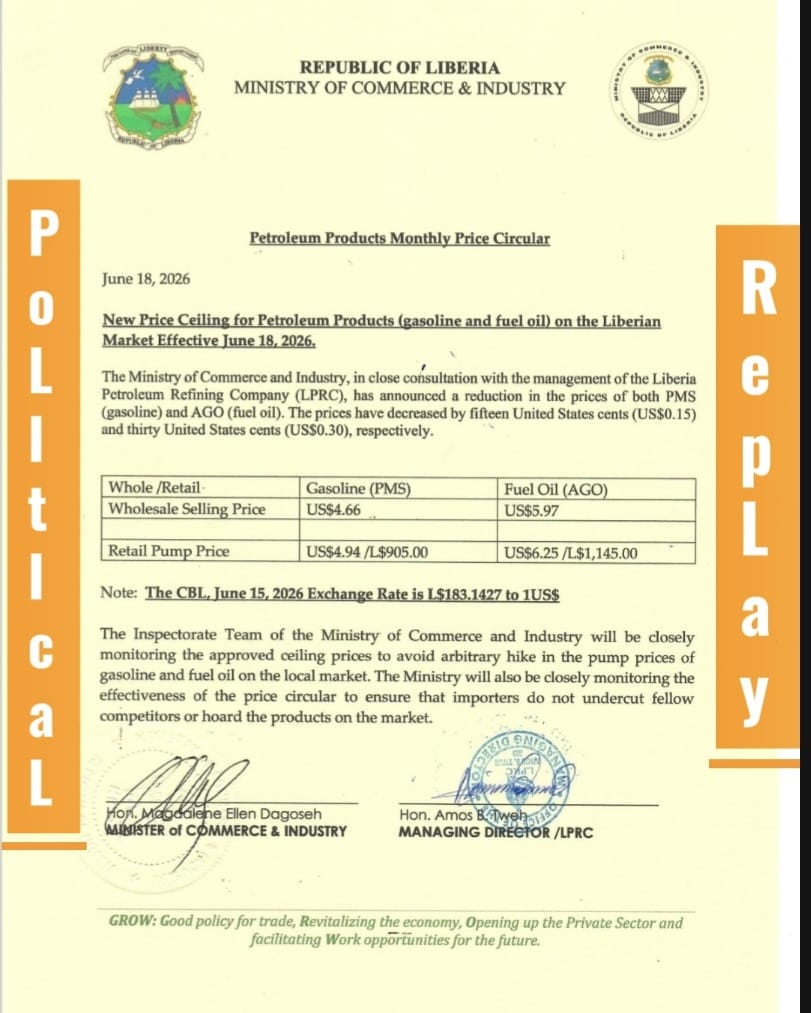
The government also announced a reduction in the price of Jet A-1 aviation fuel, a development expected to be welcomed by airlines and aviation operators utilizing Liberia’s airports.
According to the Ministry, the price of Jet A-1 has been reduced by 40 United States cents (US$0.40), bringing the approved selling price to US$7.22 per gallon.
Industry observers say changes in aviation fuel prices can influence operational costs for airlines, although the impact on ticket prices often depends on several other factors, including taxes, airport fees, and international market conditions.
Heavy Fuel Oil Price Also Falls
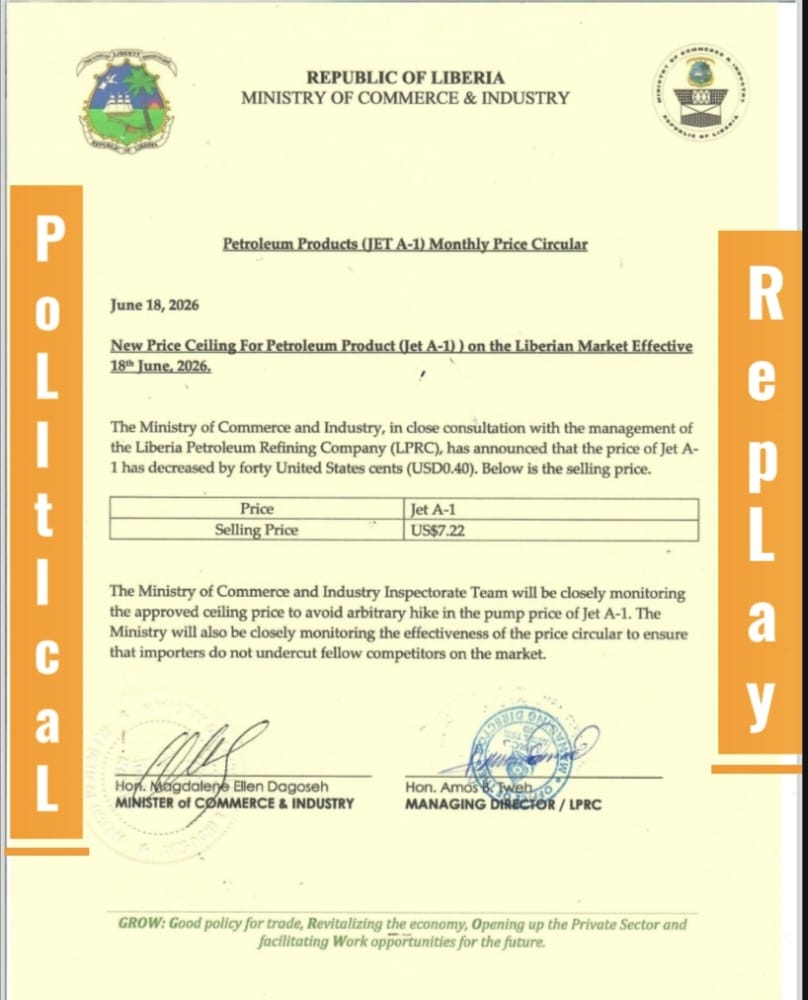
In a separate circular, the Ministry announced a substantial reduction in the price of Heavy Fuel Oil (HFO), which is widely used by industries and power generation facilities.
The price of HFO has decreased by US$19.70 per metric ton, resulting in a new approved selling price of US$1,078.66 per metric ton.
The reduction is expected to provide some cost relief to businesses and industrial operators that rely heavily on fuel-based energy systems.
Government Warns Against Arbitrary Price Hikes
The Ministry of Commerce and Industry said its Inspectorate Team will closely monitor the implementation of the new price ceilings to ensure compliance by petroleum importers and distributors.
Authorities warned that they will not tolerate arbitrary increases in pump prices beyond the approved ceilings.
“The Ministry of Commerce and Industry Inspectorate Team will closely monitor the approved ceiling prices to avoid arbitrary hikes in petroleum prices on the local market,” the circular stated.
The Ministry further indicated that it will monitor market behavior to ensure that importers do not engage in anti-competitive practices, including undercutting competitors or hoarding petroleum products.
Relief for Consumers and Businesses
The latest price adjustment comes as fuel prices remain a key concern for consumers, transport operators, businesses, and households across Liberia.
Petroleum products play a critical role in Liberia’s economy, influencing transportation costs, electricity generation, industrial production, and the prices of goods and services.
Economic analysts note that reductions in fuel prices, if sustained, could help ease operational costs for businesses and potentially slow increases in transportation fares and commodity prices.
The government has repeatedly emphasized its commitment to protecting consumers while maintaining a stable and competitive petroleum market.
With the new pricing structure now in effect, attention will turn to how quickly the reductions are reflected at fuel stations and throughout the broader economy.
For breaking news, in-depth analysis, and exclusive reports from Liberia and around the world, follow The Liberian Post on Facebook (https://web.facebook.com/profile.php?id=61576017166570) and X, formerly Twitter (https://x.com/LiberianPost).