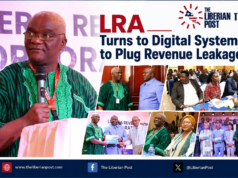
–New Five-Year Strategy Targets Tax Evasion, Fraud and Inefficiencies Through Data, Automation, Customs Modernization and Smarter Compliance
MONROVIA, Liberia — The Liberia Revenue Authority (LRA) is embarking on an aggressive digital transformation of Liberia’s revenue system, with a new five-year strategic plan targeting tax leakages, fraud, inefficient manual processes and weak compliance through automation, integrated data and intelligence-led administration.
The shift forms a central pillar of the LRA Corporate Strategic Plan 2025–2029, launched this week as Liberia moves toward a historic US$1 billion in domestic revenue collection.
The strategy seeks to fundamentally change how the government identifies taxable activity, manages compliance, processes customs transactions and interacts with taxpayers.
Rather than relying predominantly on manual procedures and after-the-fact enforcement, the LRA says it intends to increasingly use technology, data and risk-based systems to identify non-compliance and protect government revenue.

From Manual Processes to Digital Administration
The strategic plan calls for a transition from manual processes to automated systems, from fragmented information to integrated data, from reactive administration to intelligence-led revenue management, and from complex taxpayer processes to simpler and more accessible services.
That transformation is designed to make the revenue system more efficient while strengthening the government’s ability to detect irregularities.
The plan places particular emphasis on technology and data, alongside voluntary compliance, institutional capacity, effective administration of the law and stronger cooperation with domestic and international partners.
The LRA’s leadership has framed the transformation as more than an internal modernization exercise.
It is intended to change the relationship between the government and taxpayers by making compliance easier for those who want to comply while giving authorities better tools to identify those who deliberately evade their obligations.

‘No Revenue Authority Has Ever Audited Its Way to Prosperity’
One of the strongest arguments presented during the strategic-plan launch was that Liberia cannot rely solely on audits and enforcement to expand its revenue base.
The LRA’s strategy instead emphasizes taxpayer trust and voluntary compliance as essential components of sustainable revenue mobilization.
“No revenue authority on earth has ever audited its way to prosperity.”
The argument is that enforcement can reach only a limited number of taxpayers, while a functioning revenue system must bring the much larger population of taxpayers into voluntary compliance.
That requires a system in which taxpayers can understand their obligations, make payments conveniently and receive consistent treatment from the revenue authority.
The strategic plan therefore links digitalization with taxpayer service, rather than treating technology merely as an enforcement mechanism.

Data at the Center of the Revenue Drive
A major component of the transformation is the effort to move toward more integrated government revenue data.
Under the new strategy, information that has traditionally existed in separate systems can increasingly be brought together to give the LRA a clearer picture of taxpayers, transactions and potential compliance risks.
That could allow the Authority to identify unusual transactions, inconsistencies and other indicators of potential revenue leakage more quickly.
The move toward intelligence-led administration also means that the LRA can increasingly concentrate enforcement resources on areas where the risk of non-compliance is highest rather than applying the same approach to every taxpayer.
This represents an important shift from broad, resource-intensive enforcement toward a more targeted risk-management model.

Customs Modernization Takes Center Stage
Digitalization is also expected to play a major role in Liberia’s customs administration.
The LRA strategic plan identifies customs modernization as an important component of improving revenue administration and facilitating legitimate trade.
The goal is to make customs processes more efficient while strengthening the Authority’s ability to detect under-declaration, fraudulent transactions and other practices that can deprive government of revenue.
The ECOWAS representative who participated in the launch, Mohammed Konneh, emphasized the regional importance of digital tools and customs modernization.
He said strengthened regional systems can help combat fraud and revenue leakage while improving trade integration and Liberia’s participation in the regional common market.
That regional dimension is particularly important because customs revenue and cross-border trade are closely connected to Liberia’s broader economic integration within ECOWAS.

Digital Payments Could Reduce Leakages
The push toward digital revenue administration also extends to how taxpayers pay government.
A representative of the Central Bank of Liberia emphasized the development of modern payment infrastructure that can provide taxpayers with more convenient and secure channels for paying taxes and customs duties through banks and mobile platforms.
The shift could reduce transaction costs while limiting opportunities for errors, fraud and leakages associated with inefficient payment processes.
For taxpayers, the objective is convenience. For government, the objective is greater transparency and traceability.
That combination could become increasingly important as domestic revenue collections continue to rise.

US$1 Billion Raises the Stakes
The digital transformation comes at a particularly important moment for Liberia’s public finances.
LRA Commissioner General James Dorbor Jallah disclosed that domestic revenue collections had reached approximately US$912 million, placing Liberia within reach of the historic US$1 billion threshold.
Jallah has emphasized that the significance of the milestone is not the size of the number itself but what the revenue can finance.
“$1 billion is not a trophy. It is a toolbox.”
He added: “The billion is not the achievement. What the billion pays for is the achievement.”
The stronger the government’s revenue collection system becomes, the greater its ability to finance public priorities from domestic resources.
But increased collections also raise expectations that the government will prevent revenue from being lost through evasion, fraud, weak controls or administrative inefficiency.
That makes the LRA’s digital transformation particularly consequential.

Technology Meets the Fight Against Evasion
The Authority’s new strategy effectively puts technology at the center of that challenge.
Digital systems can give revenue authorities greater visibility over transactions and taxpayer behavior while reducing opportunities for manual manipulation.
Integrated data can also make it easier to compare information from different sources and identify discrepancies that might otherwise remain hidden.
The result, if successfully implemented, would be a revenue system that is not simply collecting more money but is becoming more difficult to circumvent.
That is particularly important for a country seeking to expand its fiscal space without continuously increasing the burden on compliant taxpayers.

Building Trust Alongside Enforcement
The LRA’s strategy nevertheless recognizes that technology alone will not solve Liberia’s revenue challenges.
The plan places voluntary compliance alongside digital transformation as one of its core objectives.
That means the Authority must convince taxpayers that the system is fair, predictable and worth complying with.
The strategy therefore combines stronger enforcement with improved taxpayer services.
The message is straightforward: taxpayers who comply should encounter a system that is increasingly simple and efficient, while those who deliberately evade their obligations should face increasingly sophisticated detection mechanisms.

A Broader Push for Economic Sovereignty
The LRA’s digital strategy is ultimately tied to a much larger national objective: economic self-reliance.
At the strategic-plan launch, ECOWAS officials described domestic resource mobilization as a “bedrock of national sovereignty and sustainability.”
That argument is increasingly relevant as Liberia seeks to finance more of its development priorities through resources generated within the country.
The broader transformation therefore extends beyond the LRA.
It touches the government’s ability to finance roads, schools, healthcare, electricity and other components of the ARREST Agenda for Inclusive Development.
Finance and Development Planning Minister Augustine Kpehe Ngafuan has similarly argued that Liberia’s approaching billion-dollar revenue milestone must become a platform for doing more rather than a reason for complacency.

The Challenge Is Implementation
The strategic plan sets an ambitious direction, but the real test will be implementation.
Digital systems require reliable infrastructure, trained personnel, cybersecurity safeguards, quality data and sustained institutional discipline.
They also require taxpayers and businesses to have access to the technology and payment channels necessary to participate effectively.
The LRA will therefore have to manage two transformations simultaneously: modernizing its internal operations and making the revenue system easier for the public to use.
If successful, the Authority could move Liberia toward a revenue system in which data drives decision-making, technology reduces opportunities for leakage and taxpayer services encourage voluntary compliance.
If implementation falls short, however, digital platforms could simply reproduce existing administrative weaknesses in electronic form.

A New Era for Liberia’s Revenue System?
The launch of the 2025–2029 strategic plan comes as Liberia approaches what could become its first US$1 billion domestic revenue year.
That coincidence gives the digital transformation added significance.
The country is not merely trying to collect more revenue.
It is attempting to build the institutional machinery needed to collect, protect, track and efficiently administer that revenue.
As Jallah put it, the billion-dollar threshold is not the destination. It is the tool.
And the LRA’s new strategy is designed to ensure that the tool is backed by a modern revenue system capable of delivering the resources Liberia needs to finance its own future.
For breaking news, in-depth analysis, and exclusive reports from Liberia and around the world, follow The Liberian Post on Facebook (https://web.facebook.com/profile.php?id=61576017166570) and X, formerly Twitter (https://x.com/LiberianPost).