–Finance Minister Signals Government-Wide Performance Incentives as Revenue Surge Creates Greater Fiscal Space for ARREST Agenda
MONROVIA, Liberia — Finance and Development Planning Minister Augustine Kpehe Ngafuan has signaled that the Government of Liberia is preparing to introduce performance-based incentives for government institutions that meet or exceed their revenue targets, as the country moves toward an unprecedented US$1 billion in domestic revenue collection.
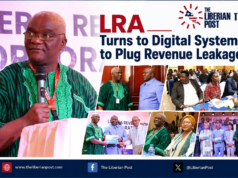
Ngafuan made the disclosure at the launch of the Liberia Revenue Authority (LRA) Corporate Strategic Plan 2025–2029, where he said the government is already discussing a broader incentive framework covering revenue-generating entities across the public sector.
The Finance Minister said the proposed system would not be limited to the LRA, but could extend to state-owned enterprises and other government institutions responsible for generating revenue.
“We are discussing incentives across as we speak,” Ngafuan declared, signaling what could become a major shift toward performance-based rewards within Liberia’s revenue system.
He went further, saying government must consider rewarding institutions that deliver on the revenue targets assigned to them.
“If you have a situation where you gave a revenue target to an SOE and they meet the target, we need to look at incentivizing them,” he said.
Ngafuan said discussions are being structured as a comprehensive package that would bring together the various institutions responsible for generating revenue for the government.

“As we go to the Legislature, we want to put everyone, the contingent of revenue raisers in the package so that we leave no one behind,” he said.
Revenue Surge Approaches Historic Threshold
The announcement comes as Liberia’s domestic revenue collection approaches a historic milestone.
LRA Commissioner General James Dorbor Jallah told the gathering that domestic revenue collections had reached US$912 million, with more than four months remaining in the fiscal year at the time of his remarks.
Jallah said the country could cross the US$1 billion domestic-revenue threshold within weeks, potentially marking the first time in Liberia’s 179-year history that the country reaches that level of domestic revenue collection.
The figures represent a substantial increase over previous years. According to Jallah, the LRA collected US$464 million in 2014, rising to US$699 million in 2024. In 2025, the Authority collected US$848 million against a target of US$804.6 million, exceeding its target by US$44 million.
Jallah said the country’s domestic-revenue-to-GDP ratio also rose from 13.4 percent in 2023 to 15.9 percent in 2025, and was projected to reach 16.3 percent in 2026.
But he cautioned against treating the billion-dollar mark as merely a statistical achievement.

“$1 billion is not a trophy. It is a toolbox,” Jallah said.
“The billion is not the achievement. What the billion pays for is the achievement.”
He said the real significance of increased domestic revenue would be reflected in Liberia’s ability to finance clinics, classrooms, roads and other national priorities without having to depend as heavily on outside financing.
Ngafuan: Billion-Dollar Revenue Must Become the New Baseline
For Ngafuan, however, reaching US$1 billion should not be the end of the government’s ambition.
He said Liberia must maintain the momentum and move beyond the milestone because the expectations of citizens are growing.
“We have to split in the billions,” Ngafuan said, adding that once Liberia crosses the threshold, “there shall be no turning back.”
He stressed that the achievement belongs to Liberians collectively and not to one institution or branch of government.
“That is an achievement of the Liberian people,” he said, describing the crossing of the billion-dollar threshold as profound because it would represent a milestone reached since the founding of the Republic.

US$1.919B 2027 Budget Figure Emerges
The Finance Minister also offered an early glimpse into the fiscal pressures confronting government as it prepares the 2027 national budget.
Ngafuan said the Ministry of Finance has already begun preparations and disclosed that a figure of approximately US$1.919 billion had emerged during discussions as of August 15.
But he acknowledged that expenditure demands continue to rise as ministries, agencies and other government institutions submit requests for funding.
That creates a delicate balancing act for the Ministry of Finance: increased domestic revenue is creating additional fiscal space, but demands on that space are also expanding.
Ngafuan said the government intends to prioritize national development needs while ensuring that the budget remains realistic.
“We will not just present a budget that is fluffy or elastic. We will present a budget that is realistic and achievable.”
He said the government would continue prioritizing the ARREST Agenda for Inclusive Development, including investments in roads, electricity and other national priorities.

Rewarding Revenue Performance
Ngafuan’s proposed incentive system appears designed to create a stronger link between revenue performance and institutional rewards.
He said the government is looking at a “holistic” approach under which agencies that meet their revenue targets could benefit from performance incentives.
“We want to be holistic. We are discussing incentives across as we speak,” he said.
The Finance Minister said the Ministry of Finance is prepared to work with the LRA and other revenue-generating institutions to achieve increasingly ambitious targets.
He also credited the broader government effort behind the revenue gains, emphasizing that revenue performance depends on a wider institutional effort rather than the work of the LRA alone.

From Revenue Collection to Fiscal Self-Reliance
The development comes as the LRA launches its five-year strategic framework aimed at transforming Liberia’s revenue administration.
The plan emphasizes stronger compliance, digital transformation, improved taxpayer services, institutional capacity, data-driven decision-making and more effective customs and domestic-tax operations.
The broader objective is fiscal self-reliance.
The ECOWAS representative at the launch described domestic resource mobilization as a “bedrock of national sovereignty and sustainability,” arguing that a stronger revenue authority gives Liberia greater capacity to finance its own development priorities and essential public services.
Jallah similarly framed the revenue drive as part of Liberia’s unfinished journey toward financial independence, arguing that political freedom means little if the country cannot adequately finance its own development.

“Freedom declared is not the same thing as freedom financed,” Jallah said.
With the government now considering performance incentives for revenue-generating institutions, the emerging policy question is no longer simply how much revenue Liberia can collect, but how the state can build a sustainable system that rewards performance, expands compliance and converts higher domestic revenue into visible improvements in the lives of Liberians.
For Ngafuan, the answer is clear: the country must keep pushing.
“The reward we get for doing well is the burning of the expectation to do more.”
And as Liberia approaches the US$1 billion domestic-revenue threshold, the Finance Minister’s message is that the milestone should become a floor—not a ceiling—for the country’s fiscal ambitions.
For breaking news, in-depth analysis, and exclusive reports from Liberia and around the world, follow The Liberian Post on Facebook (https://web.facebook.com/profile.php?id=61576017166570) and X, formerly Twitter (https://x.com/LiberianPost).