–LRA Collections Reach US$912M as Revenue Authority Targets Billion-Dollar Threshold, Raising New Hopes for Greater Fiscal Self-Reliance
MONROVIA, Liberia — Liberia is closing in on a historic US$1 billion domestic revenue milestone, with the Liberia Revenue Authority (LRA) reporting collections of approximately US$912 million as the government seeks to strengthen its ability to finance national development from resources generated at home.
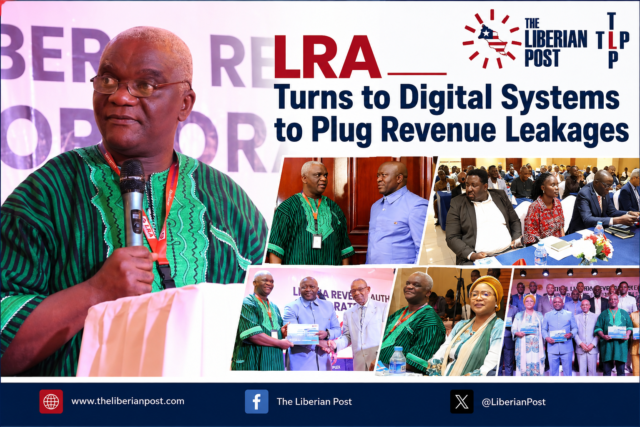
The milestone was highlighted during the launch of the LRA’s Corporate Strategic Plan 2025–2029, where Commissioner General James Dorbor Jallah presented a decade-long trajectory of rising domestic revenue collection and said the country could cross the billion-dollar mark within weeks.
If achieved, the milestone would represent a dramatic transformation in Liberia’s domestic resource mobilization capacity and provide the government with greater fiscal space to finance public priorities without relying as heavily on external assistance.
Jallah said the achievement should not, however, be viewed simply as a record-breaking collection figure.
“$1 billion is not a trophy. It is a toolbox.”
He added: “The billion is not the achievement. What the billion pays for is the achievement.”
The Commissioner General said the ultimate test of increased revenue collection is whether the additional resources translate into tangible improvements in the lives of Liberians, including clinics, classrooms, roads and other national priorities.

Revenue Collection Has Surged
The latest figures represent a significant increase from where Liberia stood a decade ago.
According to Jallah, domestic revenue collection stood at approximately US$464 million in 2014. By 2024, collections had climbed to US$699 million, before rising further to US$848 million in 2025 against a target of US$804.6 million.
The LRA’s performance in 2025 represented an important milestone in its own right. The Authority exceeded its annual target by more than US$43 million, continuing a trend of improved domestic resource mobilization. The LRA had previously reported that its 2025 collection was the highest level of domestic revenue ever recorded at that point.
By August 2026, the Authority had already moved beyond its entire 2025 collection, with collections reported at approximately US$912 million during the strategic-plan launch.
The LRA’s progress follows several years of efforts to strengthen tax administration, compliance, customs operations, digital systems and revenue enforcement.

Revenue-to-GDP Ratio Also Rising
Jallah also pointed to an improvement in Liberia’s domestic-revenue-to-GDP ratio.
The ratio increased from 13.4 percent in 2023 to 15.9 percent in 2025, with the LRA projecting it could reach 16.3 percent in 2026.
The indicator is important because it provides a broader measure of the government’s capacity to mobilize resources relative to the size of the economy.
For Liberia, where limited fiscal space has historically constrained government investment, a sustained increase could give policymakers greater room to fund public services and development programs.
The LRA has also previously linked its revenue gains to improvements in digital transformation, automation, data-driven compliance management and taxpayer services.

‘Freedom Declared’ Must Become ‘Freedom Financed’
Jallah framed the revenue drive as part of a much larger national objective: economic self-reliance.
In his remarks, he argued that Liberia’s political independence must ultimately be matched by the ability to finance its own priorities.
“Freedom declared is not the same thing as freedom financed.”
The argument reflects a growing emphasis by the government on domestic resource mobilization as a foundation for national development.
The ECOWAS representative at the launch similarly described domestic resource mobilization as a “bedrock of national sovereignty and sustainability,” emphasizing the importance of strengthening countries’ capacity to finance development from their own resources.
That message has become increasingly relevant as Liberia seeks to reduce vulnerabilities associated with external financing.

A Billion-Dollar Milestone With Bigger Expectations
Finance and Development Planning Minister Augustine Kpehe Ngafuan, speaking at the same event, warned that reaching US$1 billion should not become a reason for the government to relax its efforts.
Instead, he said the country must move into the billions and maintain the momentum.
“We have to split in the billions,” Ngafuan said, stressing that once Liberia crosses the threshold, “there shall be no turning back.”
The Finance Minister described the anticipated milestone as an achievement belonging to the Liberian people rather than to one government institution.
“That is an achievement of the Liberian people,” Ngafuan said.
His remarks underscore the government’s broader effort to make domestic revenue the foundation for an expanded national budget and development agenda.

The Real Test: What Happens to the Money?
While the US$1 billion threshold would represent an important fiscal achievement, the milestone also creates a new expectation for government: visible results.
Jallah’s “toolbox” analogy captures the central challenge.
More revenue means more potential resources for government—but it does not automatically guarantee better roads, stronger health services, improved schools or more reliable electricity.
The public will ultimately judge the significance of the milestone by what the additional revenue delivers.
That concern is particularly relevant as the government prepares its next budget and seeks to finance the ARREST Agenda for Inclusive Development, including infrastructure and other national priorities.
Ngafuan has already said the Ministry of Finance is preparing the 2027 national budget, with a working figure of approximately US$1.919 billion emerging during preliminary discussions as of August 15. He also acknowledged that spending requests from ministries, agencies and other government institutions continue to grow.
The growing revenue base could therefore provide critical fiscal space—but also comes with pressure to ensure that spending is disciplined and produces measurable results.

LRA’s Five-Year Transformation
The US$1 billion milestone is being pursued alongside the implementation of the LRA’s 2025–2029 Strategic Plan, which seeks to transform the Authority into a more modern, efficient and data-driven revenue institution.
The plan emphasizes improved compliance, stronger taxpayer services, institutional capacity, technology, data utilization and more effective revenue administration.
LRA leadership has also stressed a shift away from heavily manual systems toward automation and integrated information.
The objective is not simply to collect more money, but to build a revenue system in which compliance becomes easier, enforcement becomes more intelligent and leakages are reduced.
From Record Collection to Sustainable Revenue
Liberia’s current revenue trajectory is significant, but sustaining it may prove more difficult than reaching the first billion.
The LRA will need to broaden the tax base, maintain taxpayer confidence, improve compliance and continue modernizing customs and domestic tax administration.

At the same time, government will face pressure to demonstrate that higher revenue does not simply translate into higher recurrent spending.
The challenge is therefore twofold: First, sustain and expand the revenue gains.
Second, convert those gains into visible national development.
That is why Jallah’s warning that the billion-dollar figure is “not a trophy” may ultimately prove more important than the milestone itself.
Liberia is approaching a moment when the country’s domestic revenue capacity could fundamentally change the way government finances development.
But the measure of success will not ultimately be whether the country crosses US$1 billion.
It will be whether Liberians can see, feel and measure what that billion makes possible.
For breaking news, in-depth analysis, and exclusive reports from Liberia and around the world, follow The Liberian Post on Facebook (https://web.facebook.com/profile.php?id=61576017166570) and X, formerly Twitter (https://x.com/LiberianPost).