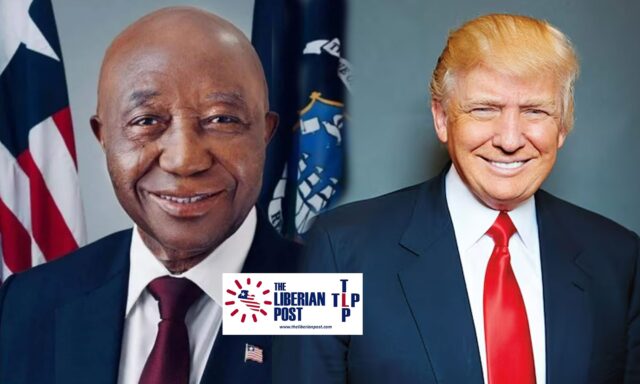
MONROVIA – US President Donald Trump will hold the inaugural African Leaders’ Summit of his second term next week in Washington, D.C., marking a watershed moment in his administration’s relationship with the continent.
Trump is hosting an African Leaders’ Summit is aimed at enhancing relations with African nations. Presidents from Gabon, Guinea-Bissau, Liberia, Mauritania, and Senegal are expected to discuss trade, security, and investment.
According to media sources confirmed by Semafor and first reported by Africa Intelligence, the summit will bring together heads of state from various Western and Central African countries for high-level discussions on trade, regional security, and investment.
Sources claim that Trump and presidents from Gabon, Guinea-Bissau, Liberia, Mauritania, and Senegal will attend the summit, which is reportedly scheduled for July 9–11, as seen on Reuters.
The declaration comes only days after President Trump secured a peace deal in Washington between Rwanda and the Democratic Republic of the Congo.
While the meeting will likely highlight US-Africa collaboration, it will also take place against the backdrop of an impending trade dispute.
In April, Trump proposed massive additional taxes on African imports under his “reciprocal trade” policy.
Tariffs range from 10% on items from Kenya, Ghana, and Ethiopia to a whopping 50% on Lesotho. South African exports would be subject to a 30% tariff under the scheme.
Tariffs were temporarily postponed for 90 days to enable negotiations with affected countries.
However, the grace period is coming to an end, and many African leaders arriving in Washington are anticipated to lobby the US administration for an extension or outright exemption.
A shift in US-Africa policy
Trump’s approach differs significantly from previous US administrations, which stressed aid and humanitarian assistance in their Africa policy.
Instead, Trump has viewed United States-Africa relations through a lens of economic self-interest, security, and transactional diplomacy.
In a statement on Tuesday, U.S. Secretary of State Marco Rubio stated that the United States will give preference to countries that exhibit “both the ability and willingness to help themselves” rather than a charity-based approach.
As part of the new plan for support on the continent, Troy Fitrel, a senior bureau official in charge of African Affairs, stated in May that U.S. envoys in Africa will be evaluated based on the commercial agreements they make.
Will Liberia Take Advantage of Trump’s ‘Commercial Opportunities’ Summit?
As the Trump’s Africa Summit set to take place next week in Washington DC, President Joseph Boakai and United States Ambassador to Liberia Mark Toner have reaffirmed the longstanding diplomatic and historical ties between Liberia and the United States.
This marks a renewed chapter in the relationship based on mutual economic interest, trade, and investment. The remarks were delivered during a ceremony commemorating the 249th Independence Day of the United States, held at the James E. Pierre Banquet Hall in Monrovia.
The event, organized by the U.S. Embassy, brought together senior members of the Liberian government, including House Speaker Richard Koon, high-ranking cabinet officials, members of the diplomatic corps, civil society actors, and private sector representatives.
In his keynote remarks, President Boakai paid tribute to the enduring U.S.-Liberia relationship, highlighting its origins in the settlement of freed African Americans in West Africa and the shared democratic values that have guided both countries for nearly two centuries.
The Liberian leader used the platform to declare a new direction for Liberia’s foreign policy, which he said will now focus primarily on economic diplomacy. According to him, this shift is intended to deliver more measurable benefits to the Liberian people by attracting investment and increasing trade.
He emphasized that Liberia’s foreign engagement strategy is evolving beyond traditional political alliances to include robust commercial and investment partnerships. The President highlighted sectors such as energy, infrastructure, digital innovation, and agriculture as critical areas of focus for economic transformation.
President Boakai welcomed the recent shift in U.S. foreign policy, which is now placing emphasis on commercial diplomacy. He described this change as both timely and strategic, stating that it aligns seamlessly with Liberia’s domestic economic priorities.
“It is therefore encouraging to note that the United States, through its Department of State, has recently unveiled a new foreign policy orientation centered on commercial diplomacy, a shift that aims to harness diplomacy to advance U.S. economic interests abroad while strengthening mutual prosperity with partner countries,” President Boakai added.
“As our two nations align our foreign policy priorities toward shared economic goals, we find ourselves at a unique moment—one that offers the promise of deeper cooperation, increased investment, and shared growth,” President Boakai noted.
“Let us seize this opportunity to build on the foundation of friendship that has endured for generations. Let us work together to create a future of mutual prosperity, where both our peoples can thrive.”
On his part, U.S. Ambassador Mark Toner, acknowledged the deep historical bond between the two countries and echoed President Boakai’s vision for a future rooted in shared economic prosperity.
Ambassador Toner emphasized that the United States is entering a new phase of its engagement with Africa, one that treats nations like Liberia as equal partners in trade and investment.
“We are engaging African nations, including Liberia, not as aid recipients, but as capable, commercial, and economic partners.”
The Ambassador further recognized Liberia’s recent election to a non-permanent seat on the United Nations Security Council, calling it a testament to Liberia’s growing role in global affairs and a reflection of its steady democratic progress.
He extended congratulations to President Boakai and his administration for leading the successful campaign, noting that Liberia’s presence on the Council would serve as a platform for advocating peace, human rights, and international cooperation.
Ambassador Toner also paid tribute to the contributions of the U.S. Agency for International Development (USAID), which has supported Liberia’s development goals for over six decades.
“USAID has been a critical partner in Liberia’s post-war recovery and democratic consolidation,” he noted. “For 64 years, USAID has helped strengthen Liberia’s institutions, improve public health, support agriculture, and advance education and civil society.”
The celebration, while ceremonial in tone, signaled a substantive shift in bilateral relations. It emphasized a move away from aid dependency and toward a partnership model rooted in investment, innovation, and mutual prosperity. Both leaders expressed optimism about this new direction and urged stakeholders in both nations to seize the moment.
This year’s theme, “Transitioning from Traditional Aid Frameworks to Commercial and Investment-led Diplomacy,” reflect both countries’ ambitions to redefine their relationship in a global economy that increasingly values shared economic interests.
The question now lingering on the minds of Liberians is whether the Government of President Joseph Nyuma Boakai will take advantage of the Trump’s African Leadership Summit next week to set the basis for more economic and commercial investment in Liberia that relying on the age-old US-aid dependency syndrome to truly signify a true independent nation. The ball is in the court of President Boakai and his Administration.
Ruling UP and Opposition CDC Partisans Debate Boakai’s Invite by Trump
The usual UP and opposition CDC partisans’ debate regarding the reigns of their respective political leaders have never seized with latest being the invite extended President Boakai and four other African presidents by US President Donald Trump.
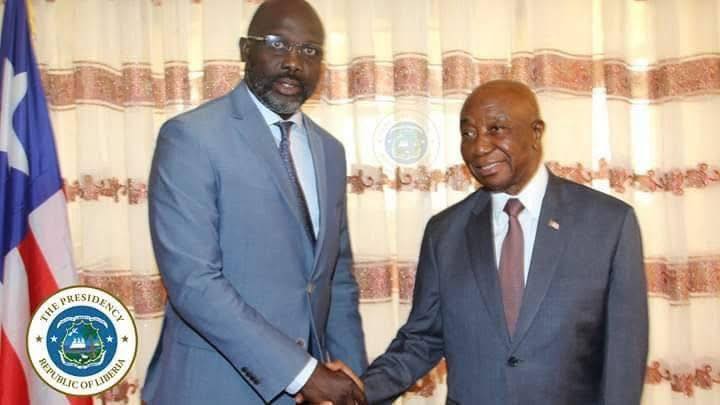
One UP supporter, Dexter Cassell, began his debate saying: “When I see CDCians parading George Weah’s photo, claiming he too was invited by the U.S. government, I can’t help but laugh.”
“Africa has 54 countries, and President Biden invited 49 heads of state, including former President Weah, to the U.S. However, on the very day Weah left the U.S., five key officials from his Administration—Nathaniel McGill, Sayma Syrenius Cephus, Bill Twehway, Samuel Tweah, and Jefferson Koijee—were slapped with U.S. sanctions for widespread public corruption.
“Are you aware that Linda Thomas-Greenfield, former U.S. Ambassador for African Affairs, then described corruption under Weah’s government as a ‘democracy killer’ and a ‘cancer’ that robs Liberian citizens?”
The American Enterprise Institute (AEI) further criticized Weah’s anti-corruption record, labeling it a serious decline and a grave crime.
The U.S. State Department’s decision to restrict visa issuance for Weah’s delegation during the 2022 UN General Assembly was a clear diplomatic rebuke of his government.
Reports of an invitation to Weah and his Minister of Justice by Langley (CIA Headquarters), rather than the State Department or the White House, were a diplomatic misstep for Liberia’s foreign record.
The U.S. Treasury’s Office of Foreign Assets Control imposed sanctions on Liberian officials under the Global Magnitsky Act, citing corruption under Weah’s government as a grave human rights abuse.
Laurent Delahousse, Head of the European Union Mission in Liberia, described Monrovia under Weah’s leadership as a ‘disgusting’ and ‘dirty’ city, stating, ‘Of all the capitals I have seen in my previous posts in Africa, I have not seen one as dirty as Monrovia,’ despite the significant financial aid provided to Liberia.”
In contrast, President Trump has invited only five African heads of state out of 54 African countries, including Liberia’s current President, Joseph Boakai. This selective invitation is not the same as Weah’s but is still significant to these 5 African countries.
Please remember that at the Official Inaugural Ball for President Joseph Boakai’s inauguration, Ambassador Linda Thomas-Greenfield remarked, “Mr. President, you have a big job ahead of you, and the United States looks forward to working closely with you as we strengthen the bonds between our two countries.” With renewed leadership, Liberia has the potential to be great again. Is left with you to say if George Weah coming back.”
As for J Jefferson Chesson of the opposition, he has a different view.
“As of the latest update (July 2025), there are no official reports confirming that U.S. President Donald Trump has recently invited five African heads of state including Joseph Boakai to an event. However, based on speculation or unconfirmed reports, Joseph Boakai has been invited by Trump. If this is true, here are reasons why Boakai might be selected.
Boakai might be invited because he’s weak and easily manipulated. Boakai’s government is incompetent, corrupt, and increasingly autocratic, perfect for a U.S. Administration that prefers pliable partners.
Under Boakai, Liberia faces rising political tensions, economic stagnation, and judicial repression, yet Trump sees this chaos as an opportunity to exploit.
The ugly truth is, Trump’s selection of Joseph Boakai exposes his contempt for African leaders and democracy. By excluding South Africa, Nigeria, Ghana, Trump signals he prefers autocrats who won’t challenge him.
Trump’s invite is not because Boakai is a good leader, he might invite him because he’s weak, corrupt, or ruthless enough to serve U.S. interests without question. This isn’t diplomacy; it’s exploitation.”
In spite of these debates that linger on for a long time, one thing that is clear is that Liberia will be represented in Washington DC next week on the invite of US President Donald Trump who wants African countries to do away with dependency syndrome and focus on commercial and economic opportunities that will drive their respective countries.
Liberia being part of this Summit shows a clear indication that indeed the tiny West African nation can gain positive lessons from the next week Summit in Washington DC, especially since the summit is focused on commercial and economic opportunities. The ball is in Liberia’s court.