President Joseph N. Boakai’s decision to sack the top leadership of the Liberia Drug Enforcement Agency (LDEA) and order a full review of its operations is not only timely—it is necessary. For too long, the agency charged with safeguarding Liberia from the scourge of illicit drugs has been plagued by inefficiency, infighting, and a startling lack of accountability.
The LDEA has not just failed to rise to the challenge—it has, in many ways, become a symbol of the dysfunction in Liberia’s security architecture. The agency’s repeated leadership crises, allegations of corruption, and public power struggles have made it less a protector of public health and safety, and more a cautionary tale of what happens when state institutions are allowed to rot from within.
President Boakai’s move, therefore, must be welcomed—but cautiously so. Dismissing officials and appointing an interim team signals urgency, but it is the follow-through that will determine whether this is a real turning point or just another reshuffle in a long line of superficial changes. As we have seen in time past that similar firing has been done in the past and nothing tangible changed at the agency.
The President’s directive for a 90-day comprehensive review offers a glimmer of hope. For the first time in years, there is an opportunity to not only diagnose what ails the LDEA but to fundamentally redesign it—from leadership culture and recruitment, to inter-agency coordination and community engagement.
However, reform cannot and must not stop at the top. The LDEA suffers from deep-rooted structural weaknesses: inadequate training, underfunding, political interference, and poor morale among rank-and-file officers. Its inability to coordinate effectively with other national security and health agencies has left Liberia exposed to the growing regional drug trade and a worsening public health crisis.
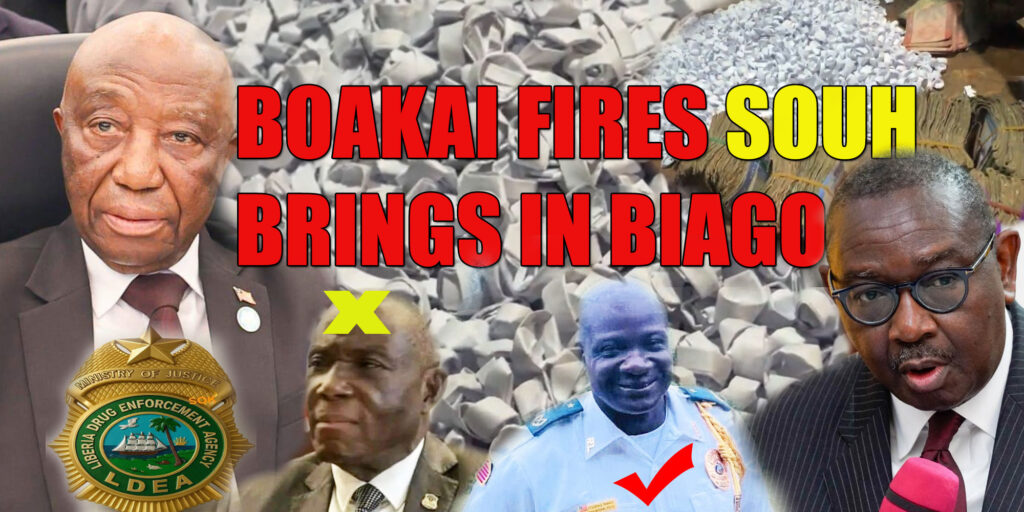
The interim team—drawn from the Liberia National Police and the National Security Agency—must prioritize professionalism and transparency. But beyond their technical mandates, they must help rebuild trust between the agency and the Liberian people, especially in communities hardest hit by drug abuse.
And there lies the deeper challenge. Liberia’s drug problem is not merely a law enforcement issue—it is a social crisis. Rehabilitation centers are scarce. Prevention programs are underfunded. Schools, families, and youth organizations lack the tools and support to shield young people from addiction and exploitation by drug networks.
So, while this purge at the LDEA is a necessary first step, it is not a solution in itself as we saw with the same purge of Col. Abraham Kromah and Fadiga. The real test of President Boakai’s leadership will be whether he can sustain the political will to see reform through to its roots, even when the headlines fade.
Liberia cannot afford another cycle of high-profile dismissals followed by business as usual. The country needs a competent, well-resourced, and accountable drug enforcement agency—but more importantly, it needs a national drug policy that is holistic, humane, and grounded in the realities of our communities.
Mr. President, you’ve opened the door. Now walk through it—and take the country with you.