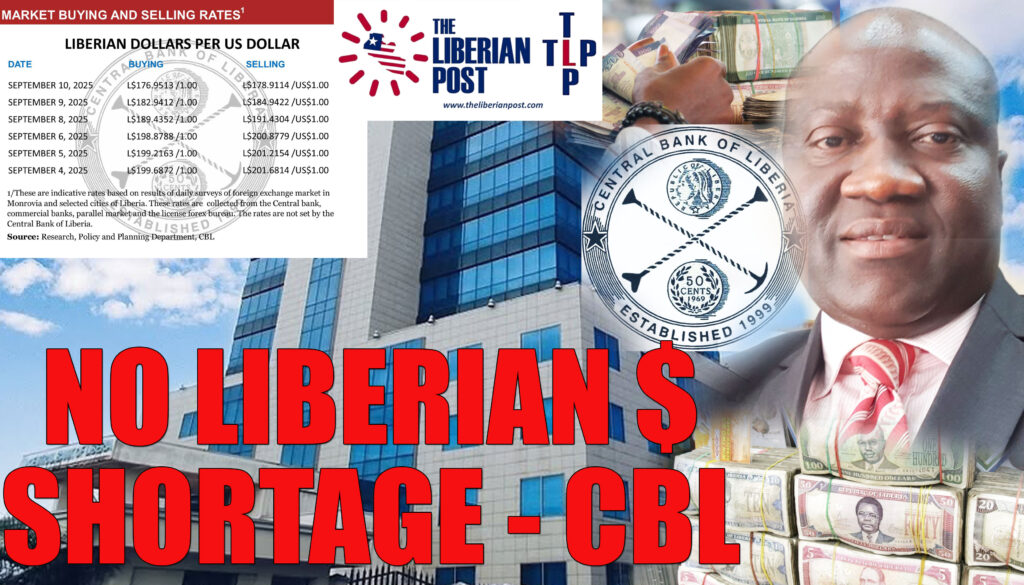
The Central Bank of Liberia (CBL) this week issued a strong public rebuttal to mounting concerns over a supposed shortage of Liberian dollars (LRD) in the market. It didn’t mince words: there is no shortage, and the public should dismiss rumors to the contrary. The CBL also highlighted a striking appreciation of the LRD against the U.S. dollar—over 10 percent in just one week—as evidence of policy effectiveness and economic recovery.
The Liberian Post applauds the Central Bank for its transparency, timeliness, and public engagement. In a time when information—whether factual or false—travels at the speed of a WhatsApp message or a message posted on social media, the Bank’s decision to speak directly to the public is welcome and necessary.
But the task at hand is not only one of technical reassurance. It is one of restoring trust in a currency system that has, over the years, suffered from chronic volatility, public skepticism, and systemic weaknesses.
Beyond the Numbers: The Public’s Lived Experience
Yes, the numbers tell a promising story. Commercial banks reportedly hold L$1.65 billion in vault cash. Excess reserves have nearly doubled compared to the same time last year. Inflation is declining. The exchange rate is strengthening.
But these are macro indicators—and while essential, they do not always reflect the experience of ordinary Liberians navigating markets, paying school fees, or waiting in ATM lines that mysteriously run dry just when salaries are due.
Too often, Liberians have heard similar reassurances while simultaneously struggling to access their own money in local currency or the USD. This disconnect breeds the very speculation and panic that the Bank seeks to eliminate.
In this regard, the perception of scarcity can become just as damaging as scarcity itself. And perceptions are shaped by personal experience, not press releases.
What Explains the Currency Surge?
The sudden appreciation of the LRD—by over 10 percent in one week—is unusual, even for a market accustomed to swings. The CBL attributes it to a combination of tight monetary policy, record-high remittance inflows, improved road access to rural markets, and a drop in inflation.
This is plausible. But it also raises a critical question: Is this appreciation sustainable, or is it an overcorrection fueled by short-term speculation and hoarding behavior in reverse?
If the appreciation is a bubble, it will burst—and the consequences could be just as disruptive as the depreciation that Liberians have long feared. The Bank must not only monitor these trends but also communicate clearly about what is driving them and what corrective measures are in place to avoid volatility.
Rebuilding Confidence: The Longer Game
To its credit, the CBL has undertaken a number of institutional reforms in recent years—from digitizing payments and launching new currency notes to tightening monetary policy and introducing the Pan-African Payment and Settlement System (PAPSS). These are not cosmetic tweaks; they are structural efforts that deserve recognition.

However, the battle for confidence in the Liberian dollar will not be won in a single news cycle. It will take consistent performance, transparent reporting, and meaningful engagement with the public—particularly with those who live outside Monrovia and are most vulnerable to cash disruptions.
It also requires the government as a whole—not just the Central Bank—to align its fiscal policies, limit unplanned borrowing, pay public workers on time, and ensure that political actions do not undercut economic progress.
A Word of Caution—and Encouragement
The CBL’s proactive stance is commendable, but it must avoid the trap of declaring victory too early. Rumors do not spread in a vacuum—they reflect fears born out of experience. Dismissing them without addressing the root causes—cash distribution bottlenecks, uneven bank access, and poor rural connectivity—will only delay the problem, not solve it.
That said, Liberia may be turning a corner. A stronger local currency, declining inflation, and healthier reserves are all cause for cautious optimism. But the road to a stable currency is a long one—and it runs through the hearts and wallets and handbags of the people.
Trust must be earned—not announced. And now more than ever, the Central Bank must continue to do the hard work of earning it, one policy action and one citizen at a time.