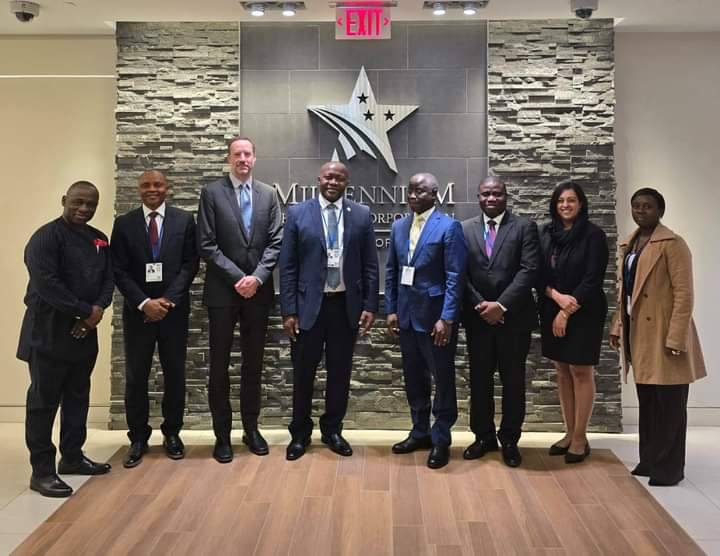
On today, Monday, September 22, Liberia will once again welcome a high-level delegation from the U.S. Government’s Millennium Challenge Corporation (MCC), this time to evaluate the country’s readiness for a potential second compact. Led by Ms. Carrie Monahan, MCC’s Managing Director for Africa, the visit is more than just a routine check-in. It is a pivotal moment that could determine whether Liberia secures another round of transformational funding at a time when our economy is searching for renewed momentum.
The MCC is no stranger to Liberia. In 2015, the first compact—valued at US$257 million—delivered tangible results that are still felt today. From the rehabilitation of the Mount Coffee Hydropower Plant, which restored reliable electricity after decades of war-induced darkness, to the establishment of the Liberia Electricity Regulatory Commission and support for road maintenance and capacity building, the compact strengthened the backbone of Liberia’s economy. For thousands of homes and businesses, the return of electricity was not just a convenience; it was a lifeline that powered hospitals, fueled industries, and offered students a chance to study at night.

Yet, as impactful as the first compact was, its duration was short, and much work remains undone. Liberia’s infrastructure gap remains daunting, with limited access to affordable energy, weak road networks, and underdeveloped systems that stifle both private sector growth and job creation. This is why the second compact, if approved, could be a game-changer. The MCC’s diagnostic approach—through its Constraints Analysis—will help identify sectors where Liberia’s growth potential is greatest and where U.S. investment can make the biggest difference.
Equally important is the timing. Liberia is grappling with fiscal pressures, donor fatigue, and an urgent need to show progress in governance and transparency. A second MCC compact would not only bring much-needed capital but also reinforce the principle that good governance and accountable leadership are prerequisites for development partnerships. The MCC model is not a giveaway—it is a contract built on performance, where funding is tied to reforms and measurable outcomes.
For Liberia, the stakes are clear. Another compact could mean scaled-up investments in energy expansion, stronger support for roads and transport systems, or even interventions in agriculture and human capital that directly lift communities out of poverty. It could also signal to other development partners and investors that Liberia remains a viable destination for long-term, results-driven engagement.
As the MCC team begins its engagements in Monrovia, the burden rests on Liberia’s leadership to demonstrate seriousness, transparency, and a readiness to manage resources responsibly. Our track record under the first compact provides a solid foundation. But this time, Liberia must aim higher: ensuring that the benefits of the compact touch not just the capital but every corner of the country where poverty still grips families and opportunity feels out of reach.
The arrival of the MCC delegation is therefore not just another diplomatic visit—it is a test of Liberia’s readiness to embrace accountability, reform, and growth. The compact is not guaranteed; it must be earned. Liberia has shown before that it can deliver results under MCC partnership. The challenge now is to prove that we can do it again, and this time, to expand the impact even further.