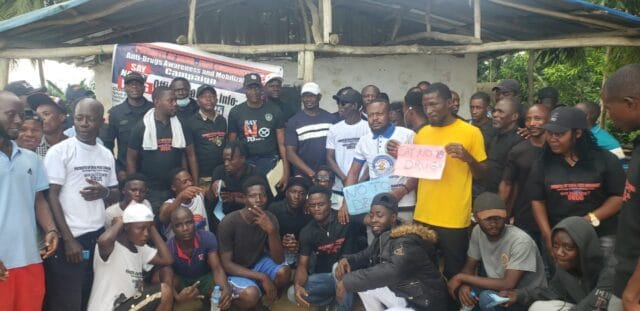
CAREYSBURG, MONTSERRADO COUNTY – In a powerful show of community unity, residents of Montserrado County District Number One, together with government officials, security agencies, and civil society actors, officially launched the “Say No to Drugs” campaign over the weekend. The initiative seeks to tackle the growing threat of illicit drug use and trafficking across Liberia.
The campaign, led by the Patriots of Drug-Free Communities, was formally unveiled in Careysburg and received strong backing from the Liberia Drug Enforcement Agency (LDEA), the Liberia National Police (LNP), and the office of Representative Rugie Yatu Barry.
“This is not about blame. This is about action,” campaign organizers emphasized during the launch.
A Community-Level War Against Drugs
Speaking on behalf of Representative Barry, Special Assistant Garrison Kerwillain Sr. urged citizens to take personal responsibility in combating drug abuse, describing it as a “community-level war.”
“To our brothers and sisters caught in the web of drug use or abuse, there is still hope. You are still a part of this community, and we have not forgotten you,” Kerwillain said. He also expressed disappointment over the absence of several community leaders despite prior notifications about the launch.
“When drug abuse begins to affect our communities, it doesn’t start in Monrovia; it starts right at home, in our own backyards. Yet when the crisis escalates, that’s when people call on the LDEA or the Representative. This must change,” he stressed.
LDEA Pledges Full Support
Deputy Commissioner of Police Patrick Kormazu, representing LDEA Officer-in-Charge DCP Fitzgerald T. Biago, reaffirmed the agency’s commitment to the campaign.
“Drugs are a national crisis. It is a pandemic that affects families, communities, and ultimately the future of our country. We at the LDEA cannot win this war alone,” Kormazu said, highlighting the need for close collaboration and intelligence-sharing between community members and law enforcement.
He added that much of the illicit substances entering Liberia originate from neighboring countries, making community vigilance essential in curbing trafficking.
A Movement Rooted in Hope and Recovery
The launch was led by Mrs. Pauline Zaza, Acting Chairperson of the Patriots of Drug-Free Communities, who declared the campaign “a movement, not just an event.”
“We are not just raising our voices; we are launching a movement of recovery, prevention, empowerment, and hope,” Zaza said. She outlined plans to provide rehabilitation, vocational training, and societal reintegration programs for individuals struggling with addiction.
Clad in symbolic black-and-white T-shirts marked with streaks of red paint to represent the pain of communities ravaged by drugs, participants underscored their commitment to giving recovering addicts a second chance.
Unity and Action at the Grassroots
Journalist Willie N. Tokpah Sr., the vision bearer behind the campaign, praised the collaborative effort of government agencies, traditional leaders, and community members. He also honored victims and survivors of drug abuse, saying, “Your resilience inspires the very essence of our work.”
Community members were encouraged to identify drug hotspots and actively partner with law enforcement to dismantle networks targeting young people.
“You know where the ghettos are. You know the dealers. And yet, when it comes to action, we hesitate. That must end today,” Kerwillain urged.
Looking Ahead
Organizers stressed that the “Say No to Drugs” campaign is an ongoing initiative. Strategic roundtable discussions are planned in the coming weeks to develop sustainable, actionable solutions.
“Let this day be the spark that lights a fire of change in every street, in every home, in every heart,” Zaza concluded. “Together, we say: Say No to Drugs. Together, we rise.”
Dennis Jlaty Blay Jr., President of the Liberia Medical Students Association, also pledged his organization’s support, noting the importance of health education and annual medical check-ups as part of a holistic approach to community well-being.