MONROVIA – As the world prepares to celebrate Mother’s Day, May 10, 2026, Liberia now has a powerful reason to honor not only the sacrifices of mothers, but also the historic legal recognition of their equal right to pass on their Liberian citizenship to their children at birth, irrespective of the pigmentation or citizenship of the father.
For decades, Liberia stood among more than two dozen countries around the world whose nationality laws discriminated against women, according to United Nations High Commission of Refugees (UNHCR). Under the old provisions of the Alien and Nationality Law, only Liberian fathers could automatically transfer citizenship to children born outside Liberia. Liberian mothers could not. That painful legal imbalance left thousands of children vulnerable to statelessness—a condition in which a person is not recognized as a citizen by any country.
Statelessness is more than a legal term. It is a human tragedy.
A stateless child may struggle to obtain birth certificates, attend school, access healthcare, secure employment, travel, or even prove his or her existence before the law. Across the world, stateless people often live on the margins of society, deprived of rights many others take for granted.
For many Liberian women living in exile or married to foreign nationals, the old law was deeply heartbreaking. A Liberian father could proudly pass his identity to his child. A Liberian mother could not.
The consequences became painfully visible during Liberia’s years of civil conflict and displacement, when thousands of Liberian women fled abroad and gave birth outside the country. According to the United Nations High Commissioner for Refugees (UNHCR), Liberia once had nearly 3,200 children outside the country and about 4,000 within Liberia who were potentially stateless because of nationality restrictions affecting women.
One widely cited example was that of a Liberian mother, Georgia Gage, whose children were born in Nigeria to a Nigerian father who later died. Without proper documentation or nationality recognition, the children faced uncertainty about their legal identity and future.
For years, international organizations, women’s rights groups, legal advocates, and civil society organizations, including the All-Liberian Conference on Dual Citizenship (ALCOD), campaigned for reform. ALCOD’s campaign was championed by its eminent Chairman, Mr. Emmanuel S. Wettee.
The UNHCR, ALCOD, and others repeatedly called on Liberia to remove the gender discrimination from its nationality law, arguing that denying mothers equal nationality rights violated international human rights standards and increased the risk of childhood statelessness.
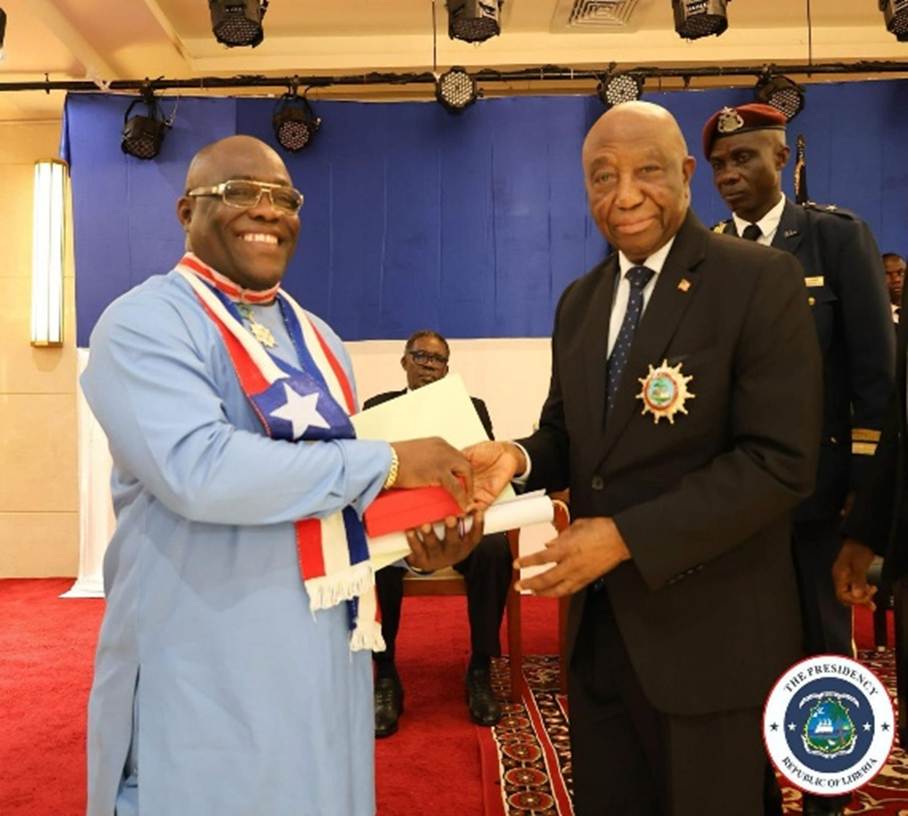
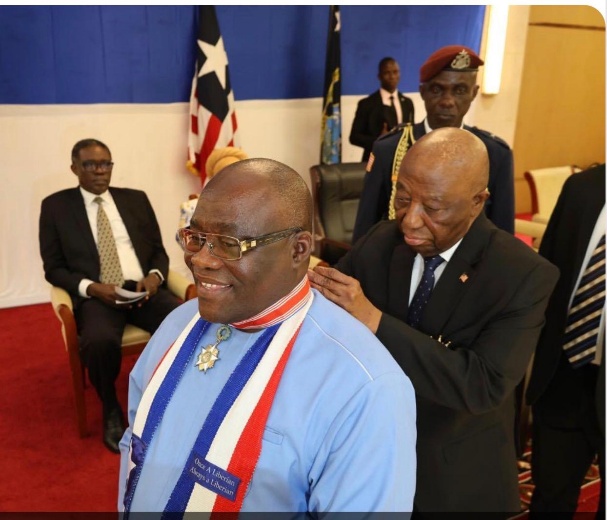
Grand Master, admitted Eminent Emmanuel S. Wettee into the Humane Order of African Redemption
with the rank of Knight Commander for leading the advocacy for Dual Citizenship and removing gender
discrimination in 1973 Aliens and Nationality Law , allowing a Liberian Mother to pass their citizenship
over to their children at birth
Liberia had already committed itself internationally by acceding to major global treaties, including the 1954 Convention relating to the Status of Stateless Persons and the 1961 Convention on the Reduction of Statelessness.
The breakthrough finally came when, following years of pressure and advocacy from ALCOD, dual citizenship advocates, the executive branch of government and others, that resulted to the 54th Legislature amending the 1973 Alien and Nationality Law, removing gender discrimination. This new bill became the law of the land when it was signed on July 22nd, 2022.
The amendment was more than a legal correction. It was a moral victory.
Today, Liberian mothers can finally transmit their citizenship to their children at birth, just as fathers can. In practical terms, this means thousands of children now have a clearer path to Liberian citizenship, identity, legal protection, and belonging. UNHCR praised the government of Liberia for removing gender discrimination in their law.
As Mother’s Day approaches, this reform stands as one of Liberia’s most meaningful tributes to motherhood and gender equality and above the struggle for women to gain equal rights in Liberia.
A mother gives life, protection, love, and sacrifice. She should never be denied the right to also give identity.
Liberia’s decision corrected a historic injustice and aligned the country with modern democratic values and international human rights standards. It also sent a broader message: that citizenship should not depend on whether one’s Liberian parent is male or female.
For many Liberian mothers across the diaspora, that change was not merely administrative. It was deeply personal.
It meant recognition. It meant dignity. And for countless children, it meant finally belonging to Liberia.
Happy Mother’s Day from ALCOD!
About ALCOD: The All‑Liberian Conference on Dual Citizenship is a coalition of diaspora organizations and activists that campaigned for more than a decade to reform Liberia’s restrictive nationality laws. Its advocacy helped secure the 2022 amendments recognizing dual citizenship for Liberians by birth. It is inclusive of European Federation of Liberian Associations (EFLA), Conference of Liberian Organizations in Southwestern United States (COLOSUS), Liberians Advocacy for Change (LAFC), Federation of Liberian Communities in Australia (FOLICA), and United Liberian Associations of Ghana (ULAG).
Follow The Liberian Post on Facebook and X (formerly twitter)