By Seltue Robert Karweaye Sr.
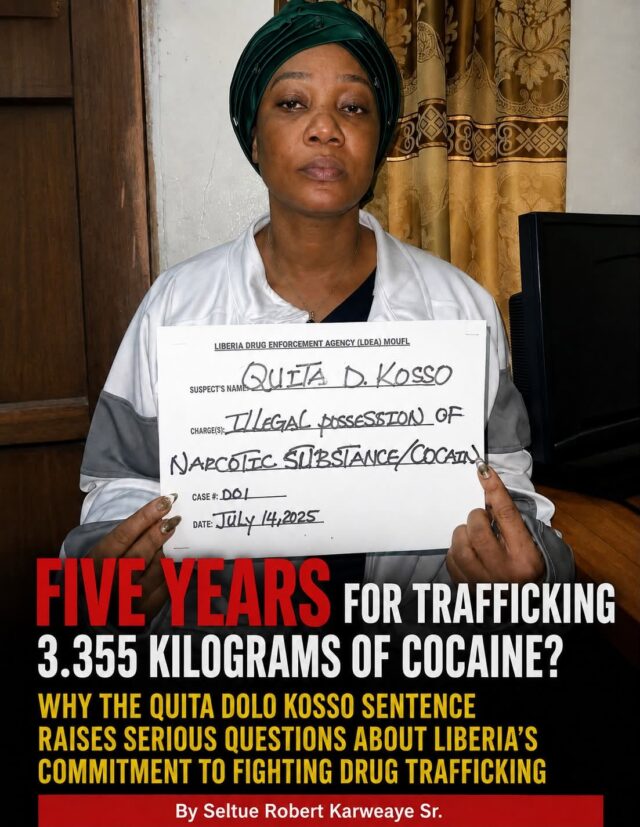
The five-year prison sentence imposed on Quita Dolo Kosso has raised legitimate questions about whether Liberia’s justice system is applying the country’s anti-drug laws consistently and whether the punishment reflects the gravity of the offense.
According to the facts presented in court, Dolo was arrested on July 12, 2025, at Roberts International Airport after arriving aboard a Kenya Airways flight from Bangkok, Thailand. Officers of the Liberia Drug Enforcement Agency (LDEA) discovered approximately 3.355 kilograms of cocaine concealed in her luggage. The narcotics carried an estimated street value of US$181,008.
Initially, Dolo claimed that the suitcase had been given to her by a friend in Thailand and that she believed it contained only clothing. She later entered into a plea agreement with state prosecutors and pleaded guilty to drug trafficking charges. Resident Judge Victoria Worlobah Duncan subsequently sentenced her to five years’ imprisonment.
That sentence raises an important legal and public policy question: Does a five-year prison term reflect the punishment envisioned under Liberia’s Controlled Drugs and Substances Act for importing and trafficking kilograms of cocaine into the country?
Liberia strengthened its anti-drug legal framework when the Controlled Drugs and Substances Act was amended in 2023. Those amendments were intended to confront the country’s growing role in international narcotics trafficking by imposing tougher penalties on major drug offenders.
The law draws a clear distinction between individuals involved in personal drug use and those engaged in commercial drug-related crimes.
For minor possession and personal use, the Act provides relatively lighter penalties and, in appropriate cases, encourages treatment and rehabilitation.
For major offenses—including trafficking, importation, manufacturing and cultivation—the law is considerably stricter. These crimes are classified as non-bailable first-degree felonies, carrying prison terms of 10 to 20 years, together with the possible forfeiture of property used in the commission of the offense and other penalties authorized by law.
On its face, transporting 3.355 kilograms of cocaine across international borders appears to fall squarely within the category of importation and trafficking rather than personal possession. The quantity involved was substantial, the drugs were allegedly concealed in luggage arriving from overseas, and their estimated street value exceeded US$181,000.
These are precisely the types of offenses the amended law sought to punish severely.
If the statutory sentencing range for trafficking is indeed 10 to 20 years, then the imposition of a five-year sentence naturally invites scrutiny. Unless another provision of Liberian law or the court-approved plea agreement expressly authorized a sentence below the statutory minimum, many Liberians are justified in asking whether the punishment is consistent with both the letter and the intent of the law.
Plea bargaining plays an important role in criminal justice systems. It encourages guilty pleas, conserves judicial resources, spares victims and witnesses lengthy proceedings, and assists prosecutors in resolving cases efficiently. However, plea agreements should not undermine mandatory sentencing provisions enacted by the Legislature. A negotiated plea should not become a mechanism for routinely reducing penalties in cases involving serious international drug trafficking if doing so conflicts with statutory mandates.

Liberia is confronting an unprecedented narcotics crisis. In recent years, authorities have intercepted record quantities of cocaine, dismantled alleged international trafficking networks, and uncovered alleged links between transnational drug syndicates and individuals within state institutions. These developments pose significant threats to national security, public health, economic stability and Liberia’s international reputation.
At such a critical moment, sentencing carries consequences far beyond the fate of any single defendant.
Strong and consistent sentences can serve as a deterrent to organized criminal networks. Conversely, weak or inconsistent sentencing may create the perception that Liberia is not fully committed to enforcing its own anti-drug laws. International trafficking organizations continually assess the legal risks associated with operating in different jurisdictions. If traffickers come to view Liberia’s penalties as negotiable or inconsistently applied, the country could become an even more attractive transit point for global narcotics operations.
Justice must be fair, but it must also be consistent and predictable. Citizens should be able to trust that similar crimes receive similar punishments under the law. Any perception that mandatory penalties are selectively reduced risks eroding public confidence in both the judiciary and the broader criminal justice system.
This debate is not merely about one defendant. It is about preserving the integrity of Liberia’s legal system and ensuring that laws enacted to protect the public are enforced as intended.
If the law mandates a sentence of 10 to 20 years for trafficking and importing large quantities of cocaine, then courts should faithfully apply that law unless a legally authorized exception clearly exists. If such an exception formed the legal basis for this sentence, the judiciary and the prosecution should publicly explain it to preserve confidence in the administration of justice and demonstrate that the rule of law has been faithfully observed.
Liberia’s fight against drug trafficking cannot be won through legislation alone. It requires consistent enforcement, prosecutorial integrity and judicial decisions that reinforce—not weaken—the rule of law.
The battle against international narcotics trafficking demands certainty, accountability and sentences that reflect both the seriousness of the crime and the clear intent of the Legislature. Anything less risks undermining the very reforms designed to protect Liberia from becoming a haven for transnational drug cartels.
For breaking news, in-depth analysis, and exclusive reports from Liberia and around the world, follow The Liberian Post on Facebook (https://web.facebook.com/profile.php?id=61576017166570) and X, formerly Twitter (https://x.com/LiberianPost).