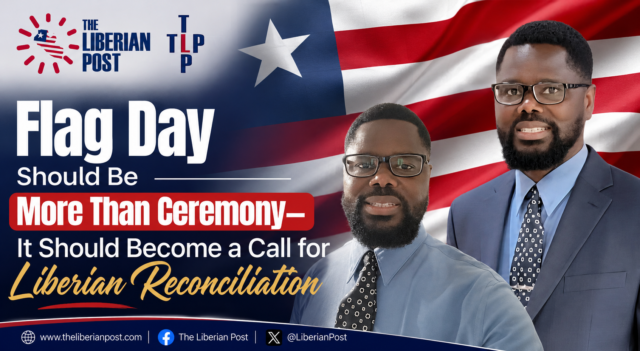
–Diaspora Advocate James Jornyoun Urges Liberians Abroad to Turn August 24 From Patriotic Celebration Into a “Foundation for Peace”
MONROVIA, Liberia — As Liberia prepares to observe National Flag Day on August 24, diaspora advocate and author James Jornyoun is calling on Liberians living abroad to move beyond speeches, ceremonies and displays of the Lone Star and use the national observance as an opportunity to confront divisions that continue to follow Liberians beyond the country’s borders.
In an article titled “Flag Day Should Be a Foundation for Peace Among Liberians in the Diaspora,” Jornyoun argues that the annual celebration should become a deliberate moment for reconciliation, civic responsibility and renewed commitment to national unity.
His central question is direct:
“What good is a flag if the people who claim it cannot make peace with one another?”
For Jornyoun, Flag Day should not simply commemorate Liberia’s national symbol. It should force Liberians—particularly those in diaspora communities—to examine whether political, ethnic, county, generational and personal divisions that have troubled the country are being reproduced in communities abroad.
He argues that Liberia’s flag should serve as a unifying covenant rather than merely a patriotic decoration, and that the diaspora has an opportunity to transform August 24 into an annual exercise in civic reconciliation.
The History Behind Liberia’s Lone Star
Flag Day is observed annually on August 24, commemorating the adoption of Liberia’s national flag in 1847, shortly after the country declared independence on July 26 of that year. The flag was first hoisted on August 24, 1847.
According to Liberian government accounts, the national flag was designed and produced by a committee of women led by Mrs. Susannah Lewis. The Ministry of Foreign Affairs describes the creation of the flag as a historic event connected to Liberia’s emergence as an independent African state and its place in the wider struggle for self-determination.
The design consists of 11 horizontal stripes—six red and five white—with a blue square in the upper-left corner containing a single white star.
Liberian government proclamations explain that the 11 stripes represent the 11 signers of Liberia’s Declaration of Independence. The single white star represented Liberia as the then-independent state on the African continent, while the colors carry historical and patriotic meanings associated with the nation’s founding.
The flag was deliberately related to the American Stars and Stripes, reflecting Liberia’s historical connection to Black settlers and formerly enslaved people from the United States and the Caribbean. Liberia’s earlier colonial flag had also resembled the U.S. flag but featured a cross in the canton; the design adopted in 1847 replaced that symbol with the single star.
The flag’s adoption therefore came at a defining moment in Liberian history: 22 days after independence had been declared, the new republic publicly unveiled the national symbol that would represent its sovereignty.
From National Symbol to National Responsibility
For Jornyoun, that history gives Flag Day a significance that extends well beyond the raising of flags.
He describes the Liberian flag as “a national covenant stitched from sacrifice, hope, and unfinished responsibility.”
The argument is particularly directed at Liberians living outside the country.
According to Jornyoun, many of the divisions that damaged Liberia did not disappear when Liberians left the country. Instead, they were carried into foreign cities and reproduced through community associations, churches, family gatherings, political organizations and social media.
He identifies county loyalties, ethnic suspicions, partisan rivalries, generational misunderstandings and memories of conflict as among the forces that can continue to divide Liberians abroad.
His concern is that physical distance from Liberia has not necessarily produced emotional or political distance from the country’s unresolved divisions.
“We may live far from Liberia, but too many of our arguments still sound painfully close to home.”
Jornyoun Wants Flag Day Recast as a Day of Reconciliation
Jornyoun proposes that August 24 become more than a patriotic observance for diaspora communities.
He wants it transformed into an annual day of civic reconciliation, involving Liberian associations, churches, youth groups, women’s organizations, elders, professionals and community leaders.
At the center of his proposal is a simple principle:
“Liberia is bigger than any political party, county, tribe, organization, personal dispute, or old bitterness.”
He argues that reconciliation should not mean erasing Liberia’s painful history.
Many Liberians, he notes, carry memories of war, displacement, loss, betrayal and disappointment. Some left the country with little more than a suitcase, while others have established new lives abroad while continuing to carry grief, homesickness and unresolved memories.
For Jornyoun, reconciliation does not require people to forget the past.
Instead, it requires the discipline to tell the truth without hatred, seek accountability without revenge and disagree without destroying community relationships.
From Celebration to Action
Jornyoun is also calling on diaspora organizations to make reconciliation tangible.
He proposes that Flag Day programs include:
- honest community reflection;
- public commitments to reject destructive divisions;
- recognition of individuals who build bridges across political, religious, regional and generational lines; and
- local mechanisms for resolving disputes before they become entrenched.
He suggests that diaspora communities establish local peace committees to mediate disputes and teach younger Liberians that the national flag represents responsibility as much as identity.
He also sees Flag Day as an opportunity for diaspora communities to connect patriotism with service.
Among his suggestions are scholarship drives, food distribution, health outreach, school-supply campaigns and other forms of support for communities in Liberia.
The underlying message is that national unity should be demonstrated through repeated acts of service and trust rather than confined to ceremonial speeches.
Diaspora Leaders Urged to Lower the Political Temperature
Jornyoun places particular responsibility on community leaders.
He argues that leaders have the ability either to heal wounds or reopen them, depending on how they use their platforms.
“Their organizations can become bridges or battlegrounds.”
He is therefore urging diaspora leaders to lower the temperature of political debate while raising the standard of civic conduct.
Political disagreement, he argues, is not inherently incompatible with peace.
Liberians should be able to hold strong political convictions without allowing those convictions to become personal attacks, community warfare or permanent hostility.
“The Lone Star should call Liberians back to a better standard: firm in conviction, gentle in speech, honest in debate, and loyal to the common good.”
A Message for Liberia’s Young Generation
Jornyoun’s appeal also focuses heavily on young Liberians growing up abroad.
He warns against allowing a new generation to inherit the unresolved quarrels of previous generations.
Young Liberians, he argues, should not be raised on stories centered exclusively on betrayal, exclusion and distrust.
Instead, they should inherit a broader understanding of Liberia built around courage, culture, service, forgiveness and hope.
He warns that teaching children to love Liberia while simultaneously modeling contempt for fellow Liberians would undermine the very patriotism adults claim to be passing on.
That concern gives the Flag Day debate a generational dimension: what kind of Liberia will today’s diaspora communities transmit to their children?
‘One Flag, One People, One Future’
Jornyoun argues that reconciliation must be more than a slogan.
He compares peacebuilding to the foundation of a building: it may be hidden from view, but everything else depends upon it.
He wants diaspora communities to use August 24 to make a public commitment:
“Under this flag, we will not make enemies of one another. We will disagree without destroying. We will compete without humiliating. We will remember without hating.”
That proposed commitment is at the heart of his argument.
The flag, in this interpretation, is not simply a symbol of the country Liberians left behind.
It represents a responsibility that Liberians continue to carry regardless of where they live.
A National Symbol With a Complicated History
The call for reconciliation comes against the backdrop of Liberia’s own complicated history.
The Lone Star emerged in 1847 as the symbol of a new independent republic whose founders sought to establish a sovereign state on the African continent.
Its design incorporated familiar elements associated with the United States while creating a distinctly Liberian national identity: 11 stripes instead of the American flag’s 13, and one star instead of multiple stars. The star was associated with Liberia’s status as an independent African republic.
The Liberian government continues to describe the flag as evidence of the nation’s sovereignty and independence and as a symbol of national pride and dignity.
Flag Day itself became an official national holiday after the Legislature approved an Act on October 25, 1915, declaring August 24 of each year National Flag Day.
More than a century later, the day remains an important expression of national identity.
But Jornyoun is challenging Liberians to ask whether the meaning of that identity is reflected in how citizens treat one another.
The Choice Before Liberians
As August 24 approaches, Jornyoun frames Flag Day as a choice between simply remembering Liberia and actively helping shape its future.
“Flag Day is not only a date on the calendar. It is an invitation from history and a plea from the future.”
He argues that the diaspora can use its distance from Liberia not as an excuse to remain trapped in old conflicts, but as an opportunity to build healthier relationships.
His appeal is ultimately about converting patriotism into conduct.
Peace, he says, is not weakness. Unity is not surrender. Reconciliation is not forgetting.
Instead, peace requires the strength to build together after suffering; unity requires choosing country over conflict; and reconciliation requires confronting the past without becoming prisoners of it.
As Liberia prepares to raise the Lone Star on August 24, Jornyoun’s challenge to Liberians abroad is therefore straightforward:
If the flag represents Liberia, then honoring the flag must also mean honoring the people who share it.
For the diaspora, he argues, this year’s Flag Day can become more than a celebration of what Liberia was.
It can become a commitment to what Liberians want Liberia—and Liberian communities around the world—to become.
For breaking news, in-depth analysis, and exclusive reports from Liberia and around the world, follow The Liberian Post on Facebook (https://web.facebook.com/profile.php?id=61576017166570) and X, formerly Twitter (https://x.com/LiberianPost).