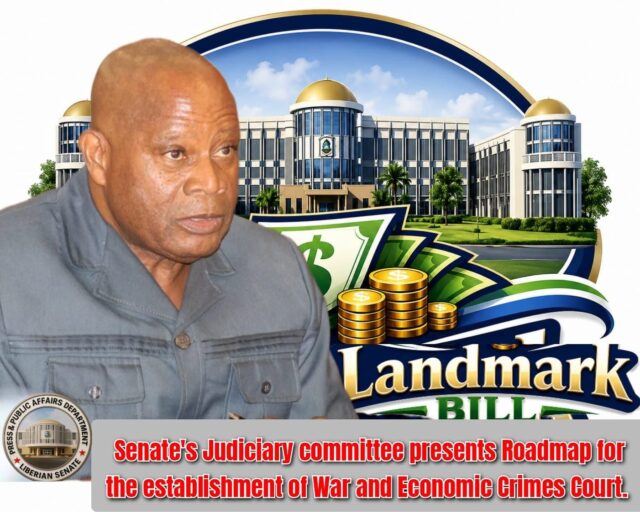
-Judiciary Committee Proposes Inclusive Review Process for Two Landmark Justice Measures
MONROVIA – In a significant move aimed at advancing accountability, justice, and the rule of law in Liberia, the Senate Committee on Judiciary, Human Rights, Claims and Petitions has submitted a comprehensive roadmap to guide the Senate’s review and harmonization of two landmark legislative proposals: the Bill for the Establishment of a Special Economic and Corruption Crimes Court and the Bill for the Establishment of a Special War and Economic Crimes Court.
The roadmap was presented to the Senate on Tuesday, June 16, 2026, by Senator Cllr. Augustine S. Chea, Chairman of the Committee, who described the initiative as a critical step toward ensuring a transparent, inclusive, and legally sound process for addressing some of Liberia’s most pressing accountability challenges.
According to Senator Chea, the proposed framework is intended to reconcile and harmonize the provisions of the two bills while addressing any legal, constitutional, procedural, and institutional issues that may arise during legislative deliberations.
He emphasized that both bills carry profound national significance, touching on Liberia’s longstanding efforts to combat corruption and address accountability for atrocities and economic crimes committed during the country’s years of civil conflict.
“The objective is to ensure a thorough, transparent, and inclusive legislative process that reflects the aspirations of the Liberian people for justice, accountability, and good governance,” Senator Chea told his colleagues.
Key Components of the Roadmap
The roadmap outlines a multi-stage review process designed to ensure broad stakeholder participation and careful legal scrutiny before any final legislative action is taken.
Among its major components are:
Comprehensive Legal Review
The Committee will conduct an extensive examination of the constitutional, statutory, and international legal implications of both bills to ensure consistency with Liberia’s laws and treaty obligations.
Stakeholder Consultations
The process will include consultations with a broad range of stakeholders, including government institutions, civil society organizations, the Liberia National Bar Association, human rights advocates, victims’ groups, development partners, and members of the public.
Nationwide Public Hearings
Public hearings are expected to be conducted across Liberia’s 15 counties to gather citizens’ views, concerns, and recommendations on the proposed courts and their mandates.
Comparative Analysis
The Committee will review experiences from other countries that have established anti-corruption courts, war crimes tribunals, and hybrid justice mechanisms to identify best practices and lessons applicable to Liberia.
Technical Harmonization
A detailed harmonization process will be undertaken to eliminate conflicting provisions, clarify jurisdictional mandates, and ensure that the proposed courts complement Liberia’s existing judicial system.
Final Report and Recommendations
Following consultations and reviews, the Committee will prepare a comprehensive report containing findings and recommendations for submission to Senate Plenary for debate, possible amendment, and final legislative consideration.
Commitment to Due Process and Fairness
Addressing members of the Senate, Senator Chea stressed that the Committee remains committed to conducting its work impartially, professionally, and in accordance with constitutional principles.
He emphasized that while many Liberians continue to demand accountability for corruption and wartime atrocities, the pursuit of justice must be guided by due process, fairness, and respect for human rights.
“The Committee is committed to ensuring that this process is conducted with the highest standards of professionalism and integrity,” he noted.
Renewed Momentum for Accountability
The Senate’s action comes amid renewed national and international calls for the establishment of accountability mechanisms to address corruption and crimes committed during Liberia’s civil conflicts.
Advocates of a War and Economic Crimes Court have long argued that such a tribunal is necessary to address recommendations contained in the final report of the Truth and Reconciliation Commission (TRC), while supporters of a Special Economic and Corruption Crimes Court contend that stronger judicial mechanisms are needed to combat public corruption and protect state resources.
The harmonization effort is expected to play a crucial role in determining how Liberia ultimately pursues accountability for both historical and contemporary offenses.
If successfully concluded, the process could pave the way for one of the most consequential justice reforms in Liberia’s post-war history.
For breaking news, in-depth analysis, and exclusive reports from Liberia and around the world, follow The Liberian Post on Facebook (https://web.facebook.com/profile.php?id=61576017166570) and X, formerly Twitter (https://x.com/LiberianPost).