



-Warn Proposed Diaspora Fund Could Burden Families, Encourage Informal Transfers
MONROVIA, LIBERIA — Two concerned Liberians residing in the diaspora, James Jornyoun and Alfred Sieh, have raised strong concerns over the proposed Diaspora Development Fund Act of 2026, warning that any attempt to finance national development through taxation on remittances could place an unfair burden on Liberians abroad and their families back home.
Their concerns come amid ongoing public debate surrounding a proposal linked to the establishment of a Diaspora Development Fund, which recently generated national discussion after a diaspora advocacy group suggested a US$1 remittance contribution mechanism aimed at supporting Liberia’s development agenda.
While supporters of the proposal argue that the initiative could create a sustainable pool of funding for infrastructure and social development projects, critics say the approach risks penalizing Liberians who already contribute significantly to the country’s economy through regular remittance inflows.
In a joint statement, Jornyoun and Sieh described dependence on remittance taxation as “an ineffective and unsustainable policy approach,” citing concerns highlighted in analyses by the International Monetary Fund (IMF) and the World Bank Group.

“Double Burden” on Diaspora Liberians
According to the two diaspora Liberians, imposing additional charges on remittances would create what they called a “double burden” on Liberians living abroad, many of whom are already paying income taxes in their countries of residence.
“Diaspora Liberians are already subject to income taxation in their countries of residence,” the statement noted. “Imposing additional taxes on remittances disproportionately affects working households and the family members who rely on these transfers for basic needs.”
Remittances remain a major lifeline for thousands of Liberian families, supporting food, education, healthcare, rent, and other household expenses.
Economic analysts have long recognized remittance inflows as one of Liberia’s most stable external financial sources, particularly during periods of economic hardship.
Call for Diaspora Political Representation
Meanwhile, Sieh and Jornyoun argued that if the Government of Liberia is serious about imposing taxation on Liberians living abroad, then diaspora communities should also be granted greater political inclusion and constitutional representation.
According to them, diaspora Liberians deserve a direct voice in national governance through out-of-country voting rights and legislative representation.

The two men proposed that 10 percent of seats within Liberia’s Legislature should be allocated to Liberian diaspora communities as part of broader democratic reforms.
Observers note that debates surrounding diaspora voting and political representation have intensified in recent years, particularly as remittances from Liberians abroad continue playing a major role in sustaining the national economy.
Warning Against Informal Transfer Channels
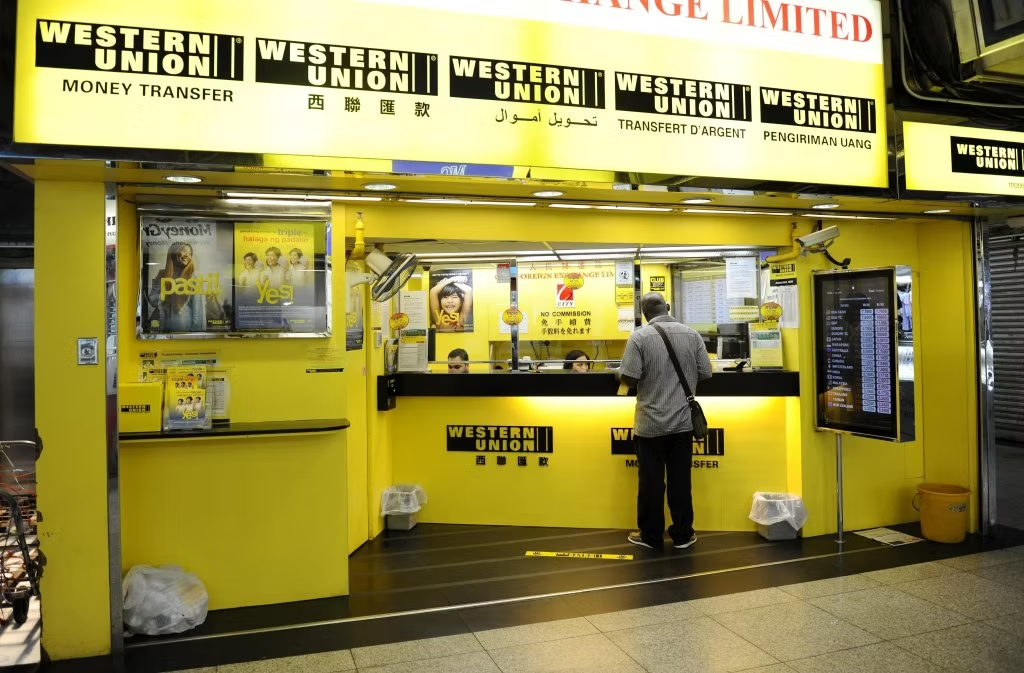
Jornyoun and Sieh also warned that increasing the cost of formal remittance transfers could unintentionally drive many Liberians toward informal and unregulated money transfer systems.
According to them, such a development could weaken financial transparency, reduce oversight, and create opportunities for illicit financial activities.

“Increasing the cost of formal remittance transfers may incentivize the use of informal, unregulated, and potentially illicit channels,” the statement cautioned.
The two Liberians further argued that overdependence on remittance-based financing could gradually reduce pressure on government to improve public service delivery and accountability.
“Excessive reliance on remittance inflows can reduce pressure on the state to provide essential public services and may, over time, weaken public demand for government accountability,” they warned.
Questions Over Economic Viability
The statement also questioned the long-term fiscal effectiveness of remittance taxes, arguing that similar policies elsewhere have historically produced limited financial returns relative to the administrative and enforcement costs involved.
According to the pair, such systems often encourage avoidance behavior while failing to generate meaningful development revenue.
“For these reasons, policy experts generally recommend that governments prioritize the creation of a stable and attractive investment climate,” the statement added.
The two men instead encouraged policies that would voluntarily attract diaspora investment into savings, entrepreneurship, and productive economic sectors rather than compulsory remittance deductions.
Clarification on Escrow Accounts
Addressing another aspect of the ongoing discussion, Jornyoun and Sieh clarified that while escrow accounts can legally be opened in Liberia, such accounts cannot be established directly through the Central Bank of Liberia (CBL).
“The CBL acts as a regulatory and oversight body and does not offer retail or commercial banking services to the public,” the statement explained.

The clarification appears connected to ongoing public conversations about possible financial management structures for any future diaspora development initiative.
Debate Continues Over Diaspora Contribution Model
The proposed Diaspora Development Fund has generated mixed reactions among Liberians both at home and abroad.
Supporters believe the initiative could harness the economic strength of Liberia’s large diaspora population to help finance national development priorities, especially at a time when external donor support continues to decline globally.
Critics, however, insist that any contribution mechanism must remain voluntary, transparent, and carefully structured to avoid placing additional financial strain on diaspora families already supporting relatives in Liberia.
The debate also reflects broader national discussions surrounding governance, transparency, public trust, and sustainable domestic resource mobilization.
As public consultations continue, observers say the success of any future diaspora financing initiative will likely depend on strong accountability mechanisms, broad stakeholder engagement, and public confidence in how funds would be managed and utilized.
Follow The Liberian Post on Facebook and X (formerly twitter).





RESPONSE TO PUBLIC CONCERNS REGARDING THE DIASPORA DEVELOPMENT FUND ACT OF 2025
By Dr. Prince Yeakehson
President, Diaspora Liberian Development Initiatives (DLDI)
The recent publication by The Liberian Post titled “2 Diaspora Liberians Raise Concerns Over Proposed Remittance-Based Development Fund” raises several important issues deserving of public clarification and legal accuracy. Public debate is healthy in every democratic society. However, for such debate to remain constructive, it must also be grounded in factual precision, legal understanding, and a proper appreciation of the intent and structure of the proposed Diaspora Development Fund (DDF) initiative.
At the outset, it is critically important to correct a recurring public misconception: the proposed US$1.00 remittance contribution mechanism under the Diaspora Development Fund Act is not a tax in the traditional constitutional or fiscal sense of the word.
This distinction is not merely semantic; it is legal, constitutional, and institutional.
UNDERSTANDING WHAT A TAX IS
Under established principles of constitutional law and public finance, a tax is generally defined as a compulsory financial charge imposed by government primarily for public revenue generation to support governmental operations and expenditures. Taxes are deposited into the national treasury or consolidated revenue accounts and become part of government-controlled fiscal spending.
The proposed Diaspora Development Fund mechanism does not fit that legal definition.
The DDF initiative was conceived by the Diaspora Liberian Development Initiatives (DLDI), an independent, non-governmental, non-political, non-sectarian, Minnesota-based nonprofit development organization established to leverage diaspora remittances, expertise, and investment toward Liberia’s long-term socio-economic transformation.
The proposed fund is intended to function as a dedicated development trust mechanism specifically earmarked for clearly defined development projects and programs, not for general government spending.
In other words:
• the proposed contribution is project-oriented rather than revenue-oriented;
• the funds are intended for restricted development purposes;
• the mechanism is designed around accountability and ring-fenced utilization;
• and the funds are not intended to become ordinary government revenue.
Accordingly, characterizing the initiative as a “remittance tax” oversimplifies and misrepresents the underlying legal and policy architecture of the proposal.
THE TRUE PHILOSOPHY BEHIND THE DDF
The philosophical foundation of the DDF is based on collective national burden-sharing through micro-contributions capable of producing macro-developmental outcomes. The principle is not based on the amount of money being sent. Rather, it is based on the frequency and scale of remittance transactions flowing annually into Liberia.
Liberians in the diaspora already contribute hundreds of millions of dollars annually toward family survival, education, healthcare, housing, funerals, tuition, and emergency support. The DDF seeks to institutionalize a small collective development contribution capable of financing transformational national projects that individual remittances alone cannot accomplish.
No single Liberian abroad can individually build national roads, modern hospitals, county guest houses, scientific training institutions, agricultural industrialization programs, or diaspora investment banks. However, millions of micro-contributions aggregated transparently can accomplish extraordinary national goals.
This is the same economic principle underlying many successful collective financing systems worldwide, including:
• cooperative development models;
• solidarity development funds;
• infrastructure levies;
• diaspora bonds;
• sovereign investment funds; and
• development trust mechanisms.
ADDRESSING THE “DOUBLE TAXATION” ARGUMENT
The argument that diaspora Liberians already pay taxes in their countries of residence and therefore should not contribute to Liberia’s development through a structured mechanism is emotionally understandable but legally misplaced. Taxes paid in foreign countries are obligations owed to those sovereign governments in exchange for public services, infrastructure, legal protections, and economic participation within those jurisdictions. The proposed DDF contribution is conceptually different. It represents a targeted developmental contribution tied to one’s continuing economic and emotional connection to Liberia.
Indeed, Liberians abroad already voluntarily spend substantial amounts supporting relatives and communities back home. The DDF merely seeks to organize a tiny portion of that existing economic relationship into a structured national development framework capable of producing measurable and visible impact.
Furthermore, many diaspora communities globally already contribute collectively toward homeland development through:
• hometown associations;
• faith-based remittances;
• cooperative unions;
• educational drives;
• scholarship programs; and
• community infrastructure projects.
The DDF simply proposes scaling that collective spirit to a national level.
ON THE ISSUE OF VOLUNTARINESS
One of the most valuable contributions emerging from ongoing public discussions is the growing consensus around ensuring that the mechanism is designed in a manner that maximizes public trust, transparency, voluntariness, and accountability. DLDI has consistently welcomed constructive criticism and policy refinement. In fact, evolving discussions surrounding:
• opt-in contribution systems;
• voluntary diaspora participation frameworks;
• independent governance structures;
• escrow protections;
• external auditing systems;
• legislative oversight;
• and eventual establishment of a Diaspora Development Bank demonstrate that public engagement is strengthening—not weakening—the initiative.
Policy development is an iterative process. Serious national initiatives evolve through dialogue, refinement, and stakeholder engagement.
ON FEARS OF INFORMAL TRANSFER CHANNELS
Concerns regarding informal remittance channels deserve serious consideration. However, such risks can be mitigated through:
• proper regulatory design;
• low administrative friction;
• digital transparency;
• public confidence;
• and clear developmental outcomes visible to contributors.
People are generally willing to contribute to systems they trust.
The central issue therefore becomes not whether Liberians are willing to contribute, but whether the institutional structure inspires confidence through accountability, transparency, and measurable development outcomes.
ON GOVERNMENT ACCOUNTABILITY
Another misconception is that the DDF would somehow reduce government accountability.
To the contrary, properly designed diaspora development mechanisms can complement, not replace government responsibility. Development partnerships between states and diaspora communities are increasingly recognized globally as legitimate tools for national development financing, particularly in developing economies facing declining donor dependency and rising infrastructure demands.
The DDF is not intended to absolve the Liberian government of its constitutional obligations. Rather, it seeks to create an additional development partnership platform capable of accelerating national progress.
ON DIASPORA REPRESENTATION
The concerns raised regarding diaspora political representation are legitimate and important. DLDI strongly supports meaningful diaspora inclusion in national governance conversations, including:
• out-of-country voting discussions;
• expanded diaspora participation;
• institutional engagement;
• and national development policymaking.
However, the existence of unresolved diaspora voting issues should not automatically invalidate broader development initiatives intended to benefit the nation collectively.
THE WAY FORWARD
Liberia stands at a historic crossroads. Declining foreign aid, rising infrastructure demands, youth unemployment, weak healthcare systems, educational limitations, and economic vulnerabilities require innovative domestic and diaspora-driven development strategies.
The DDF conversation should therefore not be reduced merely to emotional slogans such as “taxing remittances.” Rather, the national discussion should focus on the larger strategic question:
How can Liberia responsibly harness the enormous economic power of its global diaspora community for structured national transformation? That is the real policy question before the Liberian people.
DLDI remains fully committed to:
• stakeholder engagement;
• policy refinement;
• transparency;
• accountability;
• constitutional compliance;
• and broad public consultation.
CONTRIBUTION TO THE DDEF MECHANISM
It is important to clarify that, upon passage into law, the proposed Diaspora Development Fund contribution mechanism will apply not only to Liberians residing abroad, but to all individuals, businesses, organizations, institutions, and entities that remit money to Liberia through qualifying remittance channels. The underlying principle of the initiative is not based on the amount of money being sent, but rather on the frequency of remittance transactions into Liberia. In practical terms, every qualifying remittance transaction would contribute a flat US$1.00 toward the Diaspora Development Fund regardless of the amount transferred. Accordingly, DLDI respectfully encourages all persons and institutions sending money to Liberia to voluntarily add an additional US$1.00 to the amount they intend their recipients to receive. For example, if a sender intends for a family member or beneficiary in Liberia to receive US$50.00, the sender may remit US$51.00 so that the recipient still receives the intended US$50.00 while US$1.00 supports national development initiatives through the DDF. Similarly, if an individual sends US$501.00, only US$1.00 would be allocated toward the Fund. This demonstrates that the contribution is transaction-based rather than income-based or wealth-based. Consequently, whether a person remits US$51.00 or US$501.00, the contribution to the DDF for that transaction remains the same fixed amount of US$1.00. Therefore, the total amount an individual contributes annually depends not on how much money they send, but on how many times they remit money to Liberia throughout the year. Through millions of small collective contributions, Liberia would have the opportunity to finance transformational development projects capable of impacting lives, communities, infrastructure, education, healthcare, agriculture, and economic empowerment nationwide.
WHAT THE FUND IS CAPABLE OF PRODUCING
If enacted into law and managed with a high degree of transparency, accountability, professionalism, and public oversight, the Diaspora Development Fund (DDF) possesses the potential to finance transformative national projects capable of significantly improving the lives and living conditions of Liberians across the Republic. Through strategic planning and responsible stewardship, the Fund could support the expansion of reliable electricity infrastructure to underserved urban and rural communities; the construction and modernization of vocational, technical, and professional training institutions across Liberia’s four geographical regions—North, South, East, and West; and the training of specialized Liberian scientists, engineers, medical doctors, information technology professionals, agricultural experts, and industrial technicians needed to drive national development and reduce dependency on foreign expertise. Additionally, the Fund could contribute toward the expansion of affordable nationwide internet connectivity and digital infrastructure, thereby enhancing education, innovation, e-governance, and economic participation in the digital age. The initiative could also facilitate the establishment of industrial and manufacturing hubs aimed at promoting locally produced goods proudly branded “Made in Liberia,” while simultaneously generating employment opportunities and strengthening domestic production capacity. Furthermore, the DDF could support the development of safe drinking water systems, sanitation infrastructure, and community-based water projects in cities, towns, and rural communities throughout Liberia. Collectively, these investments have the potential to accelerate national development, stimulate economic growth, empower local communities, strengthen human capital development, and create a more self-sufficient and economically resilient Liberia for future generations.
MANAGEMENT OF THE FUND
The proposed Diaspora Development Fund is envisioned to operate under a decentralized and nationally representative governance structure designed to ensure transparency, accountability, inclusiveness, and equitable national participation. Under the proposed framework, each of Liberia’s fifteen counties will have representation through county-based diaspora leadership structures affiliated with the Diaspora Liberian Development Initiatives (DLDI). These county representatives, serving within the broader DLDI governance architecture, will collectively participate in annual decision-making processes concerning the identification, prioritization, approval, and monitoring of development projects intended to impact lives and communities across Liberia. This structure is intended to prevent centralized control, promote county ownership, encourage grassroots participation, and ensure that development initiatives reflect the real needs and priorities of local communities throughout the Republic of Liberia. Through this inclusive governance model, the DDF seeks to institutionalize national unity, shared responsibility, participatory development, and transparent stewardship of diaspora-supported development resources.
Under the proposed governance and accountability framework of the Diaspora Development Fund (DDF), once a development project is identified, reviewed, and formally approved by the County Diaspora Development Board under the Diaspora Liberian Development Initiatives (DLDI), the project opportunity will be publicly advertised through appropriate media platforms to ensure openness, transparency, and competitive participation. Qualified construction companies, contractors, consultants, and service providers will then be invited to submit bids or proposals for the execution of the approved project. The County Diaspora Board, working alongside relevant technical and procurement committees, will carefully vet all bids based on competence, experience, financial capacity, technical qualifications, integrity, and cost-effectiveness before awarding the contract to the most qualified and responsive bidder. To strengthen accountability and reduce financial misuse, project funds will not be released in a single lump sum; rather, disbursements will occur in carefully monitored phases tied to specific project milestones, deliverables, inspections, and performance benchmarks. Upon completion of the project, both internal and independent external audits will be conducted to verify financial compliance, project quality, contractual performance, and proper utilization of DDF resources. This multilayered accountability mechanism is intended to promote transparency, prevent corruption, encourage public confidence, and ensure that every dollar contributed toward the DDF directly impacts lives and communities across Liberia in a measurable and responsible manner.
DIASPORA ORGANIZATIONAL SUPPORTS
It is also important to clarify that the proposed Diaspora Development Fund initiative did not emerge in isolation or without broad diaspora engagement. The concept has received significant encouragement, discussion, and varying levels of support from several major Liberian diaspora umbrella organizations across the world, including the Union of Liberian Associations in the Americas (ULAA), European Federation of Liberian Associations (EFLA), Liberian Association in Queensland (LAQ), Liberian Association in Canada (LAC), and Federation of Lofa Associations in the Americas (FLAA). These engagements demonstrate that the broader discussion surrounding diaspora-led development financing is not the position of one individual or one organization alone, but rather reflects an emerging global conversation among Liberians abroad regarding how diaspora communities can collectively contribute toward Liberia’s long-term socio-economic transformation, infrastructure development, investment expansion, education, healthcare, and national reconstruction.
The organization welcomes constructive dialogue from all sectors of society, including economists, legal scholars, financial experts, diaspora organizations, civil society actors, and ordinary Liberians.
Nation-building requires courage, innovation, sacrifice, and collective vision.
History will ultimately judge whether Liberia chose fear and division—or whether it chose organized national transformation through collective responsibility and strategic development planning.
Dr. Prince Yeakehson
President
Diaspora Liberian Development Initiatives (DLDI)
Comments are closed.