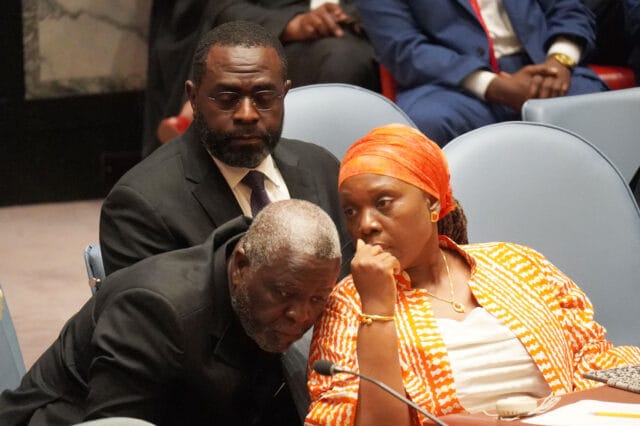
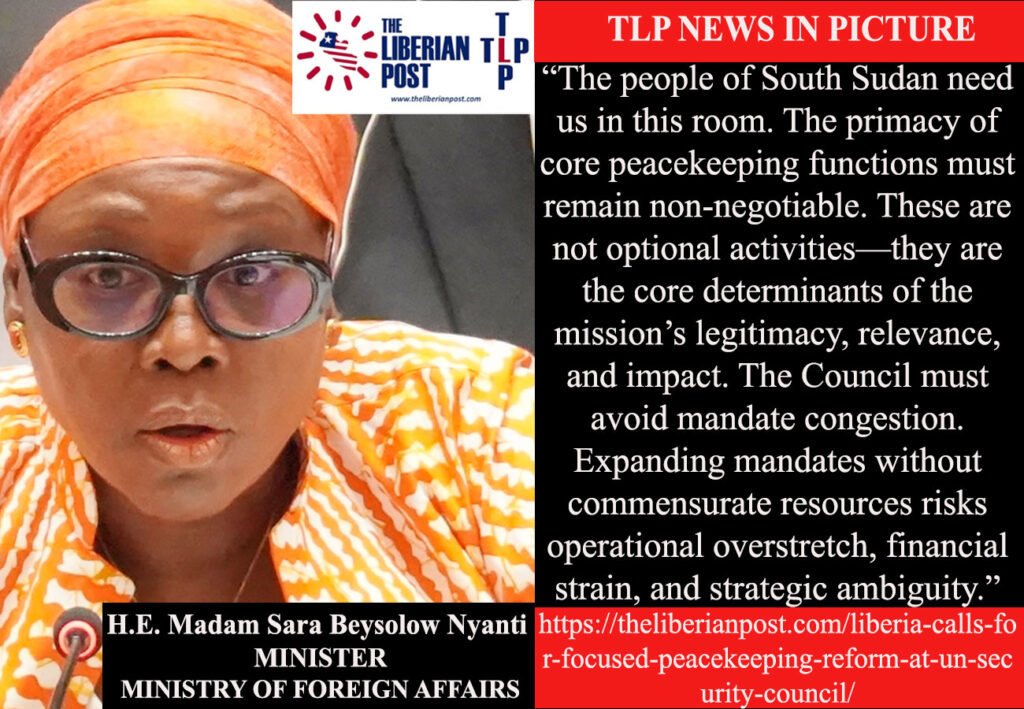
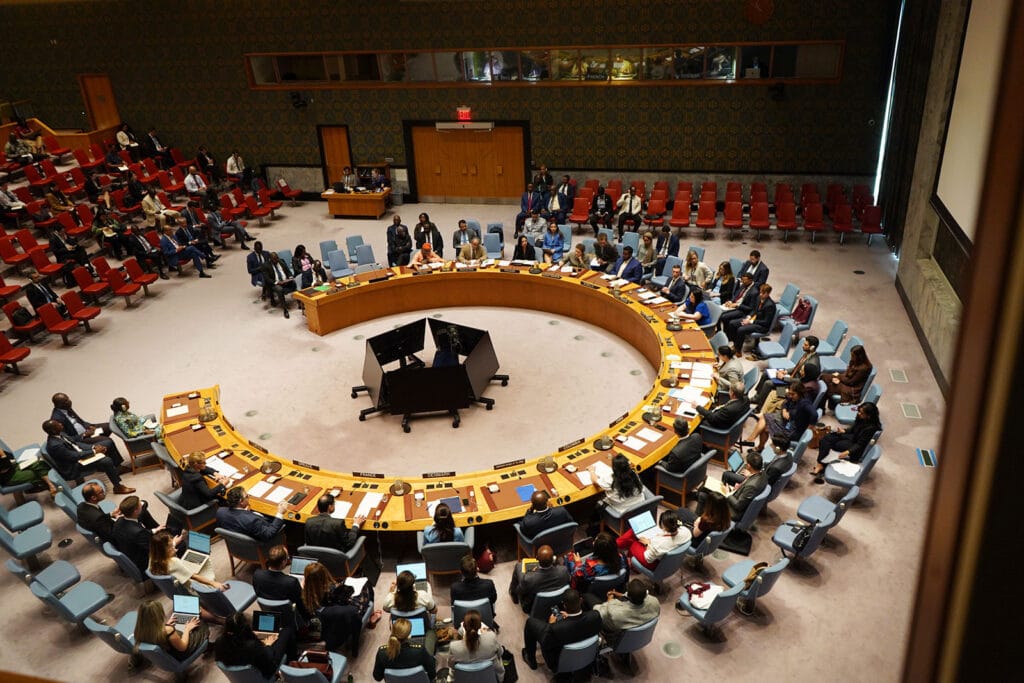
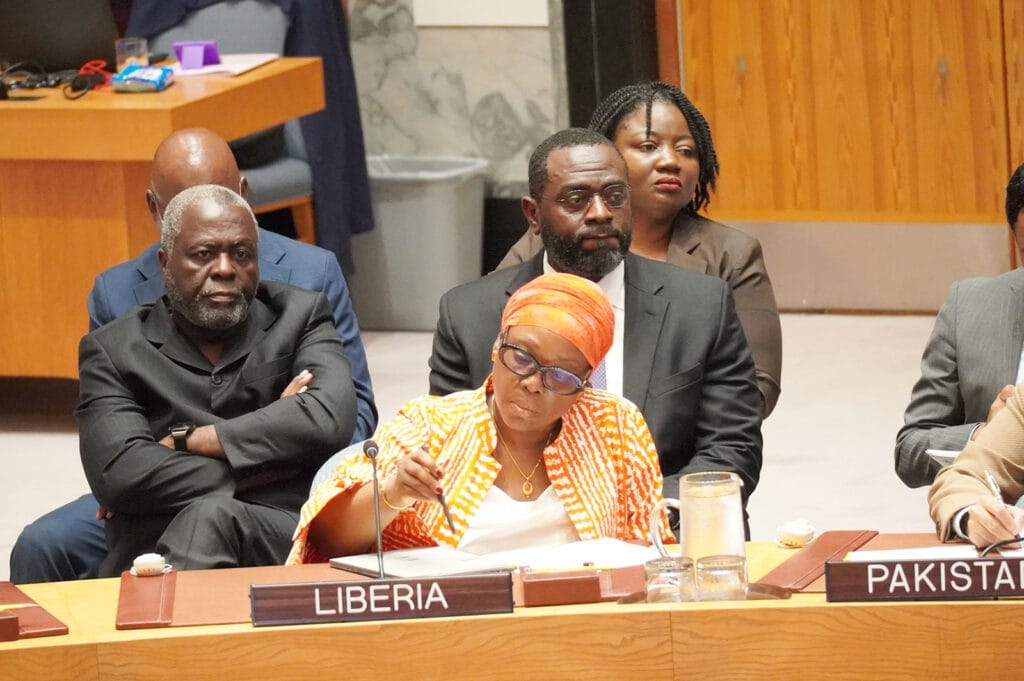
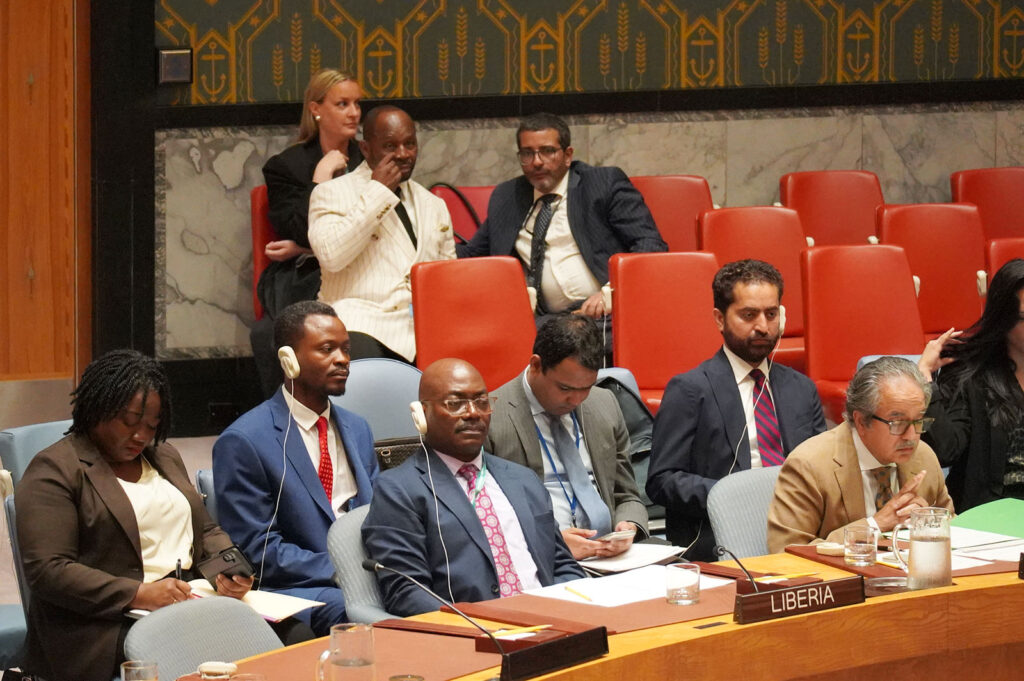
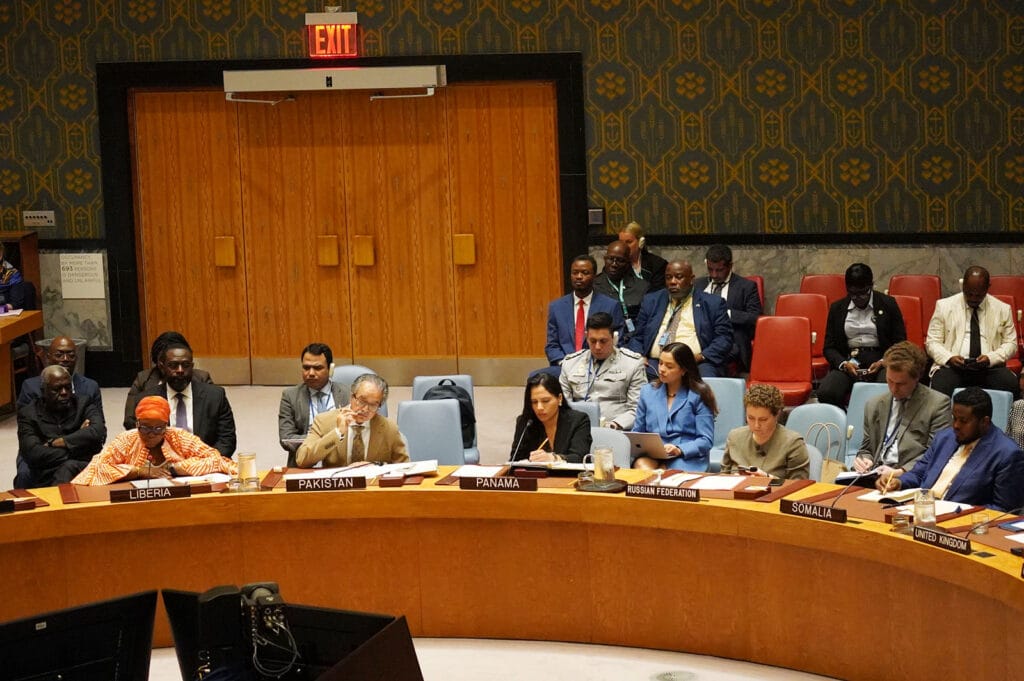
NEW YORK — Liberia has called for a more focused, disciplined, and adequately resourced approach to United Nations peacekeeping operations, as Foreign Minister Sara Beysolow Nyanti addressed the United Nations Security Council on Tuesday.
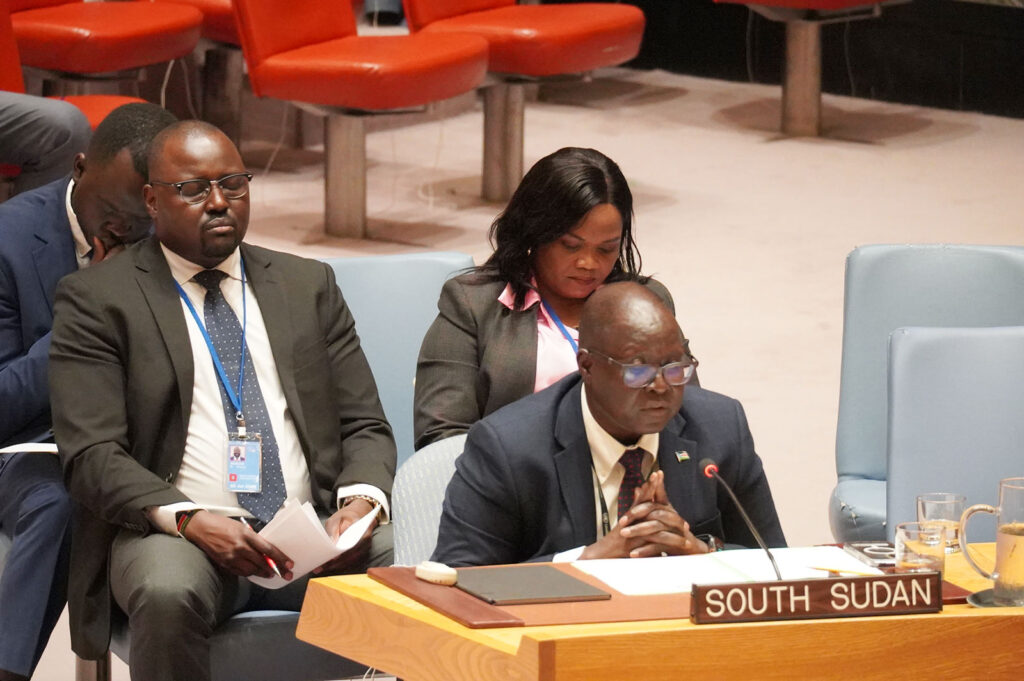
Speaking during deliberations on South Sudan, Minister Nyanti emphasized that peacekeeping mandates must remain clear, realistic, and centered on protecting civilians, warning against overextension and inefficiency within UN missions.
Liberia Aligns with African Position
Nyanti began by reaffirming Liberia’s alignment with the African bloc (A3), stressing a unified commitment to supporting peace and stability in South Sudan.
She also paid tribute to a late colleague, reflecting on her own experience serving in the United Nations Mission in South Sudan (UNMISS), which she described as shaping her personal and professional connection to the country.
“The people of South Sudan need us in this room,” Nyanti said, underscoring the urgency of international action.
“Protection of Civilians Must Be Non-Negotiable”
At the core of Liberia’s intervention was a strong call to prioritize the fundamental objectives of peacekeeping missions, particularly the protection of civilians.
“The primacy of core peacekeeping functions must remain non-negotiable,” she declared. “These are not optional activities—they are the core determinants of the mission’s legitimacy, relevance, and impact.”
Nyanti emphasized that all aspects of UNMISS operations should be evaluated based on their direct contribution to civilian protection, calling for more robust, proactive, and mobile deployment in high-risk areas.
Warning Against “Mandate Congestion”
The Liberian Foreign Minister cautioned against expanding peacekeeping mandates beyond what resources and capacities can support—a practice she described as counterproductive.
“The Council must avoid mandate congestion,” Nyanti warned. “Expanding mandates without commensurate resources risks operational overstretch, financial strain, and strategic ambiguity.”
She argued that peacekeeping missions are most effective when their priorities are “limited, clear, and achievable,” urging the Council to adopt a more strategic and disciplined approach.
Call for Better Coordination Within the UN System
Nyanti also highlighted the need for clearer division of responsibilities within the broader UN system in South Sudan, noting that peacekeeping missions should not duplicate the work of development agencies and humanitarian actors.
She suggested that areas such as gender equality, climate, and transitional justice may be better handled by specialized UN agencies, allowing peacekeeping forces to focus squarely on security and protection mandates.
Grounding Decisions in Reality
Another key point raised by Liberia was the importance of aligning mandate renewals with on-the-ground realities.
“Mandate renewals must be grounded in reality,” Nyanti stated, calling for decisions to be guided by measurable benchmarks, existing capacities, and evolving conditions.
She stressed that a streamlined mandate should not be seen as a limitation, but rather as a strategic advantage that enhances effectiveness and accountability.
A Personal Appeal
Drawing from her own experience in South Sudan, Nyanti delivered a deeply personal appeal, highlighting her continued ties to the country and its people.
“I lived with South Sudanese… I am connected to them,” she said. “They need UNMISS, they need humanitarian actors, they need the UN development system.”
Looking Ahead
Liberia reaffirmed its commitment to working with international partners, including the African Union and regional bodies, to support a peacekeeping framework that is “adequately resourced, focused, and fit for purpose.”
As debates continue over the future of UNMISS, Liberia’s intervention signals a growing push among African nations for reforms that prioritize efficiency, clarity, and tangible impact in peacekeeping operations.
Follow The Liberian Post on Facebook and X (formerly twitter)