
By Engr. Dehyu C. Zangar
I was born into darkness – not metaphorical, but literal, unbroken darkness. In 1992, one year before I took my first breath, the lights of Buchanan went off. They stayed off through my birth, my childhood, my university years, and the beginning of my career as an electrical engineer – a cruel irony I have carried like a stone in my chest for as long as I can remember. I built my entire professional life around a force I had never once seen illuminate my own city. I studied power systems and automation while my neighborhood lay in darkness, the night lit only by flickering candles.
For 34 years, the people of Buchanan carried this darkness not just in their streets, but in their spirits. Children were born, grew old, and had children of their own without ever knowing what it meant to flip a switch and watch a room fill with light. Grandparents told stories of a Buchanan that once glowed at night – stories my generation dismissed as legend.
And then, it happened.
Today, lights blazed once more across Buchanan, from Sugarcane Farm Community to Lower Hardlandsville. When I first saw them, I wept – not polite tears of professional satisfaction, but the raw tears of a man watching a ghost story become real. This is not simply infrastructure returning to a city. This is resurrection!
But I will not let sentiments blind me to the truth: this fragile new dawn could still be extinguished. And I refuse to let that happen.
A Community Reconnecting With Light
Let me tell you what light means after thirty-four years without it. It means a mother no longer sends her son walking miles through the dark to charge a phone that might save a life. It means a shopkeeper, who watched his father shutter the family store at dusk for 34 years, can finally keep his lamp burning and imagine growth. It means a girl who once studied by flicker of a dangerous kerosene lamp can now read after sunset without fear.

I remember that girl. I was that boy.
Streetlights now push back a darkness that once concealed danger and fear for every market woman and every commuter walking home with her heart in her throat. That fear is beginning to lift.
But this miracle is fragile – a candle flame cupped against the wind. While the Liberia Electricity Corporation (LEC) and its partners have fought valiantly to restore what darkness stole, a quiet enemy still stalks this progress: power theft and illegal connections. Left unchecked, this corrosion could drag us back into the darkness we just escaped.
The Persistent Challenge of Power Theft
This enemy wears many faces: poverty disguised as desperation, misinformation spreading like smoke, and distrust hardened by broken promises. In Buchanan, that distrust has legitimate roots – in billing confusion, inaccessible meters, and complaints that vanish into bureaucratic silence. When a family’s cry for help goes unanswered long enough, an illegal connection stops feeling like theft and starts feeling like survival. I understand this, because I have watched my own neighbors wrestle with it.
Infrastructure alone will never be enough. We must fight for trust with the same ferocity LEC used to restore the wires.
A Community Engagement Roadmap: The Battle for Trust
Restoring trust requires presence, honesty, and relentless communication. Town halls must sweep across Buchanan with plain-spoken answers about billing, metering, and complaints – answers residents have been denied for 34 years. These gatherings must include community leaders, women’s groups, youth, marketers and shopkeepers alike.
Every neighborhood must raise its own Community Power Committee – residents trained by LEC and trusted by their communities, proving this light belongs to the people. We must wage an unrelenting campaign against power theft through radio, theater, and real stories from real families. Statistics do not break hearts; stories do.
When residents cry out for help, someone must answer quickly and humanely – through hotlines, WhatsApp channels, and mobile service booths. Every delayed response is a small betrayal of what this light represents.
Our young people deserve special urgency. What if we trained the boys who might otherwise tap illegally into a line, turning potential saboteurs into fierce protectors? Youth-led watchdog groups, paired with real jobs, could transform an excluded population into the backbone of Buchanan’s electrical future.
Finally, let residents claim this victory through friendly competition – a “Best Compliance Community” award that makes responsible electricity use a badge of honor, with local businesses as sponsors of this shared triumph.
Running Power Operations in a City Where Poverty Runs Deep
Buchanan is not Monrovia. Any strategy borrowed from wealthier cities will fail here, and failure means darkness again. We need a tariff structure with a heart – a lifeline rate keeping a single bulb burning in even the poorest household, while asking heavier users to shoulder a fairer share. Prepaid metering must give families the dignity of controlling their own spending, rather than facing bills that become an excuse for illegal reconnection.
Where industry is scarce, let electricity become the engine of opportunity: a refrigerator for a fish seller, a tailor’s shop opens past dusk, a phone-charging stall and a beauty salon. Let residents themselves become meter readers and apprentices – active builders, not passive recipients. And let LEC fight relentlessly against loss, so the burden of sustainability never falls entirely on families with almost nothing left to give.
Reliability, affordability, and trust cannot compete against each other here. They must stand together, or the whole structure collapses.
Community Ownership: Guarding What We Bled to Regain
Infrastructure arriving after 34 years of darkness is not a gift. It is an inheritance, paid for in generations who lived and died without ever seeing their city lit. Every pole, transformer, and meter must become sacred to the people beside it. When someone tampers with a transformer at night, that is an assault on a mother’s ability to protect her child and a shopkeeper’s hope for a better year.
Silence in the face of this threat is complicity. When a neighbor sees cables stripped under moonlight and says nothing, that silence writes the next outage into existence. Guard the ground around every pole as fiercely as your own doorstep. Keep children away from live wires. Demand that only trained, authorized hands touch this system. Pay your bills not out of obligation, but reverence for what that payment protects.
Speak proudly of this victory to every visitor and skeptic. Do not let anyone normalize the theft of what we fought 34 years to reclaim. This is the spirit Buchanan must carry forward – a people who do not merely receive light, but stand guard over it, so no child born here again asks, “What does it feel like when the lights come on?”
A Call for Collective Responsibility
Electricity has returned to Buchanan, but this is not yet a victory secured. It is a fragile beginning that depends on whether we choose, together, to protect it and that must be concerning to everyone. This burden belongs to every mother, every child studying by bulb instead of flame, every shopkeeper counting earnings under electric light for the first time in living memory. It belongs to me – a son of Buchanan who dreamed of this moment and now stands, disbelieving and determined, in the light he never thought he would see.
If Buchanan rises to meet this moment together, the darkness that swallowed 34 years of our history will finally be over – not just for us, but for every child born after this day, who will never have to know what it means to wait for the lights to come home.
About the Author
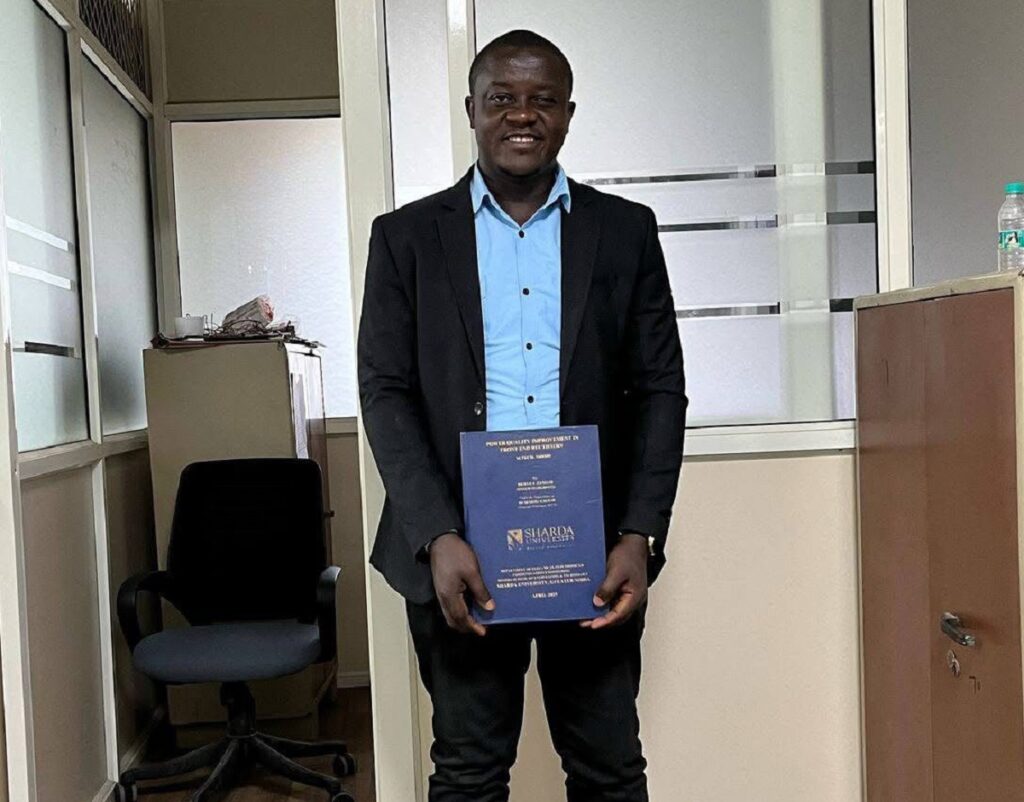
Engr. Dehyu C. Zangar is an electrical engineer with eight years of experience in designing and optimizing advanced power systems. Born in Grand Bassa County in 1993, he grew up in a city without electricity – an experience that fuels his dedication to expanding reliable energy access across Liberia. He holds a master’s degree in electrical and electronics engineering, specializing in power systems and automation, a field essential for ensuring reliable, efficient, and modern electricity delivery. He lectures at the University of Liberia, Faith University College, and Grand Bassa University, where he promotes advanced energy knowledge and community-centered solutions. His work focuses on improving electricity availability, strengthening community partnerships, and raising public awareness to support sustainable national energy development.