-GAC Finds National Bureau of Concessions Failed to Effectively Monitor Mining and Agricultural Agreements for Six Years
MONROVIA – A new performance audit has uncovered sweeping failures in Liberia’s oversight of some of the country’s largest mining and agricultural concession agreements, raising fresh concerns about accountability, community benefits, environmental compliance, and the government’s ability to ensure that investors fulfill their contractual obligations.
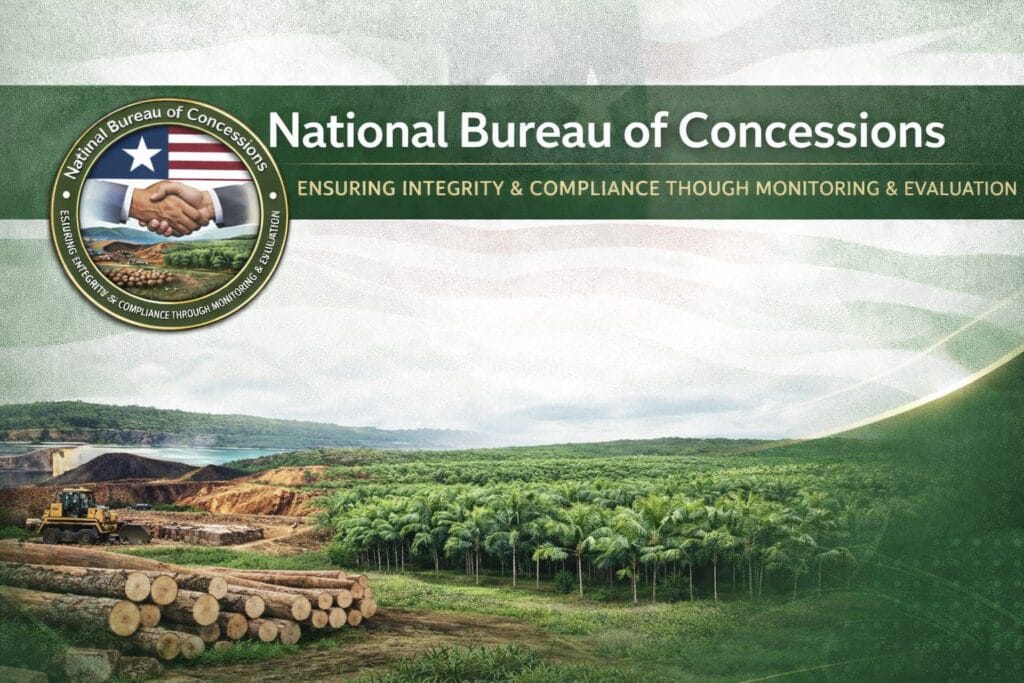
The audit, conducted by the General Auditing Commission (GAC), found that the National Bureau of Concessions (NBC)—the government agency responsible for monitoring concession agreements—operated between 2018 and 2023 without key monitoring systems, compliance mechanisms, annual reporting structures, or effective evaluation tools.
The findings have significant implications for Liberia’s concession sector, which represents billions of dollars in investment and remains a major driver of economic activity.
Watchdog Without Tools
At the center of the audit’s findings is the conclusion that NBC was largely unable to fulfill its statutory mandate during the six-year period under review.
Auditors found that the Bureau lacked an approved Monitoring and Evaluation (M&E) framework, operational plans, and policy guidelines necessary to track concession performance. Even the Concessions Information Management System (CIMS), a donor-funded database intended to serve as the country’s central repository for concession data, was reportedly non-functional.
The GAC concluded that NBC “did not effectively carry out its mandate to monitor and evaluate concession agreements in Liberia.”
The review focused primarily on Liberia’s mining and agriculture sectors, which account for more than 85 percent of concession investments and contributed over half of the country’s Gross Domestic Product in 2022.
Billions in Investments, Little Monitoring
Perhaps most alarming, auditors found that NBC failed to conduct meaningful compliance monitoring of concessionaires.
Of 16 active concession agreements reviewed, the Bureau initiated monitoring activities for only one company—Firestone Liberia—in 2021. Even that review was never completed and no final report was issued.
The audit also found no evidence that NBC conducted risk assessments to identify high-risk concession operators, maintained records of violations, or established systems to track non-compliance.
As a result, government authorities may have lacked reliable information needed to determine whether concessionaires were complying with investment commitments, environmental obligations, labor standards, and community development agreements.

Communities Left Without Answers
The audit raises broader questions about whether communities hosting major concessions are receiving the benefits promised under concession agreements.
According to the report, NBC conducted no formal assessments of concession impacts on employment, infrastructure development, environmental protection, revenue generation, or community welfare.
The omission is particularly significant given recurring disputes involving some of Liberia’s largest concession operators.
Auditors referenced community protests involving Bea Mountain Mining Corporation in Grand Cape Mount County, demonstrations linked to Bao Chico Resources in Gbarpolu County, and labor-related concerns involving Golden Veroleum Liberia in Grand Kru County.
For years, affected communities and lawmakers have questioned whether concession agreements are delivering meaningful economic and social benefits despite extensive natural resource extraction.
The audit suggests that government authorities may have lacked the data necessary to objectively answer those questions.
Annual Reports Never Submitted
The GAC also found that NBC repeatedly failed to comply with legal requirements mandating annual reporting to both the President and the National Legislature.
Although draft reports and executive summaries were prepared for some years, auditors found that none were finalized or officially submitted. No reports were prepared at all for several years during the audit period.
The failure deprived policymakers, lawmakers, and the public of critical information regarding concession performance and compliance.
Severe Staffing and Resource Constraints
The report attributes part of the problem to serious institutional weaknesses within the Bureau.
NBC reportedly operated with only 37 employees despite an approved staffing requirement of 84. Technical monitoring personnel were significantly outnumbered by administrative staff, while many employees lacked specialized skills in compliance monitoring, impact evaluation, risk assessment, data analysis, and stakeholder engagement.
The Bureau also faced major logistical challenges.
Auditors found that NBC had no dedicated budget for monitoring vehicles or specialized field equipment and operated only four vehicles during the audit period, most of which were assigned to administrative purposes. Monitoring teams reportedly lacked access to GPS technology, environmental testing equipment, geographic information systems, and modern data-management tools.
Public Engagement Mechanisms Collapse
The audit further found that systems designed to connect concession-affected communities with government oversight institutions had largely broken down.
Fifteen Multi-Stakeholder Platforms established across nine counties were reviewed, with auditors finding that most lacked legal registration, failed to maintain records, and ceased meaningful operations after 2019.
A toll-free complaint center established in 2022 reportedly stopped functioning after only six months, while NBC was criticized for lacking an effective public communications strategy and maintaining no functional website.
Call for Institutional Reforms
In response to the findings, the GAC has recommended a sweeping institutional overhaul of the Bureau.
Among its recommendations are the establishment of a comprehensive monitoring and evaluation framework, introduction of risk-based compliance monitoring systems, strengthening of annual reporting mechanisms, expansion of staffing and training programs, and investments in vehicles, technology, and field equipment.
The Commission also called for stronger community engagement mechanisms and the restoration of public complaint channels.
Why the Audit Matters
The findings arrive at a time when Liberia continues to rely heavily on concessions to drive economic growth, generate government revenue, create employment, and attract foreign direct investment.
Analysts say effective oversight is critical not only to protecting communities and the environment but also to maintaining investor confidence and ensuring that concession agreements deliver the benefits promised to Liberians.
The Auditor General warned that without effective monitoring and evaluation systems, both government authorities and affected communities are left without the evidence necessary to determine whether concessionaires are honoring their commitments.
The GAC has indicated that it intends to conduct a follow-up review to assess whether NBC implements the recommended reforms.
For many observers, the audit represents more than an assessment of one institution. It is a broader examination of how Liberia manages some of its most valuable economic assets—and whether the country is receiving full value from the concessions that shape its development future.
Follow The Liberian Post on Facebook and X (formerly twitter)