–President Says Historic Domestic Revenue Record Will Be Used to Expand Support for Businesses, Public Services and National Development
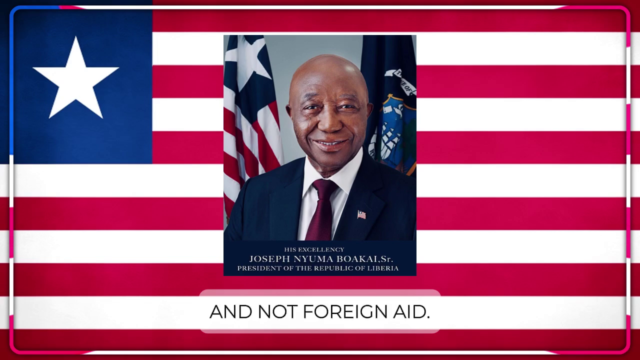
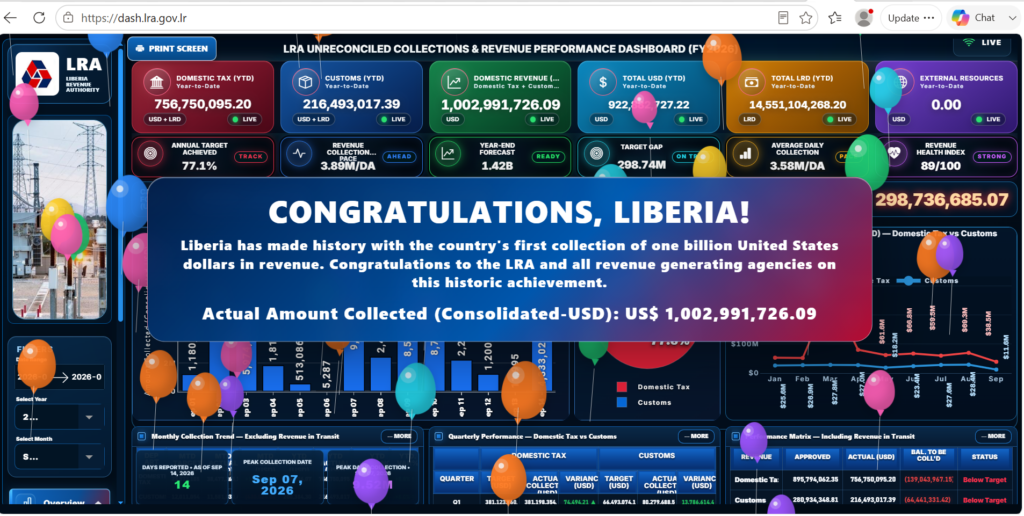
MONROVIA, Liberia — President Joseph Nyuma Boakai has declared that Liberia’s historic crossing of the US$1 billion domestic revenue mark must be measured not simply by the size of government’s collections, but by the improvements those resources bring to the daily lives of Liberians.
In a special national address Monday, September 14, following the confirmation that Liberia had surpassed the billion-dollar threshold for the first time in the Republic’s 179-year history, Boakai said the achievement represents a major expansion in the country’s capacity to finance its own development.
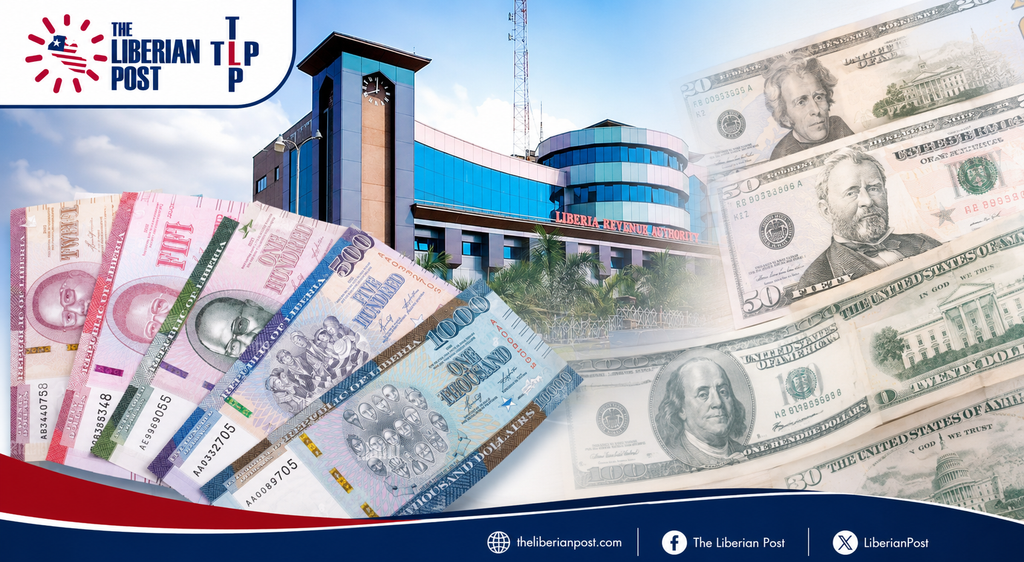
“For the first time in Liberia’s 179-year history, we have raised more than one billion United States dollars in domestic revenue in a single year,” the President said.
The address, titled “One Billion, One Liberia,” credited the achievement to the combined efforts of the Liberia Revenue Authority (LRA), the Ministry of Finance and Development Planning, government institutions and ordinary Liberians who paid taxes, duties, fees and other lawful charges.
Boakai specifically praised LRA Commissioner-General James Dorbor Jallah and his team, while stressing that the milestone belongs to the broader Liberian population.
“This achievement belongs not just to our illustrious leader, President Joseph Nyuma Boakai, Vice President Jeremiah Kpan Koung, LRA Commissioner General James Dorbor Jallah, or myself,” Ngafuan said in his own remarks earlier on Monday. “It belongs to all Liberians.”
Revenue Climbed From US$612 Million in 2023
Boakai used the milestone to chart what he described as Liberia’s rapid expansion in domestic revenue generation.
According to the President, domestic revenue stood at approximately US$612 million in 2023, increased to about US$699 million in 2024, and rose further to approximately US$848 million in 2025.
Liberia has now surpassed US$1 billion in 2026 and, according to Boakai, remains on course to achieve the government’s US$1.3 billion annual revenue target by the end of December.
The President said the achievement is particularly significant because it has occurred amid global economic uncertainty, including disruptions to trade and the effects of the conflict in the Middle East.
He said government efforts to maintain the supply of essential commodities, particularly rice and fuel, and to stabilize prices helped protect Liberians from greater economic pressure while supporting the broader economy.

A Plan for Liberian Businesses
The President also announced that his administration is considering allocating a portion of the increased revenue through a dedicated Special Purpose Vehicle (SPV) to provide affordable financing for Liberian-owned businesses and support other critical sectors of the economy.
In the official written address, Boakai said the proposed mechanism would align with the ARREST Agenda for Inclusive Development (AAID) and the administration’s commitment to broad-based economic participation.
The proposal introduces a new dimension to the government’s domestic-resource strategy: using part of the increased fiscal space to expand access to affordable capital for Liberian entrepreneurs rather than relying solely on conventional commercial financing.
The transcript of the address reinforces the same direction, with the President describing the proposed vehicle as a means of supporting Liberian-owned businesses, social programs and critical sectors of the economy.
‘A Billion Dollars Entrusted’
Boakai repeatedly cautioned against viewing the milestone as merely a financial statistic.
“A billion dollars raised is a billion dollars entrusted,” the President said in the official address, stressing that every dollar must serve the public good and advance the ARREST Agenda.
He said the ultimate test of increased revenue would be whether ordinary Liberians experience tangible improvements.
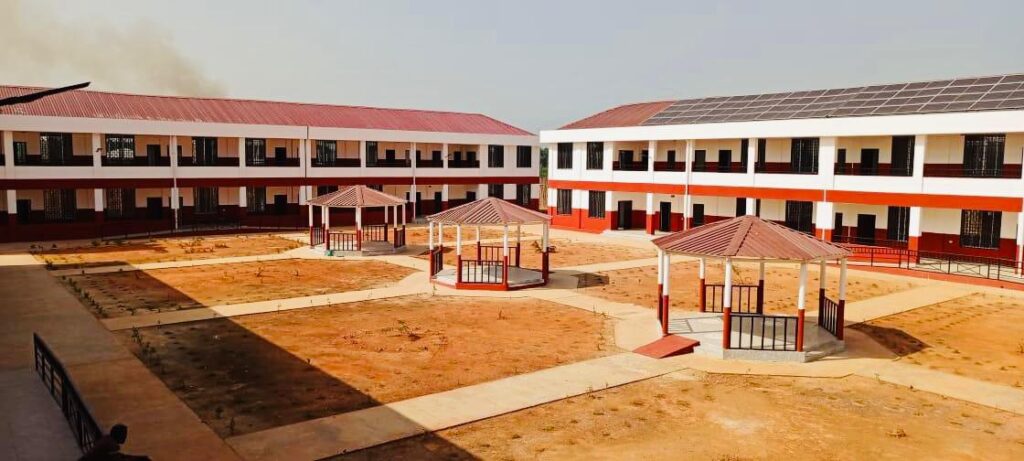
For market women, that could mean support to expand their businesses. For civil servants, it could mean improved compensation. For students, better learning environments and rehabilitated public schools and the University of Liberia.
The President also pointed to hospitals receiving regular supplies of medicines and appropriate diagnostic and treatment equipment, while doctors, nurses, teachers and other public servants are sustained at their duty stations.
In the transcript, Boakai similarly stressed that “every dollar generated” must produce results that Liberians can “see and feel.”
23,000 Public Workers and 3,400 Volunteers
Boakai used the address to point to some of the areas where increased domestic resource mobilization has already supported government spending.
He said improved revenue performance has enabled the administration to raise salaries for more than 23,000 public service workers and officials, including personnel in health, public works, security, the Judiciary, the General Auditing Commission and the Liberia Anti-Corruption Commission.
The President also said more than 3,400 long-serving volunteer teachers and health workers have been placed on the national payroll.
He cited additional support to the Liberia Drug Enforcement Agency, recruitment and training in the Armed Forces, youth skills and livelihood opportunities, and road interventions supported by the procurement and deployment of government “yellow machines” across the counties.

From Revenue to Roads, Schools and Hospitals
Boakai’s message closely mirrors a broader argument made by Finance Minister Augustine Kpehe Ngafuan during his Monday commencement address at Tubman University in Maryland County.
Ngafuan said the significance of the growing revenue envelope should be measured by what it delivers to citizens—from salaries and medicines to transportation, roads, working laboratories and educational opportunities.
During the same address, Ngafuan pointed to visible public investments along the route from Monrovia to Maryland, including roads, National Transit Authority buses, health infrastructure and government-supported projects at Tubman University.
He said the growing fiscal capacity should give Liberia greater ability to respond to citizens’ needs, while cautioning that a larger budget cannot solve every problem accumulated over generations.
The President struck a similar note, saying Liberia had reached an important threshold but that the aspirations of its people were “greater than one billion.”

Taxpayers Get a Message From the Presidency
Boakai also used the moment to directly recognize the taxpayers who made the milestone possible.
He singled out market women, traders, workers, professionals and businesses, saying every honest declaration, every receipt and every payment made on time represented an act of faith in the country.
“You kept faith with your country, and your country must keep faith with you,” the President said.
That message comes as the government seeks to deepen domestic resource mobilization and increase voluntary compliance while reducing Liberia’s dependence on external assistance.
The LRA has been pursuing digitalization, stronger compliance measures and improved revenue administration as part of the broader effort to expand domestic collections.

The Next Test: Accountability
Despite celebrating the milestone, Boakai warned against complacency.
He said reaching US$1 billion creates a greater responsibility for government to improve its performance and remain accountable to citizens.
“The reward for good work is the responsibility to do better work and remain accountable,” the President said.
That point is likely to define the next stage of Liberia’s fiscal story.
Crossing the billion-dollar threshold provides government with a larger pool of domestic resources, but it also raises expectations for better public services, stronger infrastructure, more opportunities for Liberian businesses and improved living conditions.
The President concluded his address by calling for continued domestic resource mobilization to build what he described as a “capable state that is more responsive to its citizens.”
For Liberia, the historic US$1 billion milestone is therefore both an achievement and a test: whether the country can turn increased domestic revenue into sustained, visible and broadly shared development.
For breaking news, in-depth analysis, and exclusive reports from Liberia and around the world, follow The Liberian Post on Facebook (https://web.facebook.com/profile.php?id=61576017166570) and X, formerly Twitter (https://x.com/LiberianPost).