–Finance Minister Calls for Stronger Industry Partnerships, Research and Skills Development as University Marks 17th Commencement and Founders’ Day
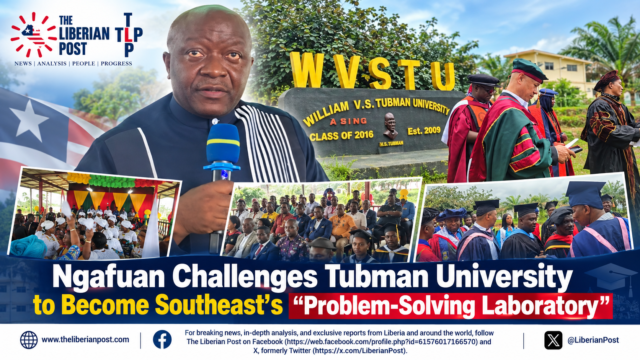
HARPER, MARYLAND, Liberia — Finance and Development Planning Minister Augustine Kpehe Ngafuan has challenged Tubman University to move beyond producing graduates and become a practical engine for economic transformation in southeastern Liberia, calling on the institution to connect education, research and innovation directly to the country’s development challenges.
Serving as keynote speaker at Tubman University’s 17th Commencement Convocation in Maryland County on Monday, September 14, Ngafuan urged the university to establish stronger partnerships with employers, expand research and ensure that graduates leave campus equipped to solve real-world problems.
He said the university should ultimately become what he described as the “Southeast problem-solving laboratory,” where academic research addresses issues ranging from coastal erosion and climate-resilient roads to renewable energy, sustainable mining and public health.
Ngafuan argued that higher education should be viewed as productive infrastructure because its value is ultimately measured by how knowledge and skills improve people’s lives.
“Knowledge must leave the textbook and enter the rice field. Innovation must leave the laboratory and reach the marketplace,” he said, emphasizing that education becomes an instrument of economic transformation when graduates apply what they learn to practical national problems.
He cited examples including an agriculture graduate helping farmers increase yields, an engineer designing roads capable of withstanding Liberia’s heavy rains, a health-science graduate bringing care closer to rural families and a teacher building confidence among children.
From War-Damaged College to Growing University
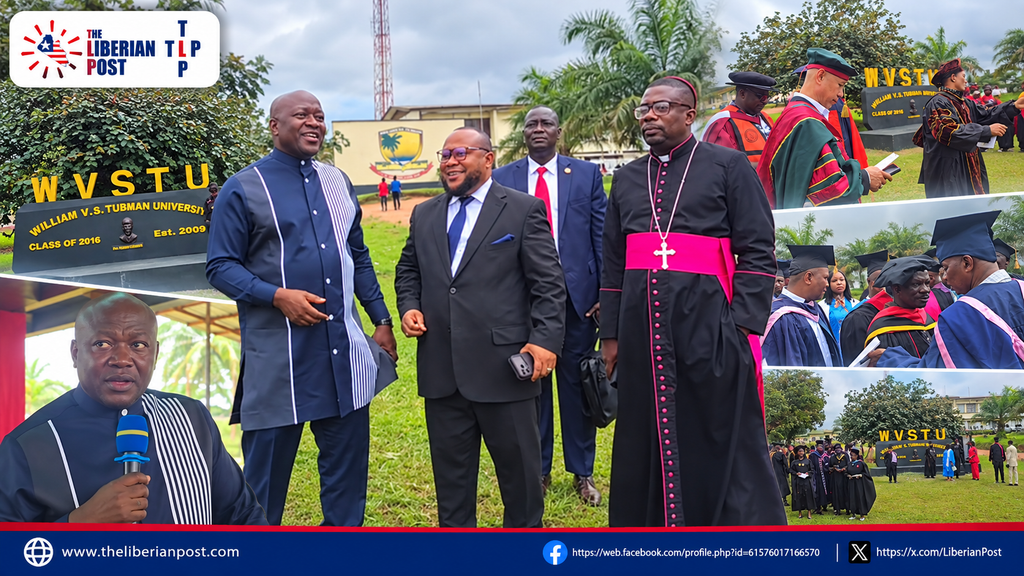
Ngafuan’s address also reflected on Tubman University’s institutional journey, from its origins as Tubman College of Technology to its emergence as a comprehensive university following years of disruption caused by Liberia’s civil war.
He recalled that the institution was established in 1978 with 87 students studying architecture, civil engineering, electrical engineering, electronics and mechanical engineering. The December 1989 war later halted instruction, emptied classrooms and scattered students and faculty, leaving the institution’s facilities damaged and looted.
The Finance Minister said the university’s survival and recovery demonstrate how institutions can help a society recover from conflict and rebuild for the future.
He recalled that when the institution was elevated to university status in 2009, the government provided seed resources despite difficult roads, damaged infrastructure, limited faculty and a national budget still burdened by post-war reconstruction.
According to Ngafuan, 287 students began the university’s new chapter, while the institution now serves nearly 3,000 students across six colleges and more than 20 degree programs, illustrating the transformation that followed the initial public investment.
Ngafuan Links Public Investment to Institutional Growth
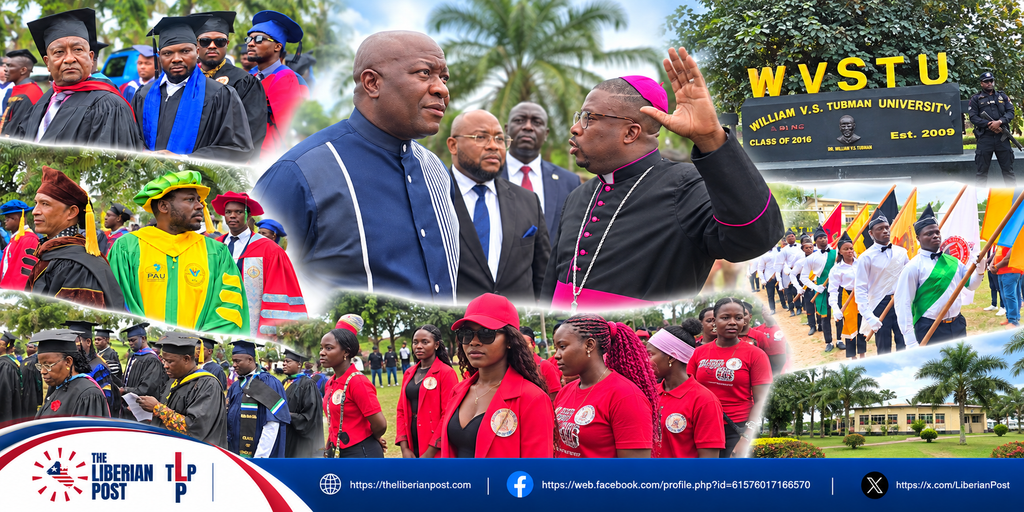
Ngafuan said Tubman University’s growth demonstrates that public investment, when combined with visionary leadership and committed people, can change the destiny of an entire region.
He pointed to government-supported rehabilitation and construction projects at the university, including work on the academic complex and Elizabeth Davis Russell Building, faculty residences, staff quarters, classrooms, the old engineering building, the Monrovia office, the perimeter fence and a new College of Engineering and Technology building.
He said the projects represent a national responsibility rather than a favor to the university, arguing that taxes paid by citizens must ultimately create opportunities throughout Liberia.
The Finance Minister also noted that Tubman University’s allocation in the 2026 national budget is approximately US$6.4 million, substantially above the roughly US$1.5 million in early government support in 2009 that helped launch its transformation.

A Five-Year Agenda for Transformation
Ngafuan challenged the university to ensure that its newly developed five-year strategic plan produces measurable results rather than remaining a policy document.
He said the plan, built around governance, academic excellence, research and innovation, sustainability and infrastructure, sets ambitious targets, including 80 percent graduate employment within six months, at least 10 percent of graduates establishing businesses within three years, and a 20 percent increase in non-government revenue over five years.
He stressed that the university cannot achieve those goals alone.
According to Ngafuan, the private sector should help train future workers, sponsor laboratories, support research, provide internships and apprenticeships, and help shape relevant curricula. Development partners, he said, should align their assistance with the university’s strategic plan, while alumni should contribute through scholarships, mentoring, equipment, expertise and internships.
He also urged the university to generate responsible income through professional education, research, consulting, grants and alumni support without creating barriers for students from poor families.

‘Complete Before You Multiply’
Ngafuan proposed five priorities for Tubman University’s next five years, beginning with what he called “complete before you multiply.”
He urged the institution to complete, equip and maintain projects already underway before taking on too many new initiatives.
“An unfinished building teaches no class, and an unequipped laboratory conducts no experiment,” he said.
He also called for stronger links between classrooms and workplaces, greater investment in faculty, more student participation in decisions affecting them and a deliberate effort to make Tubman University a regional center for solving practical problems.

A Message to Graduates
Turning to the graduating students, Ngafuan urged them not to treat university education simply as a pathway to obtaining certificates.
He told graduates that while their families could finance their education, they could not learn or sit examinations on their behalf.
“Do not come here only to collect a degree,” he said. “Develop the competence to solve problems. Work with others, communicate clearly, act with integrity, and continue learning.”
Ngafuan also warned graduates that time is among their most valuable assets and encouraged them to use their youth to acquire practical skills, develop meaningful relationships and serve their communities.
He particularly urged students in different disciplines to understand that professional success increasingly depends on skills beyond their specific fields, noting that engineers must communicate, business students must understand technology and health professionals must understand the communities they serve.

‘Make Liberia Better’
Ngafuan further challenged the graduates to align their personal ambitions with Liberia’s national interests.
“Liberia needs your dreams to improve Liberia,” he told them, urging them to remain invested in the country’s future and committed to solving its problems rather than pursuing success solely for themselves.
He said graduates entering public life, business, engineering, health, education or other professions should understand their responsibility to communities and to a country still rebuilding and expanding.
His address closed with a call for Tubman University to rise through knowledge, innovation and public service, and for its success to contribute directly to the advancement of southeastern Liberia and the country as a whole.
For breaking news, in-depth analysis, and exclusive reports from Liberia and around the world, follow The Liberian Post on Facebook (https://web.facebook.com/profile.php?id=61576017166570) and X, formerly Twitter (https://x.com/LiberianPost).