
In a political environment often dominated by noise, speed, and short-term calculations, the value of longevity in public service is frequently underestimated. Yet, the recent public remarks by Deputy House Speaker Thomas P. Fallah offer a compelling reminder that experience—when properly applied—remains one of the most critical assets in governance.
For over two decades in the Legislature, Fallah represents a category of leadership that is becoming increasingly rare: one grounded in institutional memory, procedural understanding, and the discipline that comes with time. Longevity, in this sense, is not merely about staying in office—it is about learning, adapting, and developing the judgment necessary to navigate complex national challenges.
His reflections on legislative disagreements, national security concerns, and concession governance all point to a central theme: governance is not a sprint; it is a long-distance race that requires patience, perspective, and a steady hand.
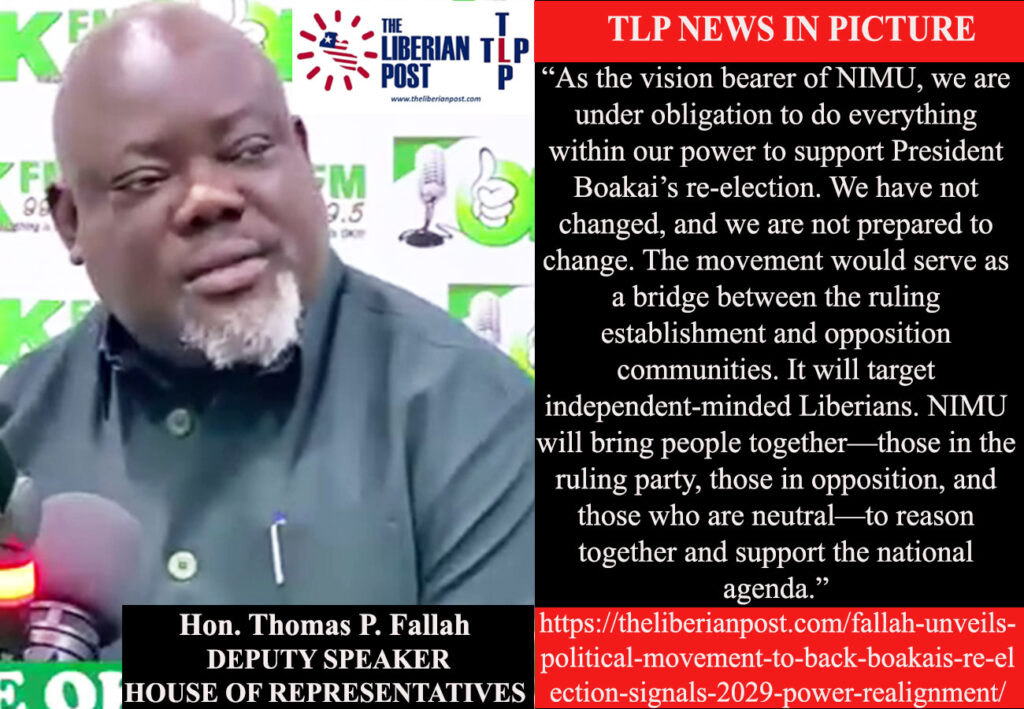
In describing the Legislature as a “theater of disagreements,” Fallah acknowledges an essential truth about democracy—divergent views are not a weakness, but a feature. However, what distinguishes effective leadership is the ability to manage those disagreements without allowing them to descend into disorder.
This is where respect for authority becomes indispensable.
Authority, particularly in democratic institutions, is often misunderstood. It is not about dominance or suppression; rather, it is about maintaining order, upholding rules, and ensuring that institutions function as intended. Fallah’s defense of procedural discipline within the House underscores the importance of structure in governance.

Without respect for institutional authority—whether in the Legislature, the judiciary, or the executive—democracy risks devolving into chaos. Rules, procedures, and leadership hierarchies exist not to silence voices, but to channel them productively.
Equally important is the concept of wisdom, which cannot be divorced from experience.
Wisdom in leadership is reflected in restraint, in knowing when to act decisively and when to exercise patience. It is seen in the ability to rise above political provocation, to focus on solutions rather than blame, and to prioritize national interest over personal or partisan gain.

Fallah’s call for a measured, solution-oriented approach to issues such as the Bea Mountain concession debate and the Foya border situation illustrates this principle. Rather than engaging in political point-scoring, he emphasizes investigation, dialogue, and reform—an approach that speaks to maturity in leadership.
At the same time, his forward-looking political positioning—particularly through the formation of a movement to support President Joseph Nyuma Boakai—highlights another dimension of experienced leadership: strategic thinking.
Leaders who endure are not only reactive; they are anticipatory. They understand the importance of building structures, alliances, and narratives that extend beyond the present moment.

However, longevity must also be accompanied by accountability. Experience without reflection can lead to stagnation. The true test of long-serving leaders lies in their ability to evolve, to correct past missteps, and to remain responsive to the changing needs of the people.
Liberia’s governance landscape stands at a critical juncture. As new leaders emerge and political dynamics shift, the balance between experience and innovation will be essential.
The lesson is clear: youth and energy are vital, but they must be complemented by experience, respect for authority, and wisdom.
In the end, the strength of a nation’s leadership is not measured solely by how loudly it speaks, but by how wisely it acts.
Follow The Liberian Post on Facebook and X (formerly twitter)