
Liberia stands at a familiar crossroads—one that has defined much of its economic history. For decades, the country has exported its natural wealth in raw form, only to import finished goods at a premium. Rubber, one of Liberia’s most enduring resources, exemplifies this paradox. It leaves as “cuplumps” and or processed in some forms and returns as costly tyres and in other essential forms.
Now, a private-sector proposition is challenging that cycle.
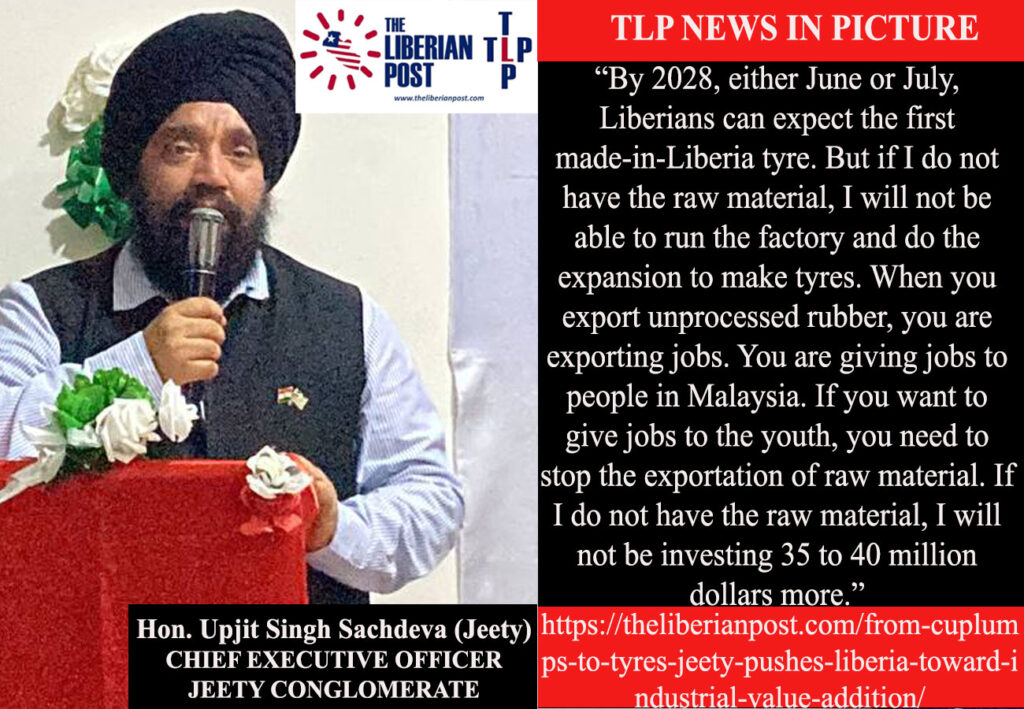
Jeety Rubber LLC’s ambition to produce Liberia’s first domestically manufactured tyres by 2028 is more than a corporate milestone; it is a test of national economic direction. At its core, the proposal asks a fundamental question: Is Liberia ready to transition from extraction to industrialization?
The logic behind the initiative is difficult to dispute. Exporting raw rubber exports jobs, skills, and value. Processing and manufacturing at home, by contrast, multiplies economic impact—creating employment across the value chain, stimulating auxiliary industries, and strengthening domestic revenue streams. Countries that have successfully industrialized did not do so by remaining suppliers of raw materials.
Yet, vision alone will not build factories.
Mr. Upjit Singh Sachdeva’s demand for a guaranteed supply of 550 tonnes of wet rubber daily exposes the structural weaknesses of Liberia’s rubber economy. Supply chains are fragmented, productivity among smallholders remains inconsistent, and policy signals have often been mixed. Without addressing these fundamentals, even the most ambitious industrial plans will struggle to take root.
The call to restrict or ban the export of unprocessed rubber is perhaps the most contentious aspect of the proposal. Critics will argue that such a move could disrupt trade, reduce immediate foreign exchange earnings, and penalize exporters. These concerns are not without merit. However, they must be weighed against the long-term cost of inaction—continued dependence on imports, limited job creation, and vulnerability to global commodity price shocks.
A balanced approach is required. Rather than an abrupt ban, policymakers could consider phased restrictions, export quotas, or incentives that make local processing more attractive than raw export. The objective should not be to stifle trade, but to redirect it toward value addition.
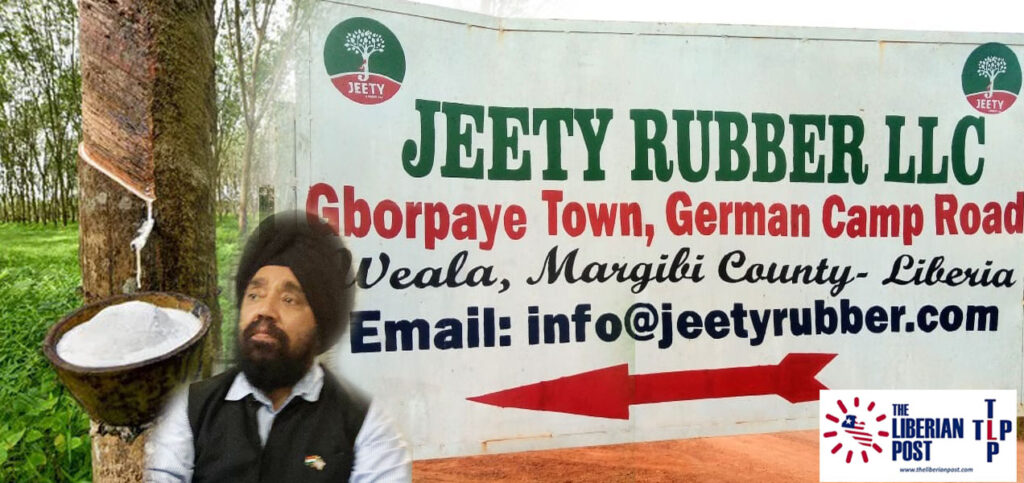
Equally critical is the welfare of Liberia’s rubber farmers. Any industrial policy that does not improve farm-gate prices and rural livelihoods is destined to fail. Farmers are the foundation of the supply chain; without them, there is no raw material to process, no tyres to manufacture. Ensuring fair and stable pricing is not just a social imperative—it is an economic necessity.
Jeety Rubber’s ongoing US$18 million expansion signals a level of private-sector confidence that policymakers should not ignore. The willingness to commit an additional US$35–40 million toward tyre manufacturing, contingent on supply guarantees, represents a rare opportunity to catalyze industrial growth without sole reliance on public funding.
But this is not about one company.
It is about setting a precedent. If Liberia can successfully support the transition from raw rubber exports to tyre production, it sends a powerful signal to investors across sectors: that the country is serious about value addition, serious about jobs, and serious about economic transformation.

The risk, however, is equally significant. Failure to act decisively could reinforce the status quo—where bold ideas are announced, investments stall, and opportunities slip away.
Liberia does not lack resources. It has long lacked the systems and policy coherence to fully utilize them.
The shift from cuplumps to tyres will require coordination—between government ministries, regulators, farmers, and investors. It will demand infrastructure, financing mechanisms, and above all, political will.
This is Liberia’s industrial moment. The question is whether the country will seize it—or watch it roll away.
Follow The Liberian Post on Facebook and X (formerly twitter)