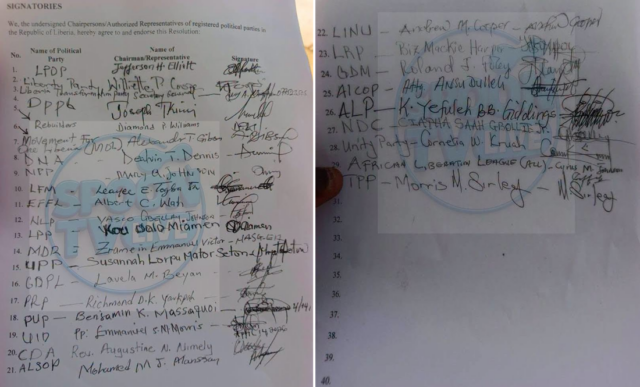
MONROVIA — A significant majority of Liberia’s registered political parties have formally endorsed the nomination of Jonathan K. Weedor as Acting Chairman of the National Elections Commission (NEC), according to a signed resolution obtained by The Liberian Post.
The resolution—bearing the names, signatures, and party affiliations of representatives—shows that 30 out of Liberia’s 42 registered political parties have thrown their support behind Weedor, signaling broad-based political confidence in his leadership at a critical time for the country’s electoral governance.
The endorsement process was coordinated by the Inter-Party Consultative Committee (IPCC), the umbrella body that facilitates collaboration among political parties. Documents reviewed indicate that senior representatives, including chairpersons and authorized party officials, appended their signatures to the resolution affirming support for Weedor’s continued stewardship of the NEC in an acting capacity.
Among the political institutions listed in the signed document are the Liberia People’s Democratic Party (LPDP), Liberty Party, Liberia Transformation Party, People’s Democratic Party of Liberia (PDPL), Movement for One Liberia, National Democratic Coalition (NDC), Liberia National Union (LINU), Liberia Restoration Party (LRP), African Liberation League (ALL), and several others.

The signatories include prominent party figures such as Jefferson H. Elliott, Willette P. Cooper, Joseph T. Kiumi, Alexander T. Gibbs, Mary G. Johnson, and Benjamin K. Nyassaquoi, among others—reflecting what observers describe as a cross-sectional endorsement spanning both established and emerging political movements.
Push for Continuity at NEC
In their resolution, the parties emphasized the need for stability and continuity at the NEC, particularly as Liberia continues efforts to consolidate its democratic gains and strengthen electoral systems.
“The current moment requires steady leadership and institutional continuity to ensure the credibility and preparedness of the electoral process,” a senior IPCC member familiar with the resolution noted.
Weedor, a long-serving elections official, brings extensive institutional experience to the role. Prior to his current appointment, he served as a commissioner at the NEC, where he was involved in key administrative and operational functions, including electoral planning and internal governance.
His elevation to Acting Chairman followed leadership transitions within the Commission, placing him at the helm during a period marked by both reform expectations and heightened scrutiny of electoral institutions.

Endorsement Amid Broader Debate
While the endorsement by a majority of political parties strengthens Weedor’s standing, his appointment has generated mixed reactions in some quarters, with segments of civil society raising concerns about the importance of maintaining both actual and perceived independence of the NEC.
However, supporters argue that the overwhelming backing from political parties—captured in the signed resolution—demonstrates a level of institutional trust that is critical for electoral stability.
Role of the IPCC
The Inter-Party Consultative Committee has historically played a pivotal role in mediating consensus among Liberia’s diverse political actors. Its involvement in coordinating the endorsement process underscores an effort to build cohesion around NEC leadership at a time when electoral credibility remains central to national governance.
Looking Ahead
With formal political backing now clearly documented, attention is expected to shift toward how Weedor navigates the dual challenge of delivering credible electoral administration while maintaining public confidence in the NEC’s neutrality.
Analysts note that while political endorsement provides a strong foundation, sustained transparency, accountability, and performance will ultimately define the success of his tenure.
Follow The Liberian Post on Facebook and X (formerly twitter)